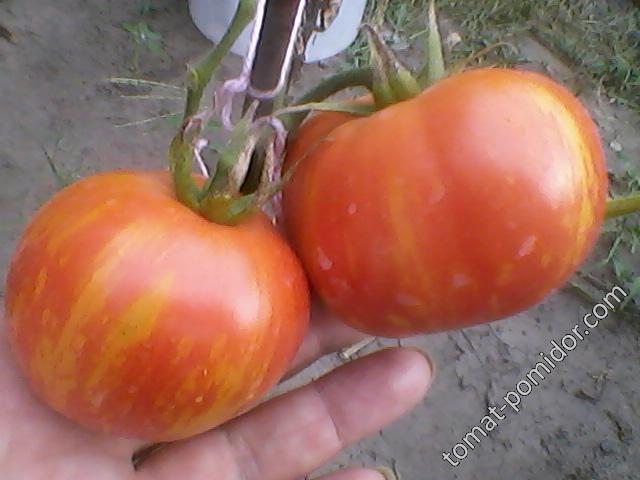
🍅 Quick take: Renegade is a mid-to-late season, indeterminate tricolor beefsteak bred by Dr. Randy Gardner by crossing the legendary Russian heirloom Malakhitovaya Shkatulka (Malachite Box) with modern disease- and heat-resistant lines. It produces gorgeous, shifting amber-bronze and ruby slicers weighing between 7 and 14 oz (200-400 g) with occasional giants. Gardeners report intense, sweet-spicy complexity that needs zero salt, though it can be prone to early-season blossom end rot (BER) and moderate leaf mold in humid high tunnels. Breeding & comparisons ↓ | 3-year review ↓ | Full summary ↓
Growers’ Notes and Photos (USDA Zones 4-10 Experience)
Ordered my seeds from our member Sofia. Here was the description: Indeterminate. Mid-season. Tricolor fruits averaging 10.5 oz (300 g), delicious and extremely sweet.
For me, the vine turned out very vigorous, tall, though with average overall yield. But man, is it stunning and insanely delicious, words honestly can’t do it justice 👍 The flavor isn’t just flat sugar, it has a faint hint of balancing acidity and a distinct, savory-spicy undertone. Absolutely loved this tomato.


For me, the vine turned out very vigorous, tall, though with average overall yield. But man, is it stunning and insanely delicious, words honestly can’t do it justice 👍 The flavor isn’t just flat sugar, it has a faint hint of balancing acidity and a distinct, savory-spicy undertone. Absolutely loved this tomato.
Kind of a bizarre name for such a great variety: Renegade!
Seeds came from a fellow forum member. Grew it in the greenhouse and this is what came up. Early on, it got hammered by awful blossom end rot, total nightmare. Soil drenches of calcium nitrate twice at the seedling stage and again after transplant didn’t do a thing. What finally stopped the rot was a foliar spray with calcium chloride, after that the vine straightened right out. The tomatoes turned out super sweet, but who knows what variety this actually is 🤷
Lucky folks who managed to grow the true-to-type one, I wanted it so badly 😢
Edited December 13, 2019 by Anela


Lucky folks who managed to grow the true-to-type one, I wanted it so badly 😢
Edited December 13, 2019 by Anela


Breeding Pedigree and Regional Taste Comparisons
The official name of the variety is spelled Renegade. It was bred by crossing the heirloom Malachite Box (Malakhitovaya Shkatulka) with a heat-tolerant, disease-resistant breeding parent. The work was carried out by Dr. Randy Gardner. It carries regular leaf foliage. A relatively new release, introduced in 2017.
Didn’t work out in my garden. Grew it back in 2019 outdoors in open ground. Yielded fine, but the taste was totally average, didn’t notice any notable sweetness or interesting undertones. Just a regular tomato that happens to be a tricolor. But take that with a grain of salt, tricolors generally don’t do well in my dirt. Even the much-praised Copper River turned out completely ordinary for me, nothing special.
Delicious, high yielding, grew in the greenhouse right on the western side.
Renegade. Indeterminate, very solid and tasty 😋 tricolor. Very similar counterpart to Copper River, although in my garden setup Copper River ends up slightly sweeter. Regular foliage, moderate yield, fruit weights hover right around 7 oz (200 g).


Multi-Year Track Record: Flavor Dynamics and Leaf Mold
Honestly, I was originally hooked by the name Renegade. It sounded punchy, rebellious, and resonated with my mood back then. Then I read the reviews on here and decided to track down some seeds for a trade two years back.
Haven’t regretted it for a second. Growing it for the second straight season now. I am absolutely head over heels in love with it: gorgeous, mouthwatering, and handles indoor counter ripening like a champ.
The flavor is rich and remarkably complex, so full of taste right off the vine that you don’t even want to reach for salt. Solid production. Resistance to leaf mold is below average, but it handles partial shade like an absolute champ without losing any flavor intensity.
Skin colors shift between predominantly emerald green and dark burgundy in completely random patterns. Classic bicolor behavior.

I received seeds for this tomato under the wrong label, but after comparing notes with the seed saver, we confirmed its real identity: Renegade.
The flavor was outstanding: sweet with just a tiny squeeze of acid. Probably the tastiest bicolor/tricolor I have ever eaten. The fruits grew to about 10.5 to 14 oz (300-400 g), and one was an absolute whopper, pictured sliced on the scale. Definitely growing this again next season.


The flavor was outstanding: sweet with just a tiny squeeze of acid. Probably the tastiest bicolor/tricolor I have ever eaten. The fruits grew to about 10.5 to 14 oz (300-400 g), and one was an absolute whopper, pictured sliced on the scale. Definitely growing this again next season.


Season number three growing Renegade!
It definitely leans mid-late to late in maturity. The variety maintained the exact same phenomenal flavor as it had during my first two years. Just an explosion of rich, deep taste.
Fruit color constantly shifts depending on whether the cluster got direct sun or sat in the shade, and shifts with the calendar: earlier fruit is distinctly redder, and as we hit autumn, the skins turn bronze and brown.
The vine is robust with an aggressive root system. It will catch leaf mold if the tunnel humidity spikes, and it can drop blossoms during extreme heatwaves, so from a gardening standpoint, it behaves like your typical large heirloom beefsteak.
In the harvest bin photo, those bronze-brown fruits are late-harvest Renegades.
Sitting on top is Virginia Sweets, which mysteriously lost its crisp stripes by mid-September, classic bicolors for ya! The bright reds are a Tarasenko Hybrid line.
The ones on the garden bed and next to my headphones are all Renegades.


Full Summary: Plant, Yield, Taste and Storage
- 🌿 Plant & Growth: Vigorous, tall indeterminate vine supported by a very aggressive, deep root system. Regular foliage. Tolerates partial shade exceptionally well without sacrificing brix. Mid-late maturity.
- 📈 Yield & Weights: Yield is moderate to high, with fruits averaging 7 to 14 oz (200-400 g) and top-end specimens exceeding 1 lb. Like many large beefsteaks, vines can abort flowers during severe summer heat spikes.
- 🛡️ Disease & BER Dynamics: Highly susceptible to Blossom End Rot (BER) during early flushes under irregular water uptake, which growers cured effectively with foliar calcium chloride sprays rather than root drenches. Shows moderate susceptibility to leaf mold (Passalora fulva / Cladosporium) in high tunnels.
- 🎨 Color & Taste: True tricolor/bicolor profile with dynamic skin shifts: direct sun exposure brings out red-burgundy hues, while shaded or late-autumn fruit ripens to an olive-bronze tone. The flavor is a consistent home run: rich, complex sweetness with savory-spicy undertones that make salt unnecessary. Frequently compared to Copper River.
- 🌎 Who Reviewed It: Extensively trialed over multiple seasons in USDA Zone 4 (Moscow Region, Tatarstan, Vladimir Region), continental Zone 4/5 (Kazakhstan), Zone 7/8 (Caucasus), and sub-tropical Zone 10 (Spain).