Growers’ Notes and Photos (USDA Zones 3-4b Experience)
Flavor is quintessential bicolor. Having a massive sweet tooth myself, I fell in love with it at the soft, jelly-ripe stage – tasted like pure syrup! Growth-wise and in ripening speed, it trailed slightly behind Canada, but the internal flesh on this one is noticeably more tender and melt-in-your-mouth.
Extended production and staggered ripening window. Definitely growing it again. The photo below was snapped September 15, 2018, right after a sharp temperature drop before I pruned off any old foliage. Grown in large patio containers – it’s the second pot from the right, with the lower fruit clusters already picked.
Edited September 15, 2018 by Alisa


I have seeds for this line from Kulik. It was very productive and sweet, and the hearts were on the modest side. But the fact that it’s a bicolor was only obvious during the very earliest stages of breaker stage. Once fully ripe, the tomatoes turned almost completely monochromatic solid orange. You could only tell it was a bicolor once you sliced it open. To be fair, a lot of my bicolors turn nearly solid-colored when fully ripe.
Inn@: Irina, is the bicolor patterning really distinct on your fruit? Well, are the stripes clearly visible?…
Because this one started ripening earlier than most of my other bicolors have in past years, the yield was a very pleasant surprise. Or maybe this season was just an exceptional year for bicolors in general? All my bicolors pumped out great crops this season. Or perhaps I just stumbled onto faster-maturing bicolor genetics?
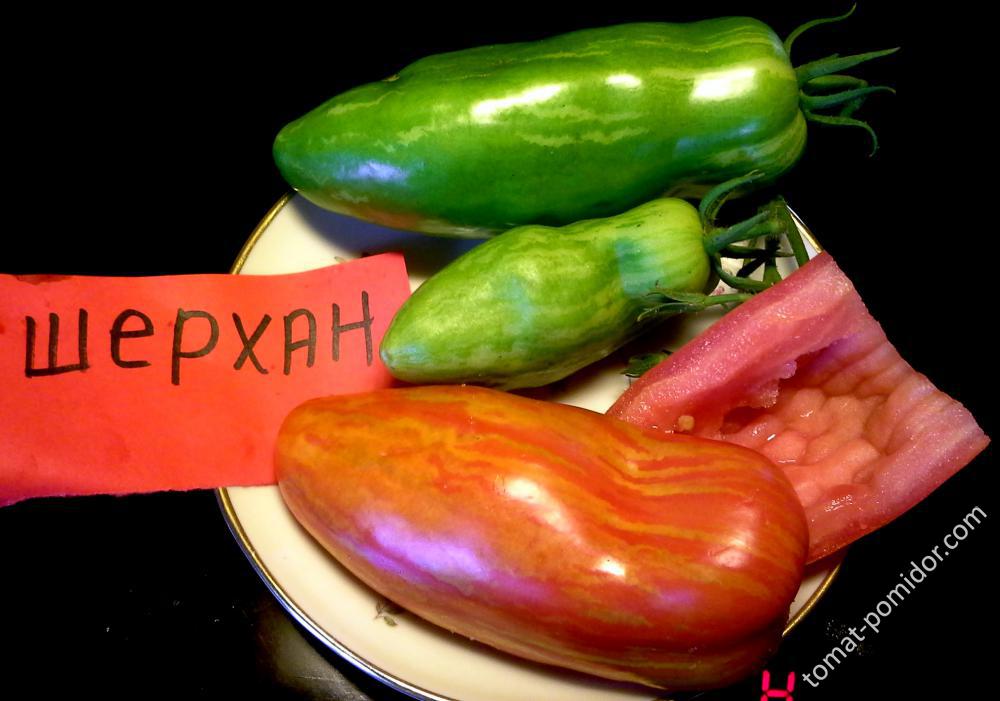
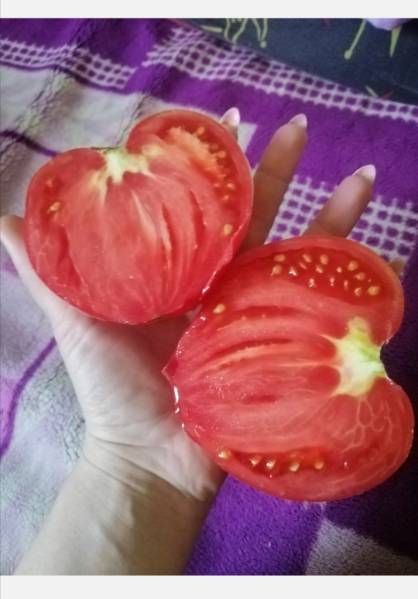
Generally speaking, bicolors with this color spectrum turn either deep rich orange or slightly reddish at full maturity. More accurately, the fruit become saturated orange with subtle reddish-pink longitudinal veins running down the sides, rather than bold, high-contrast stripes like you get on true striped cultivars. Most of the time, the bicolor trait reveals itself on the cutting board with that classic red starburst flame right through the center. That’s really what sets them apart from pure yellow or golden-orange hearts. On some other bicolors, the entire central meat turns deep orange-crimson when sliced.


Quick Facts: Variety Summary
- 🌿 Growth Habit: Indeterminate vine with regular leaf foliage and typical slender oxheart framework. Adapts readily to large patio containers as well as greenhouse beds.
- 🍅 Fruit Profile: Heart-shaped bicolors running from 7 oz (200 g) up to giant 1 lb+ specimen slicers. Warm golden-orange skin with delicate rose-red longitudinal marbling. Inside, dense low-seed flesh features a distinctive crimson core starburst.
- 👅 Flavor & Texture: Extremely sweet and fruity with low acid. Highly prized for its tender, silky texture, reaching dessert-level syrupy sweetness when harvested slightly soft at the jelly-ripe stage.
- 🎨 Striping Reality: Unlike “zebra” striped cultivars with contrasting green or gold bands, the striping on this heirloom appears as subtle red vein-like blushes on an orange skin, with the primary bicolor effect revealed internally upon slicing.
- 🌎 Heritage: Traditional family heirloom from the Commonwealth of Virginia, USA.