Quick Summary: Short-Season Melon Growing Masterclass
- 🌍 Why this matters: If you live in a cold climate (like USDA Zones 3-4) with short summers and June frosts, growing melons can feel impossible. In this article, a seasoned grower from Rybinsk (North-West Russia) shares his proven techniques for harvesting sweet watermelons and melons outdoors.
- 🌱 Key Techniques: Success relies on strict variety selection, careful seedling timing (never older than 2 weeks before transplanting), and the use of traditional “hot beds” (trenches filled with decomposing organic matter to heat the roots from below).
- ✂️ Pruning Secrets: A simple but critical rule: watermelons fruit on the main stem (so pinch side shoots), while melons fruit on side vines (so pinch the main stem early).
- 🛡️ Disease & Weather: Learn how to use floating row covers against late frosts, avoid nitrogen toxicity, and why holding back water at the end of the season is crucial for sugar accumulation.
Growing Watermelons in a Cold Climate: The Russian North Experience (USDA Zone 4a)
 By Igor Pechurin | December 3, 2018
I want to share my experience of consistently getting high yields of watermelons and melons in the north of the Yaroslavl region (Rybinsk). Success depends on well-chosen varieties and effective agrotechnology.
Best Short-Season Melon Varieties
Among the criteria for selecting varieties, the main one is extreme earliness combined with high taste qualities. Varieties like Podarok Solntsa (Sun’s Gift), Sugar Baby, Ultraranniy (Ultra-Early), and from the large-fruited ones – the Dutch variety Crimson Sweet and the Top Gun F1 hybrid have proven themselves well.
For resistance to brief cold snaps and the ability to set fruit independently (without extra pollination) in bad weather, the Sibiryak (Siberian) variety stands out, which I’ve been growing in recent years. It is not huge (a classic icebox type), up to 4-5 kg (8.8-11 lbs), with a thin rind and sweet, sugary flesh, and it guarantees a harvest every year. In terms of early ripening, Sibiryak surpassed all tested varieties; we harvest its first fruits in July. Outwardly, they are dark green and barely noticeable against the foliage. Fully ripened watermelons store well for up to three months.
As for melons, I got decent results with Chinese selection varieties (Danyana, Minnesota Midget). They are very tasty and aromatic, but in a cold summer, they don’t have enough time to accumulate sweetness. An original variety from Korea, Anson (Lazy Man’s Dream), has a sweet edible rind, but unfortunately, it is prone to cracking and consequently rotting.
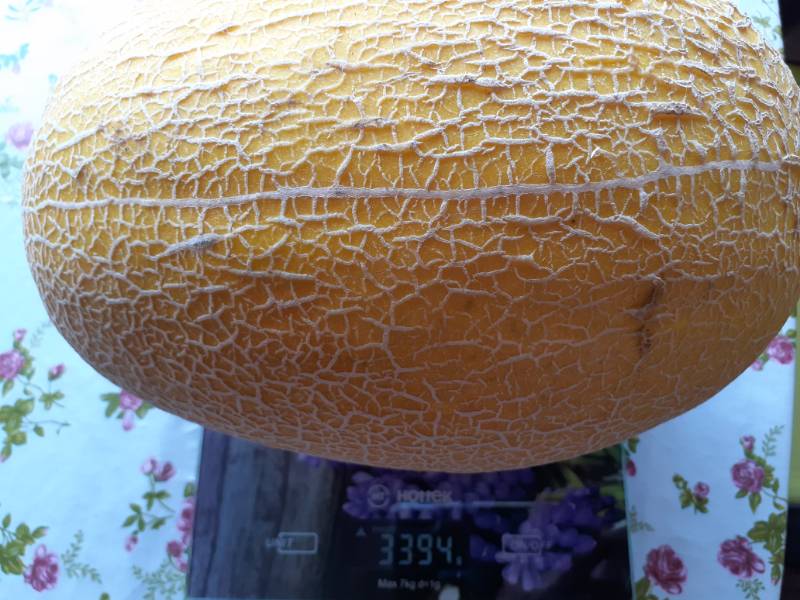
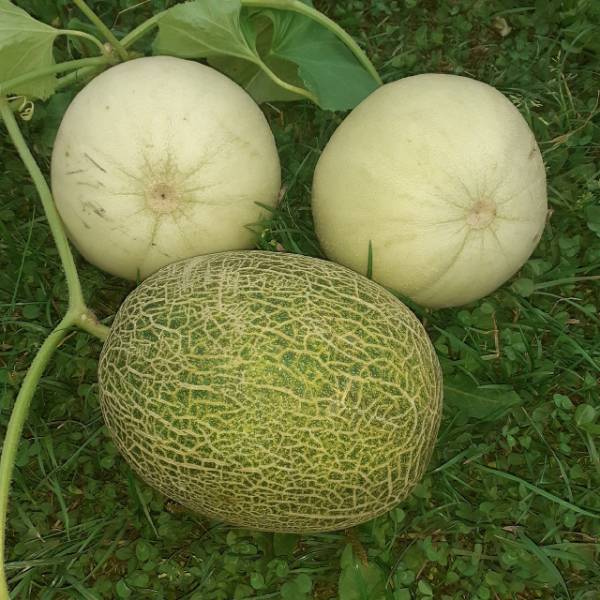
More resistant to low temperatures are the melons Izumrudnaya (Emerald) and Severnaya Papaya (Northern Papaya), which I prefer. Izumrudnaya owes its name to its light green flesh, sweet and aromatic, yielding nothing in taste to a true southern melon. The fruits are oval, reaching a weight of 3 kg (6.6 lbs).
These melons can be stored ripe for up to three weeks. The small fruits of Northern Papaya have orange, sweet, and aromatic flesh. The weight of these miniature fruits does not exceed 0.8 kg (1.7 lbs); they are round, slightly ribbed, and silvery-green. The only downside is poor storability—no more than a week.
Starting Seeds Indoors
In our area, to get a head start on melon and watermelon growth, you cannot do without seedlings. We sow seeds at the end of April in half-liter (16 oz) containers, taking light, nutritious soil (a mix of compost, sand, and garden soil). You can pre-soak them for 1 hour, or not soak them at all.
Before germination, we maintain a temperature of at least 25 °C (77 °F); at lower temperatures, the seeds might not sprout. The average germination time is 1-2 weeks. Once sprouted, we move them to a windowsill, where it is cooler and brighter. We have to turn on fluorescent grow lights so the seedlings don’t stretch out. We water moderately and only with warm water.
The optimal age of seedlings before transplanting into the ground is two weeks from the moment of germination, no more. Otherwise, the roots will spiral around, and… you know yourself, don’t expect any good results, I assure you.
Open Ground Planting & “Hot Beds”
Initially, I grew melons in a greenhouse in a vertical culture; the yield was small despite high labor costs. This is probably due to temperature distribution: it is hot at the top, and cool at ground level, but melons love to keep their roots “in the warmth.” Now we plant them horizontally in beds, just like in nature. The technology is refined and, in my opinion, simple. We choose a bright spot, prepare the bed in autumn: we add compost, ash, superphosphate, and dig a trench one spade deep and three wide, filling it with all sorts of plant tops and stems.
In autumn, there is a lot of plant debris, and the mound turns out high. Gradually it settles, and by November, I cover it with the excavated soil, resulting in a raised “hot bed” (similar to the Hugelkultur method, acting as biological heating from below). In spring, after the snow melts, I cover it with clear plastic film to heat up. By the time of planting seedlings, it will warm up well, and the bio-heating will start working. At the end of May, it’s time to plant melons and watermelons.
I plant them in a single row at a distance of 0.7 m (2.3 ft) from each other. Over each plant, I stick a small wire arch and cover the bed with white non-woven material (floating row cover / agricloth). You can’t do without it; frosts in our area can happen until mid-June. On warm days, we remove this material; in cold weather, we throw it back on.
Thus, there is no permanent cover, so it can perfectly be considered open ground. I must specifically mention mulch; it preserves heat and won’t let weeds rise. We mulch with black landscape fabric or mowed grass.
Pruning & Care Tips (Agrotechnology)
Care for watermelon and melon is almost identical, with the exception of pinching (pruning).
Watermelons form ovaries on the central stem, so correspondingly we pinch the side shoots, usually after the 3rd to 5th leaf.
For melons, it is the exact opposite—they bear fruit on side shoots, as they say, of the 2nd and 3rd orders, therefore we pinch the central stem (above the 3rd to 5th leaf). We do this procedure on each plant once; all further efforts to shape them, as many authors recommend, I consider an unnecessary waste of time: after all, when the plants start growing vigorously, it’s impossible to track all the branches and their order.
Weeding throughout the season is generally not required, because weeds cannot break through the black non-woven material. We water the plantings with warm water about once a week, i.e., less frequently than cucumbers.
I think watermelons can be watered even less often, as they are considered a drought-resistant crop. Along with watering, we do several feedings with an infusion of weeds (weed tea), dried bread crusts, or a wood ash solution. I am convinced that nitrogen fertilizers should be avoided, and fresh manure is even more harmful; plants will use it to grow green mass and won’t set fruits.
By the way, so that they set faster in bad weather, you can pollinate the flowers manually with a brush or cotton swab. This will speed up fruiting, and in our climate, every day counts. I leave no more than five fruits per plant, plucking off the excess.
Practice has shown that a larger number won’t have time to ripen. As they ripen, I reduce watering and stop it completely from the end of July. I try to pluck off the very ends of the shoots—excess green mass, and care is practically over at this point. The most pleasant part remains—harvesting on time! It is not simple to determine the ripeness of watermelons: neither a yellow spot at the point of contact with the earth nor a crunch when pressed allows you to confidently choose a ripe fruit. A more reliable sign is the withering of the tendril in the first internode from the watermelon. We just do it simply—we mark the formed ovaries with numbered stakes. Ripe watermelons are well stored for up to three months.
With melons, it is simpler: as they ripen, they turn yellow and acquire a characteristic netting. The signal for harvesting is the appearing aroma.
Over the years of growing melons and watermelons, I am convinced that this is a very interesting and fruitful activity even in our, not the warmest, climate. Moreover, my friends from northern regions—Vologda, Arkhangelsk, the Komi Republic—report their successes in melon growing.
Comments:

Igor, thank you for the article. I’m glad for your success.
I live further north than you and also try to delight myself and my family with melons every year. I haven’t managed to “make friends” with watermelons yet; they don’t gain sweetness, but with melons, even if not on an industrial scale, I manage to taste ripe ones every year. For the last three years, I’ve settled on the Viktoria variety. It fully manages to ripen in a polycarbonate greenhouse. The taste is mind-blowing, especially in a good summer. You can’t take much from a plant, but 2-3 ripe melons are quite possible. Next season, I also want to try growing a melon outside the polycarbonate greenhouse, but a lot will depend on the summer weather here. There’s very little time; the soil warms up too slowly in spring, even under plastic.
Igor, thank you very much for the article.
Do you carry out any treatments on the seedlings or adult plants against diseases, and with what preparations?
Valeriy1968 said:
Igor, thank you for the article. I’m glad for your success.
I live further north than you and also try to delight myself and my family with melons every year. I haven’t managed to “make friends” with watermelons yet; they don’t gain sweetness, but with melons… Next season, I also want to try growing a melon outside the polycarbonate greenhouse…
Valeriy, it is simply amazing – to grow melons in Vologda! And with watermelons it is more difficult for us too, they don’t gain sugars every year either. I wonder, do you grow melons sprawling in the polycarbonate greenhouse or in a climbing (trellised) culture?
Igor Pechurin said:
Valeriy, it is simply amazing – to grow melons in Vologda! And with watermelons it is more difficult for us too… I wonder, do you grow melons sprawling in the polycarbonate greenhouse or in a climbing (trellised) culture?
Igor, only climbing. Space in the greenhouse is golden. I grow melons in the tomato greenhouse; for a melon to ripen, maximum sun should hit it (especially the northern sun). Next year, possibly, the peppers and melons/watermelons will get their own polycarbonate apartment.
Marinakhv said:
Igor, thank you very much for the article.
Do you carry out any treatments on the seedlings or adult plants against diseases, and with what preparations?
Marina, we don’t treat seedlings and plants with anything, there is no need. In August, sometimes white rot appears on the stems, so we just sprinkle these places with wood ash.
Valeriy1968 said:
Igor, only climbing. Space in the greenhouse is golden. I grow melons in the tomato greenhouse… Next year, possibly, the peppers and melons/watermelons will get their own polycarbonate apartment.
Exactly – golden space in the greenhouse. I tried growing in polycarbonate – it didn’t work out, the yield was too small and I lacked experience. But I don’t give up hope of returning to polycarbonate, again, if the “housing issue” is resolved.

Greetings to everyone from the Urals! This year is not a melon year for me at all)) Anyway, questions for the experienced. I have strong seedlings of melons and watermelons, 10 varieties each, with 4-5 leaves, grown in a greenhouse, hardened off. I planted them out in early June in open ground in very different places: with cucumbers, in the greenhouse, and with strawberries. I put 1 liter of compost and biohumus in the planting hole, the transplant went fine.
Then they froze in growth; within a month, all the watermelons dried up, the melons held on longer but grew slowly, despite the heat, watering, loosening, and feeding. In the end, there is only one melon fruit in the cucumber bed in open ground. I don’t even know what was wrong with them…. Maybe someone experienced will tell me.
Good evening, everyone! My name is Galina. I am from Udmurtia. Please accept me into your friendly company. And I immediately have a question. I grow watermelons, melons, momordica, and trichosanthes. For this season I bought seeds of Sicana; does anyone have experience growing this plant?
Greetings to all!
I am originally from Rybinsk, just like the author of the post. Over 20 years ago, I moved to Yaroslavl for work. Just like in Rybinsk, we have night frosts until mid-June. In 2023, 2/3 of the June nights were below zero. This year the summer is significantly warmer and more humid, which, surprisingly, continues to this day (September 14).
My great-great-grandmother grew a melon patch in Rybinsk on a collective farm, in open ground, about which there is a record of her agro-exploits in the Rybinsk Museum. But the climate in Rybinsk was drier before they flooded Mologa and made the reservoir.
I decided to try it too. First experience in open ground. June – cold, July – rainy, from September 1st +5 +7 °C (41-45 °F). In the end, out of 5 watermelons – 2 pieces of 2.5 kg. Melon out of 3 pieces – 1 reached condition. The watermelons barely had sweetness and pink flesh. But it’s an experience, you can’t do without it.
My husband “welded” a greenhouse. I read about different varieties. Chose a few. In priority not F1, so that I could have my own seeds, because with purchased ones it is increasingly a lottery. Accordingly, seedlings on the window, without additional lighting on the south side. We grow watermelons vertically. Last year in one greenhouse there were watermelons, melons, and cucumbers. The watermelons were sweet, but the melons were not sweet at all.
In ’24 we decided not to plant melons. Greenhouse 3*6, 18 plants on each side. We didn’t make warm and high beds. After reading the author’s post, we will prepare warm beds for next year.
Returning to planting seedlings, everything was dying within 10-14 days. As a result, 1/3 of my supply survived. We had to buy the missing amount of seedlings in the nearest nursery. We didn’t understand what the reason was. Sprayed with ash and watered with warm water. Spraying with Fitosporin [Editor’s note: a popular Russian bio-fungicide based on Bacillus subtilis] around the stem without touching it helped. After that, everything started growing.
From the varieties “Crimson Sweet”, “Ogonek” – we plant for the third year. This year I planted the “Orange King” variety. The seed producer claims yellow-orange flesh. But this is probably for growing in the southern strip. We got yellow flesh, but the taste itself is very unusual, aromatic, juicy, sweet, there is a hint of pineapple. The fruit is 6.7 kg (14.7 lbs), in the description up to 10 and more. The color is dark green with yellow spots. The same spots are on the foliage. Also, this season I planted Carolina Cross. Haven’t picked it yet, the peduncle hasn’t completely dried up. Visually ~ 8-9 kg (17-20 lbs). I will add a photo of Carolina a little later.
In the photo, the dark watermelon is a 4.8 kg Ogonek variety.
With yellow spots – “Orange King”.
On the large dish “Crimson Sweet” at 6.6 kg.
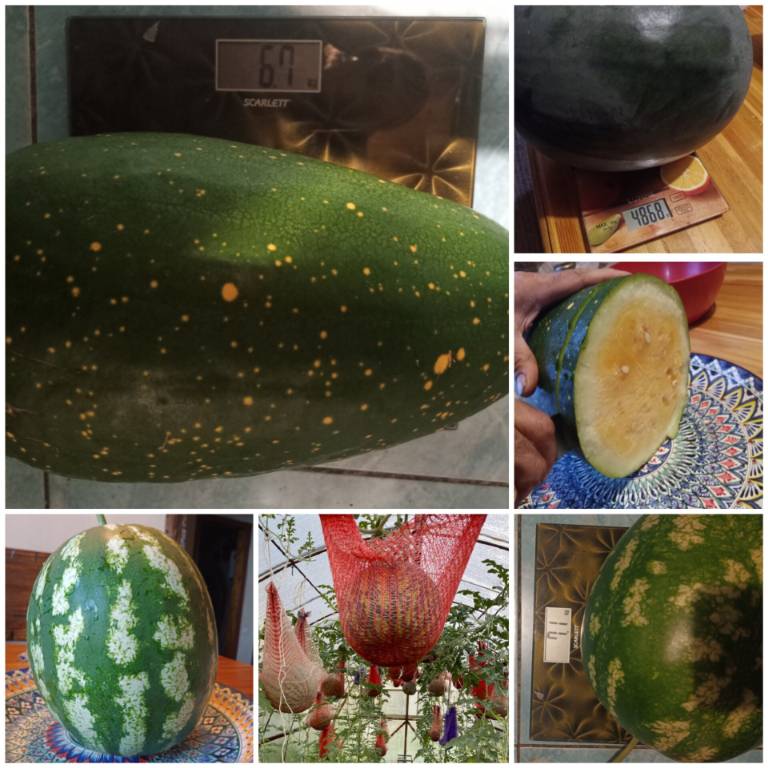
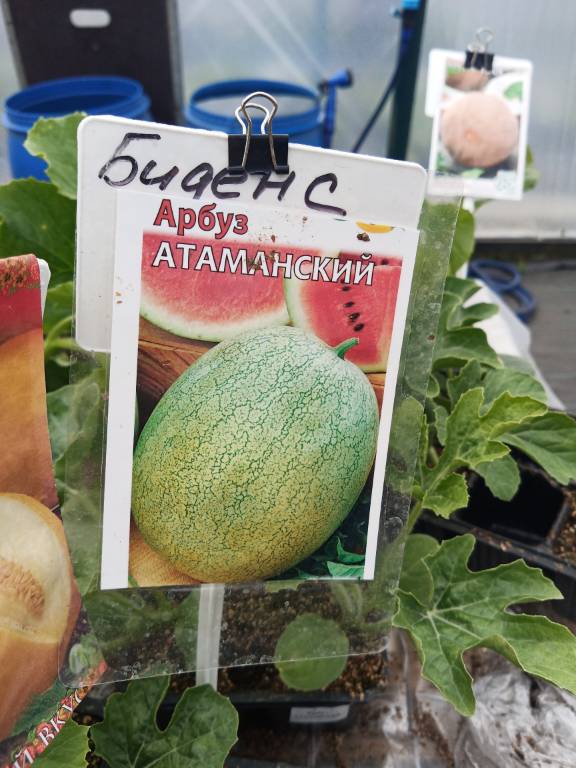
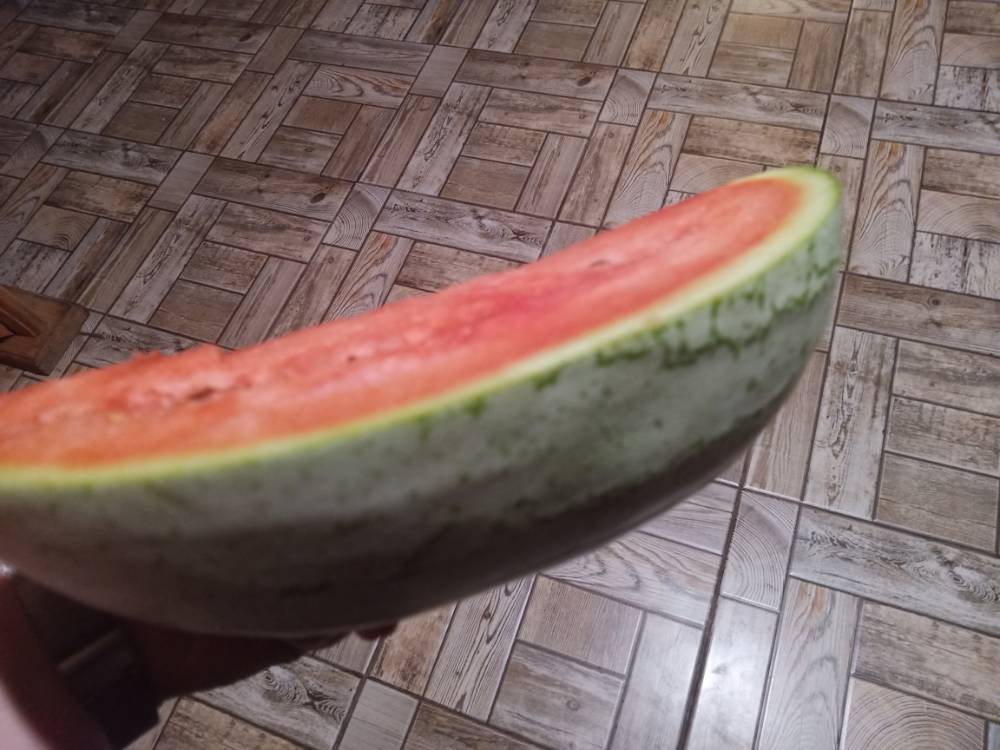
Buying seedlings at the nursery to replace my dead ones, I took a picture of the sign. The “Atamanskiy” watermelon came out to 3 kg (6.6 lbs). Few seeds, the flesh is closer to pink, in structure – like grains, very sweet. The green part of the flesh is thin. We will grow it again. I recommend this variety 👍

@Igor Pechurin Igor, could you tell me, please, where you buy seeds? It turned out to be quite a difficult task to find a watermelon of exactly this variety. There are all sorts of variations on the theme of “Siberia” (Siberian lights, Siberian honey, etc.), but I understand that all this is not the same.