📌 Quick Summary (TL;DR): Strawberry Clipper Weevil Control
- 🐛 The Pest: The Strawberry Blossom Weevil (closely related to the North American Strawberry Clipper Weevil) is a tiny black/brown beetle about 3 mm (1/8 inch) long.
- 🥀 The Damage: If you see small holes in your strawberry leaves or notice unopened flower buds hanging by a thread and falling off, you have a clipper weevil infestation. They lay eggs inside the bud and cut the stem.
- 🛡️ Organic Control: Bio-insecticides (like Spinosad or Neem), hot pepper sprays, and companion planting with garlic or onions. Note: Bio-sprays only work when temps are above 16°C (60°F).
- 🧪 Chemical Control: Synthetic pyrethroids or Malathion can be used right as the flower stalks emerge, but strictly before the flowers open to protect bees.
- 🚜 Prevention: Black plastic mulch, crop rotation (moving strawberries far away from raspberries), and cleaning up old debris heavily reduce their numbers.
Let’s Catch and Punish the Strawberry Clipper Weevil!
The 2014 season gave me an unusually massive “harvest” of the raspberry-strawberry weevil. The sad part is, this “harvest” could have been entirely avoided. I acted a bit irresponsibly in the spring: firstly, this beetle hadn’t bothered me much for a long time. Sure, it would drop by for a visit, but its presence wasn’t overwhelming. Still, even those few sightings should have told me that sooner or later, I’d have to fight it. Secondly, because it had been absent, I completely missed the moment of its mass emergence on the strawberries—which is the most crucial time. Now, this means that next spring, I must be ready to face them again, and it won’t just be a couple of passing bugs…
The Raspberry-Strawberry Weevil (Anthonomus rubi, closely mirroring the North American Clipper Weevil Anthonomus signatus) is a beetle from the true weevil family. Its body is about 3 mm (1/8 inch) long, colored black or brownish. It is a very common and dangerous pest of strawberries, raspberries, blackberries, and even roses. One generation of beetles develops per summer. The overwintering pest becomes active in the spring when the soil temperature rises above 12°C (54°F). Early-season strawberry varieties are the most susceptible to weevil attacks.
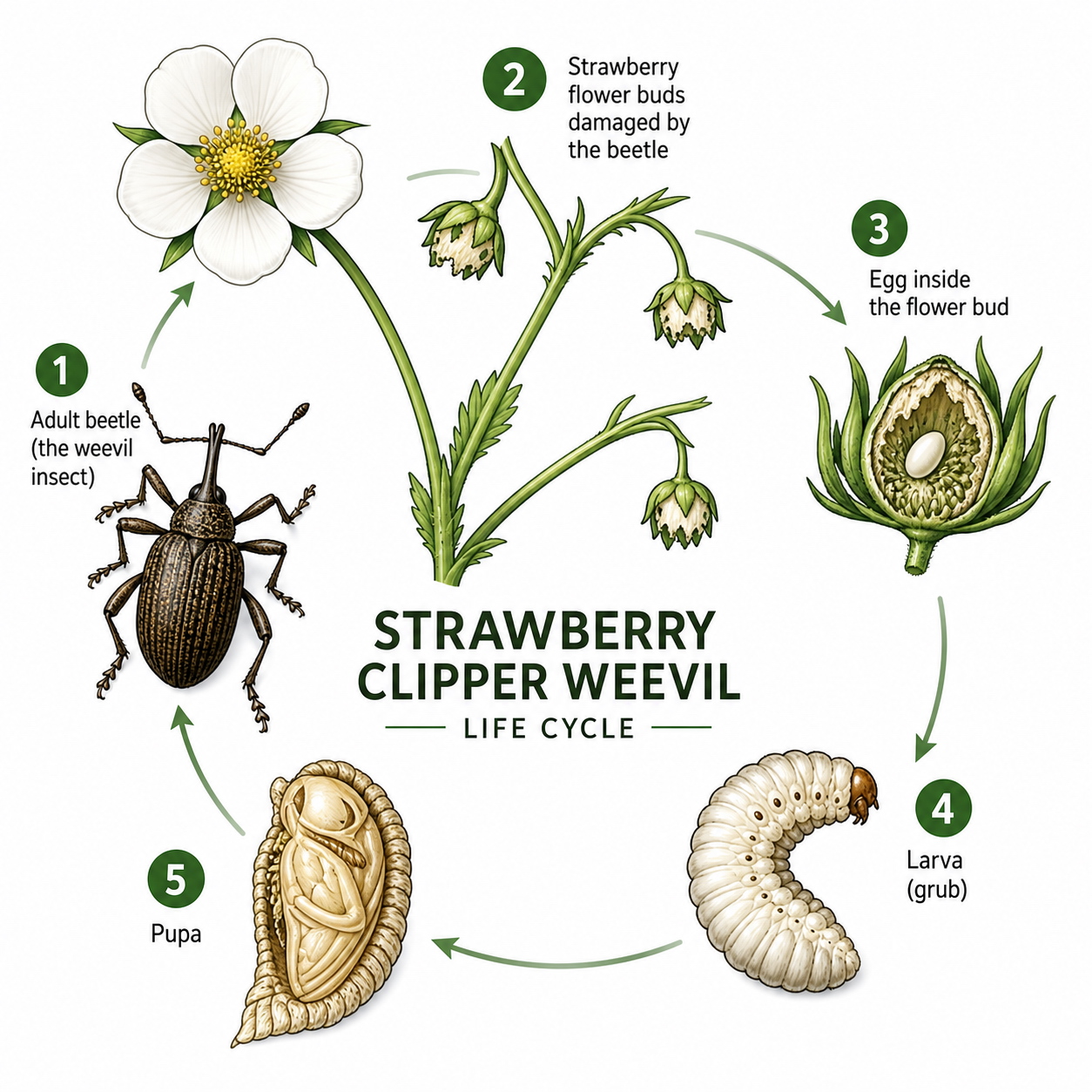
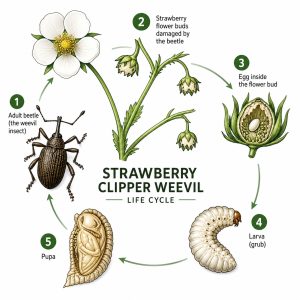
1 — adult beetle; 2 — clipped buds damaged by the beetle; 3 — egg inside the bud; 4 — larva; 5 — pupa.
How to Spot a Weevil Infestation
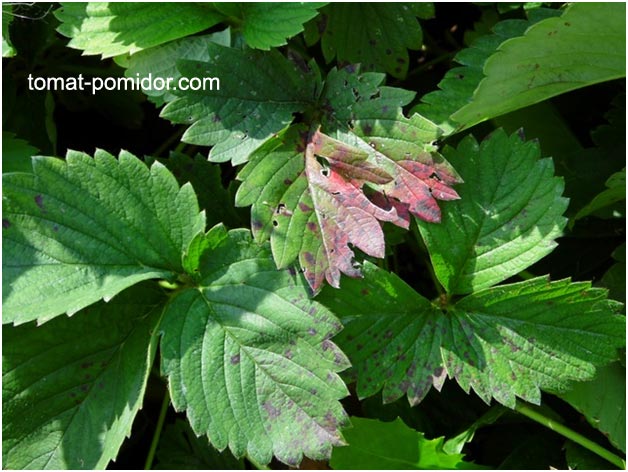
You will rarely, if ever, actually see these evil little long-nosed beetles sitting and chewing on your strawberry leaves in the spring. Therefore, we don’t look for the weevil itself; instead, small round holes and punctures suddenly appearing on the leaves will tell us they have arrived. At first, they aren’t very noticeable, but then there are more and more of them.
If you don’t take action, the leaves will soon be riddled with tiny holes. Next, the feast continues on the emerging flower stalks. The females lay their eggs inside the unopened flower buds through a chewed hole, and then immediately gnaw through the stem just below the bud. Dried-up buds that look like they were cut with scissors or are just hanging by a thread—does this picture look familiar? This is the classic clipper weevil damage. Don’t wait for this to happen, as you can lose almost your entire berry harvest. Start fighting the beetle as early as possible, before the buds even form.
Control Measures & Treatments
In the spring, as soon as we spot the first signs of the weevil on the strawberries, it’s time to roll up our sleeves and do the first spray.
For organic control, biological preparations like Spinosad or Avermectins (sold here as Fitoverm, Akarin, or Iskra-Bio) work great. They are biological in origin, which is why I prefer them. A huge plus is that they also perfectly control spider mites, which are a very frequent guest on garden strawberries. Pests do not build up a tolerance to these bio-insecticides. They can be used throughout the growing season, and the waiting period before harvest is only 3 days.
Some gardeners use “heavy artillery” against the weevil. The beetle becomes most vulnerable right when the flower clusters begin to emerge but the individual buds haven’t separated yet, as it moves from under the leaves up onto the flower stalks. In this very short window, treatments with synthetic pyrethroids (like Cypermethrin / Inta-vir) are done. Remember that you must never spray plants once they start blooming to protect bees. Plus, by the time the flowers open, it’s already too late—the weevil has already ruined the future harvest. Timing is everything.
In August, the strawberries should be treated again to kill the new generation before they overwinter.
Pro Tip: All chemical treatments should be done in the early morning hours to spare beneficial insects, particularly ground beetles, which eat weevils with a huge appetite and in large quantities (about 20 per day).
Folk Remedies & DIY Organic Sprays
- Garlic, Mustard, or Insecticidal Soap: Use about 200 g (7 oz) of the active ingredient per 10 liters (2.5 gallons) of water. You will have to spray the plants every evening during the bud formation period. This method is for those who have a lot of free time and aren’t lazy.
- Hot Pepper Infusion: The result is wonderful, but it’s only for those who can handle working with hot peppers. Take 500 g (1 lb) of dried hot peppers or 1 kg (2.2 lbs) of fresh ones, crush them, pour in 10 liters (2.5 gallons) of cold water, and let it steep in a closed enamel pot for 2 days. Then boil it for 10 minutes and steep for another 2 days. Strain it, squeeze out the pulp, and spray. Store the leftovers in a cool place in a tightly sealed container.
- Celandine and Onion Skins: Gardeners highly praise this method. Take onion skins and celandine herb in a 2:1 ratio, fill a 3-liter (1 gallon) jar 1/3 full, and pour boiling water over it. Let it cool, strain, and spray. Do the first spray during the bud stage, and repeat two weeks later.
Prevention is the Best Cure
What kind of strawberry beds will the weevil prefer? Naturally—neglected, unkempt, overgrown with weeds, filled with old plant debris, overly dense, and older beds. But even if your beds are perfectly tidy, they still might come to eat.
You have to scare them away. For example, by planting garlic nearby. Companion planting works, but you need a lot of garlic—every strawberry bush should be next to a garlic plant. It’s best to plant a whole bulb, not just a clove. Most importantly, you must occasionally trim the tips of the garlic leaves to release the scent, because the weevil hates the smell, not just the physical presence of the plant. Onions work too. Marigolds, calendula, and nasturtiums growing nearby will also annoy the pest.
Certain agricultural practices help reduce the weevil population. This includes digging the soil around the bushes in autumn and removing/burning all old plant debris. Because of this, I had to remove the grass clippings I used as mulch this summer; my strawberries will winter without mulch. Also, some friends heavily dust the soil around the plants with wood ash, and the weevil leaves them alone.
Bonus Tip: The Yeast Trap
Besides repelling and spraying, you can make a trap. Take 1 liter (1 quart) of water, add 200 g (7 oz) of sugar and 100 g (3.5 oz) of yeast, and leave it to ferment in a warm place. Then pour this “brew” into narrow-necked glass bottles so the beetle can’t get out. Place them among the bushes, and change the bait every three days throughout the blooming period.
Happy hunting!
With strawberry season just around the corner, I am bumping this thread. Maybe someone else can share their methods for saving strawberries from these little pests.
In the spring, during the emergence of the flower stalks, you can spray with pine extract—the weevil doesn’t like this smell—or sprinkle fresh crushed pine needles around. The remedy is only effective as long as it smells (which is quite short-lived), so you might have to repeat it. Regularly collect all damaged, clipped buds with the larvae inside and destroy them. In August, loosen the soil in the beds (they gather there to overwinter). You can also mulch with pine needles—it acts as a repellent.
The weevil used to plague me too, even though I did spray treatments. But when I moved the strawberries about 50 meters (160 feet) away from the raspberries, the weevil disappeared completely! Maybe it’s a coincidence, but I am very happy.
A few years ago, the strawberry weevil annoyed me greatly, destroying up to 50% of the flowers. As soon as I started planting strawberries on black plastic mulch, the weevil practically disappeared. Plus, I only keep strawberries in one spot for 2 years, and then plant the new ones in a completely different location (crop rotation).
We also faced a weevil problem on our strawberries this season. A search for registered chemicals for home use on strawberries and raspberries gave only a few options based on Malathion and Pyrethroids (like Fufanon, Iskra M, Alatar). We ended up treating the strawberries and raspberries with Malathion (Fufanon).
Keep in mind that bio-insecticides only work at temperatures above +16°C (60°F), so using them in the early cold spring is highly ineffective.
Decis-Profi (Deltamethrin) is a contact insecticide that works well at the stage when the strawberry flower stalks and young raspberry shoots emerge. The waiting period before harvest is 20 days.
Ammonia water (household ammonia) works pretty well too.
I called a professional extermination service to my property—there were no mosquitoes, flies, spiders, or weevils all summer! They treat the ground, the trees, the garden beds, and the perimeter of the buildings. Last year it cost me $10 (600 rubles) for my 0.15-acre lot. This year I missed the timing, and the weevil ate half my strawberry harvest and even got to the blackberries.
I learned how to fight them back in 2015. I read about a “nuclear mix” in a magazine ) and now I use this remedy exclusively every single year. I spray it not only on strawberries, but on raspberries and roses too.
Elena Demi wrote:
I learned how to fight them back in 2015. I read about a “nuclear mix” in a magazine ) and now I use this remedy exclusively every single year. I spray it not only on strawberries, but on raspberries and roses too.
What is this mix? Can you share the recipe?