Jump to: The Naming Debate | Full Summary
Growers’ Notes and Photos (USDA Zones 3-5 Experience)
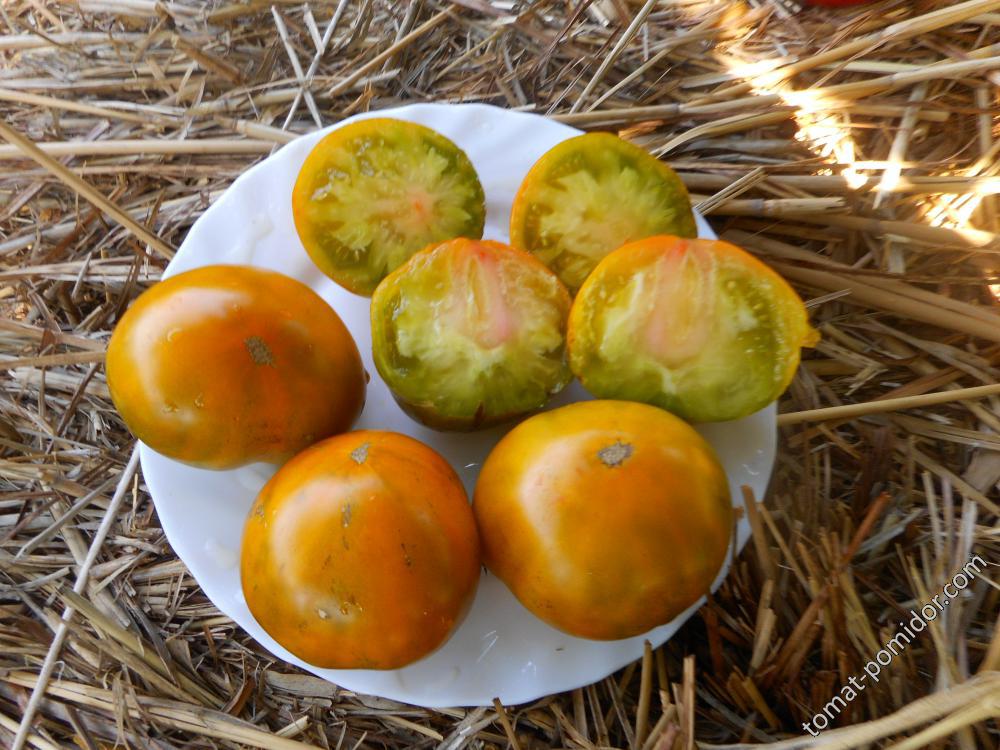
German Gold. Got the seeds as a gift straight from Germany. Indet, yellow-pink, and an absolute monster of a sprawling vine with huge regular leaves. Grew it in the greenhouse, it hit about 5.5 ft (1.7 m) tall, pruned to a single leader. I did let one late sucker slide on one of the plants, and it actually managed to set and ripen a couple of late ones.
Yields were definitely on the lower side for me, but the flavor is out of this world!!! Took my #1 spot for taste out of everything I grew in 2012. The flesh is incredibly tender. It’d be a downright sin to cook these down for sauce or even chop ’em up for a salad. You just gotta eat it in thick slices straight off the vine, naked… not even a dash of salt!
My biggest one weighed in at 22.8 oz (647 g). Set fruit for a long time and managed to size up some big ones on the upper trusses right before the season shut down. Loved it for both the looks and the taste.


Olga, sure sounds like you’ve got a classic bicolor on your hands!
Galina, I wasn’t totally sure! I remember reading on Tania’s site (from Canada) that bicolors specifically have two-toned flesh. But this one is marbled on the outside too. That’s why I hesitated to call it that 😉
Olga, bicolors are actually two-toned inside and out.
That first pic is absolutely gorgeous — you’ve got pink and yellow fruit hanging on the exact same cluster!
Well, I’ve got no problem calling them bicolors then! 😀
Sveta, as they ripen, they start off yellow, shift to yellow-pink, and eventually blush pink with these little yellow flecks or stripes. And the inside looks exactly like the photo. Really cool genetics — pink skin, yellow flesh.
Olga, Tania’s database actually lists this exact one as a late-season indet bicolor. I grew it this year from Popenko’s seed stock. Saying I “really liked it” is an understatement, it’s a spectacular variety! Just like Gusev says, it’s an absolute masterpiece. Phenomenal flavor, gorgeous to look at, and it was actually a heavy producer for me.

The Naming Debate
Val, are you sure we’re talking about the exact same variety? Because “Old German” literally translates to… well, Old German.
And this is “German Gold.”
Old German.
German Gold.
They sound super similar in seed catalogs, but they could easily be two completely different strains 😉
Did some digging online, and it really looks like it’s the exact same tomato. Both histories say they’re 19th-century Mennonite heirlooms. The specs are identical too: bicolor, indet, late-season beefsteak. A real stunner of a tomato, regardless.
Quote by Ellena
Did some digging online, and it really looks like it’s the exact same tomato…
It’s so pretty, we might as well just compromise and call it “Old German Gold” lol.
Quote by IrinaA
It’s so pretty, we might as well just compromise and call it “Old German Gold” lol.
Honestly, yeah – just to save everyone the headache 😉
Quote by Ellena
Did some digging online, and it really looks like it’s the exact same tomato…
Are you kidding me ??? I literally just started 5 seeds of each under lights, darn it. Could’ve used that cell space to trial something else.
I bet it’s gonna be the exact same story with ‘Australiets’ and ‘Aussie’, right? Probably the exact same seed. 🙂 🙁
Quote by Marina
I bet it’s gonna be the exact same story with ‘Australiets’ and ‘Aussie’, right? Probably the exact same seed. 🙂 🙁
Marina, yep, looks like it. Popenko lists it in his catalog as: “Australiets (Aussie)”. And another seed vendor site literally says: “Tomato Aussie, Heirloom (Australian Tomato, 10 seeds. Indet).”
Wait, so does that mean Olya was actually reviewing Old German this whole time? Because the “German Gold” in the main database photos looks like a pure yellow tomato.
Quote by Ellena
Marina, yep, looks like it. Popenko lists it in his catalog as: “Australiets (Aussie)”.
Thanks for the heads-up, I’ll definitely keep that in mind for my grow list 🙂
Quote by IrinaA
Wait, so does that mean Olya was actually reviewing Old German this whole time? Because the “German Gold” in the main database photos looks like a pure yellow tomato.
Ladies, I just labeled it based on exactly what was printed on the seed packet. And it specifically said “German Gold.”
Honestly (just eyeballing the photos), I think Val and I grew two entirely different strains. Hers is a paler yellow and much rounder. I didn’t get a single perfectly round fruit; mine were all wonky, ribbed, oblate beefsteaks.
Full Summary: Plant, Yield, Taste and Storage
- 🌿 Plant habit: Crazy vigorous, sprawling indeterminate vines with large regular foliage. It is a late-season producer, so it requires patience.
- 📈 Yield: Mixed results. Cherry experienced below-average yields (though noted she heavily pruned it to one stem), while vavladi found it to be a heavy producer.
- 👅 Flavor profile: Universally praised as an absolute masterpiece. Very tender, sweet, and melt-in-your-mouth delicious. Cherry ranked it her #1 tasting tomato of the year.
- 📦 Fruit specs: Fruits are massive bicolors. Cherry’s largest weighed in at an impressive 22.8 oz (647 g). They are oblate, ribbed, and very juicy. Not a long-keeping tomato due to the tender flesh.
- 🌎 Who Reviewed It: Two growers (Cherry and vavladi) provided hands-on growing feedback. The rest of the thread dove into seed-saving and naming debates.
The confusion in this thread is incredibly common among seed savers. “German Gold”, “Old German”, and “Mammoth German Gold” are frequently mixed up in seed catalogs. Many trace back to the same 19th-century Mennonite heirlooms, and genetic drift (or simple mislabeling by vendors) has led to strains that are either mostly yellow or heavily marbled with red/pink. The thread also touches on another common catalog issue: Aussie and Australiets are indeed the exact same seed, with the latter just being the direct Russian translation of the word “Australian.”