Quick Summary: Peony Planting, Dividing & Care
- 🗓️ Best Time to Transplant: The golden rule of peonies—always divide and transplant in the Autumn (mid-August to mid-September). Spring transplanting should only be done as a last resort with young, undivided root balls.
- ✂️ The “3-to-5” Division Rule: When dividing an adult bush (5-7 years old), ensure each root section has exactly 3 to 5 eyes (growth buds). Too many eyes on a small root will starve the plant, and too few will take years to bloom.
- 📏 Crucial Planting Depth: The most common reason peonies refuse to bloom is planting them too deep. The eyes must be strictly 3 to 5 cm (1.2 to 2 inches) below the soil surface.
- ☀️ Location & Soil: Peonies crave full sun and rich, deep soil. They absolutely require a neutral pH (6.5-7.0), which means you should avoid using acidic peat moss for planting or mulching unless it has been neutralized.
- 💡 Pro Tips from the Forum: In the comments below, growers share brilliant hacks for sandy soils (using buried cotton to retain moisture), how to properly dissolve rooting hormones, and the unique challenges of dividing woody Itoh peonies.
Peonies: Transplanting, Dividing, and Propagation Guide
How do people usually plant peonies? Most gardeners only remember this beautiful flower in the spring when they see roots for sale at a local garden center. When choosing a variety, many follow a simple principle: “Well, I already have pink and white, so I need a dark one.” They plant it quickly, water it occasionally, weed around it, and the peony still grows and blooms for decades! You’d be hard-pressed to find another flower with such royal looks that can remain the star of the flowerbed without being transplanted for dozens of years with minimal care.
However, more experienced flower growers, discovering the gigantic variety of herbaceous peonies and their hybrids, know that proper planting is key to maximizing their blooming potential. Today we will talk about how to plant peonies to minimize maintenance for years to come.
How to Propagate Peonies by Root Division
Most often, a desired variety is propagated by dividing the bush. The parent plant should be older than 3-4 years—ideally 5-7 years old. (Don’t forget to label your varieties!)
- Dig and Wilt: Carefully dig out the root ball and cut the stems 10-15 cm (4-6 inches) above the roots. Move the root to a shaded area for a few hours. This allows the roots to wilt slightly, making them less brittle and less likely to snap.
- Divide the Crown: The roots of an adult peony are quite massive and intertwined. You can initially try to pull the bush apart by hand, but you will likely need a sharp, sterilized garden knife. Crucial rule: Each resulting division must have 3 to 5 eyes (growth buds) and a sufficient amount of small feeder roots.
- Clean and Disinfect: Wash each section under running water. Cut out any rotten or broken parts. Soak the divisions in a mild copper fungicide dip (or a weak hydrogen peroxide solution) to sanitize them.
- Seal the Wounds: Dust all cuts with wood ash or crushed charcoal. Let them sit for another 24 hours to allow the wounds to dry and form a protective corky layer, preventing soil-borne infections.
Pro Tip: If you are not planting them immediately, you can dip the roots in a protective clay mash (made from clay, wood ash, and a liquid rooting hormone). Peony rhizomes also store incredibly well in slightly moist sphagnum moss.
How Deep to Plant Peonies?
This is the most critical step. The growth buds (eyes) must be placed exactly 3 to 5 cm (1.2 to 2 inches) below the soil surface. Every year the crown will grow slightly higher. If planted too deep, the peony will produce beautiful foliage but zero flowers. Hybrid varieties grow much faster, so they can be planted just slightly deeper.
What happens if you transplant an adult bush without dividing it?
The following year, it will bloom decently. However, in subsequent years, new roots will struggle to form, and the growth of the bush will stall.
Propagation by Blind Root Cuttings
When dividing bushes, you often accidentally break off pieces of the rhizome. Regardless of whether they have a visible eye or not, plant these pieces in a separate nursery bed. A dormant, hidden bud inside the root can activate and sprout. In a couple of years, almost every piece will yield a new plant that can be moved to a permanent location. This method is great for propagating rare varieties. However, keep in mind that digging and dividing your main bushes too often will weaken them and stop them from blooming.
When is the Best Time to Transplant Peonies?
The best time for transplanted peonies to establish themselves is Autumn (from mid-August to mid-September in mid-latitudes). The later they are transplanted (e.g., in October), the less chance they have to grow feeder roots and survive the winter.
While people often transplant peonies in the spring, it must be done immediately after the soil thaws, before the buds start growing. Dividing and transplanting peonies after they have already started actively growing in the spring results in weak, sickly plants that will bloom much later than fall-planted ones. In spring, it is only safe to move young 1-2-year-old bushes with an intact soil clod (without dividing them).
Where is the Best Place to Plant Peonies?
Like most flowering plants, peonies love the sun. In the shade, buds rarely form, and you may never see flowers. If you don’t have a fully open spot, plant them near a southern or southeastern wall, keeping them at least 1.5 meters (5 ft) away from the foundation. Never plant peonies under the canopy of large trees, as the tree roots will steal all the moisture and nutrients.
Soil Preparation for Peonies
Peonies require well-cultivated soil. It must be loose, nutritious, moisture-retaining, and deep. Dig a planting pit at least 60×60 cm (24×24 inches). If you have a high water table, plant them on a raised mound.
Dig the pits in advance so the soil has time to settle. Place a layer of compost or well-rotted manure at the bottom, and add dry phosphorus-potassium fertilizers (up to 200 g / 7 oz per pit). Fill the rest of the pit with loose, medium-fertility soil. If necessary, loosen heavy clay with compost, leaf mold, and sand, or improve sandy soils by adding clay to retain moisture. If planting many peonies, dig a trench and space the bushes 70-100 cm (28-40 inches) apart.
Author: Svetlana F.
Peonies do not like peat. It is not advisable to use it for peonies, not even as mulch, winter cover, or adding it to the planting pit. Peat usually has an acidic reaction, and peonies require a neutral environment (pH 6.5-7.0).
Peonies love peat, but only neutralized peat. Every year before winter, I heavily mulch my pruned peony bushes with it, and then I pull the mulch back in the spring when the shoots appear. The peonies are very happy!))
It is not mandatory to mulch peonies. What goal are we pursuing when we mulch? Protection from frost? Well, they aren’t afraid of frost. The main thing is to plant them correctly.
Quote from OlgaTal:
The main thing is to plant them correctly.
That’s exactly what is unclear. How do you do it correctly?)
Thank you for the well-written material
The peony is such a grateful and incredibly strong plant! Many years ago at my mom’s summer house, someone dug up and stole all our peonies; those jerks even left their shovel behind(( I cried, gathered the remaining broken bits of roots, and planted them without any hope. And they grew! And they are still living with me in a new place, blooming and bringing me joy! But they are still slightly afraid of frost if they aren’t well covered by snow, so in the fall, I cover them with humus or compost.
There is a very good article specifically on Itoh peonies out there on the web, including cultivation techniques, without needing to do a rain dance around them.
My sweetie
Quote from Ketrin007:
That’s exactly what is unclear. How do you do it correctly?)
Just saw your question. This is how I do it. If I am planting a peony in its permanent spot, I make sure to dig a pit measuring 50x50x50 cm (20x20x20 inches). I try to fill the pit with fresh, loose soil. The planting depth is 3-5 cm (1.2-2 inches) away from the buds.
Quote from OlgaTal:
Just saw your question. This is how I do it…
Thank you, I’m just about to plant new ones soon.
Quote from Ketrin007:
Thank you, I’m just about to plant new ones soon.
I wrote a cheat sheet on planting peonies in the peonies section.
Well, I usually had no problems with peonies until last year: a severe drought altered the soil, and everything burned out… My wife and I just bought some new root divisions – we’ll try to do it exactly as you advise, consider it good timing that I got here)))
Quote from Aksakal:
…a severe drought altered the soil, and everything burned out…
Unfortunately, problems with peonies do happen. I’ve loved them for a long time))). If you want the peony to bloom faster and bloom abundantly in the future – make the planting pits more spacious (even if you are planting a root division the size of a pencil) and do not bury the eyes deeply.
Quote from OlgaTal:
I wrote a cheat sheet on planting peonies in the peonies section.
Olga, please tell me where I can see this cheat sheet. And another question: I planted peonies from a spring purchase into pots. Can I just transplant them by sliding the root ball out, or do I need to inspect the roots?
Quote from Meggi:
Can I just transplant them by sliding the root ball out, or do I need to inspect the roots?
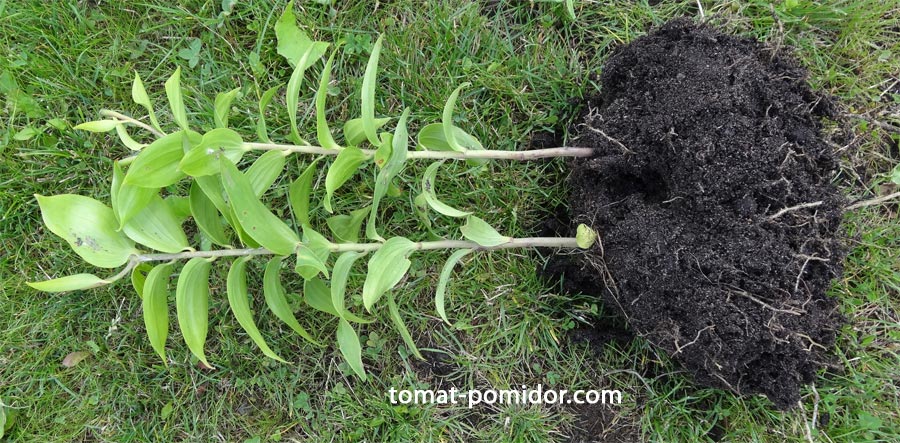
A peony won’t completely fill a pot with roots over the summer. If the soil ball doesn’t fall apart, it indicates poor health and/or poor soil quality. I also sometimes had to plant them in pots in the spring. In the fall, I took them out, inspected them, and checked for rot (if I saw any rotting – I cut it back to healthy tissue, soaked it for half an hour in a dark pink potassium permanganate / fungicide solution, and dried it for 6-8 hours). And then planting. I could talk about it for a long time. But I think everything is clear in the picture.
I will add that if it’s hard for you to determine the 3-5 cm depth when burying peony roots, lay any suitable stick across the edges of the planting hole. Place your hand on the stick with your thumb pointing down. This is your reference point. After watering, pull up or lower the buds to the desired depth.
Quote from OlgaTal:
A peony won’t completely fill a pot with roots over the summer…
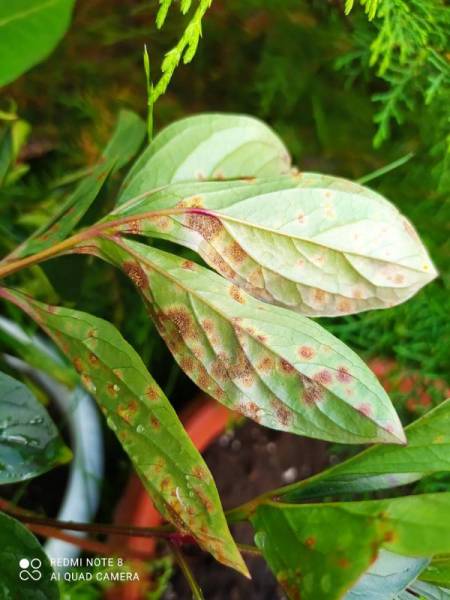
Olya, can I ask another question: These spots appeared on one of the new peonies. What should I do?
Quote from Meggi:
Olya, can I ask another question: These spots appeared on one of the new peonies. What should I do?
It’s hard to see clearly in the photograph, but it seems like there are growths. This is rust. Cut everything down to soil level right now. And treat the soil with a copper-containing preparation. Burn the foliage.
Quote from Aksakal:
…a severe drought altered the soil, and everything burned out…
On sandy soils that don’t retain moisture well, measures are taken to maximize the provision of soil moisture to the roots. You can use two options:
- Nutrient mix for filling the planting pit – 1:1:1 humus, clay, excavated soil + 200 gr. of autumn fertilizer + a 0.5-liter jar of ash. Mix everything.
- At the bottom of the planting pit, you can place a piece of an old cotton blanket or mattress 50×50 cm (20×20 inches) in two or three layers. And on top, pour a mound of nutrient soil to plant the root.
If you got a plot with sandy soil that has very little humus – solid sand, then it’s better to combine the two options.
This will give the root a good starting opportunity to grow absorbing roots. The bush will get stronger and delight you with gorgeous blooming in the future.
Quote: “Before planting, dip in a special mash prepared from clay, ash, Heteroauxin (2 tablets per 10 liters of water), you can add copper sulfate (50 g per 10 liters), and dry.”
The acids contained in Heteroauxin (rooting hormone) do not dissolve in water, it’s not Kornevin.
You need to crush the Heteroauxin tablets and pour 30-50 gr. of alcohol, vodka, moonshine, etc. For example, calendula tincture will also work. If the preparation dissolves poorly, put it in a warm place for 2 hours, but not in the sun! Then dilute it in the required amount of water.
If the sediment has not dissolved after soaking in the alcohol solution, alas, you bought a fake. Next time, do not buy this brand of preparation.
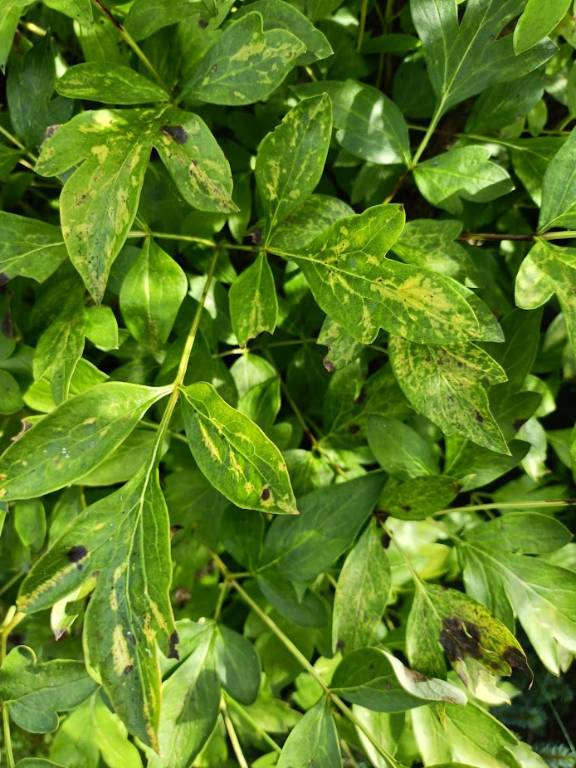
Good morning. These spots appeared on the peony leaves. Tell me, what is This?
Good time of day! My Bartzella peony has grown significantly, and I want to divide it (cut a piece off) without digging up the main bush, is it possible to do this? Please share your experience, how and when is it best to do this? Thank you!
Hello. With Itoh peonies, this is difficult to accomplish. For me (I read that this is a feature of the species), all the roots converge in the crown, and the branches go up from it. The first time I divided, I barely split a large bush into 3 huge divisions. I couldn’t get them any smaller. Meaning, essentially there were three intertwined crowns with roots/branches that I also had to untangle. One plus – a broken piece with a bunch of branches and almost no roots, gave roots and bloomed two years later.
And keep in mind that you won’t be able to divide an Itoh at all later on, because there will be such a jungle there that you won’t be able to figure it out.
Try digging from the side to organize and root such a broken piece with part of the crown. I watched a video showing that Itoh peonies are even propagated by cuttings, and apparently, they root perfectly and grow into full-fledged plants.
Quote from Meggi:
Good morning. These spots appeared on the peony leaves. Tell me, what is This?
Hello! Peonies have 3 diseases, just like humans:
Fungal infection:
- botrytis (gray mold)
- rust
- wilt (verticillium, etc. When you cut the stem, the core is blackened)
Bacterial…
Viral.
– Leaf MOSAIC (yellow spots, streaks, yellow rings) is your case.
It is caused by a number of factors: Unfavorable growing conditions, stress, improper transplanting, using an infected tool during pruning/work.
De facto, there is no cure, dig it up and burn it. BUT this is debatable because different owners and collectors act at their own risk.
You can leave the bush and know/mark that you only work on it with a separate tool and sterilize it during subsequent treatments, so as not to spread the infection to others. Insects can also act this way, transferring sap from plant to plant (but I don’t have specific data here).
And there is a controversial treatment option that is not widely practiced or known: the virus is afraid of high temperatures, and in early spring, as soon as the shoots appear, pour hot water over them at ~80°C (175°F), you can also add potassium permanganate.
+ subsequent care including timely application of fertilizers / immunomodulators like for humans))))) for nourishment and recovery.
Foliar feeding / loosening the trunk circle – aeration.
What to do is up to you, the internet is there to help.
I know the practice of treating the virus with high temperatures on Schlumbergera (Christmas cactus) as well.
I tested this practice on my peony – it didn’t boil =)