Full summary ↓
Peat Moss vs. Acidified Water: Fixing Alkaline Greenhouse Beds Without Going Broke
On Feb 27, 2026 at 11:32 AM, Yulia Orenburg wrote:
I agree that adjusting your irrigation water pH every time is a given, and you can fix your soil using whatever method works for your budget. To me, buying a bottle of sulfur is the cheapest, most foolproof option since other acids end up costing more. Hauling in acidic peat moss is way too expensive here, a 9 cu ft (250 L) bale runs about $25 (2,200 RUB), and you’d need several for a greenhouse. Plus, how are you even supposed to mix that by hand with a pitchfork? From my experience, you need at least a cement mixer for that kind of volume, and my husband spends several days mixing soil just to fill a small greenhouse. There are way more than two ways to skin this cat.
Nobody’s saying wood ash is off-limits either, it’s great in the right spot, you just need to neutralize it in a tomato greenhouse instead of letting it sit there making life miserable.
As for other water acidifiers, we’re just swapping notes. I really love using PeKacid through drip irrigation, at least for a flush at the end of the season. Every acid has its time and place.
Julia, let’s break this down step by step. Suppose you want your tomato bed to stay slightly acidic today, tomorrow, next month, and all the way through the end of the season. Meanwhile, your soil started out alkaline in spring from all that wood ash dumped into it.
Think about watering with acid. You’ve probably seen what happens when you splash any acid onto a piece of chalk (calcium carbonate): it fizzes for a couple minutes and then the acid fizzles out. Bury that piece of chalk in soil and the reaction lasts a few hours tops. Mineral soil is packed with a whole boatload of those carbonates. So what, are you going to dump buckets and barrels of acid just to neutralize all the carbonates in the soil’s buffer? Imagine what that would do to the plant roots, not to mention your wallet.
As for adding elemental sulfur, yes, it eventually acidifies soil. But it takes months to oxidize into sulfuric acid. Your tomatoes will suffer through alkaline conditions long before they ever see any benefit from that sulfur.
Next up, acidic peat moss is expensive (honestly, any peat is pricey these days). If mixing peat into full beds costs too much to keep your tomato root zone slightly acidic, switch to low-volume container growing (about 3-4 gal / 10-15 L per plant), or keep watering with mildly acidified water every single time, especially when feeding. Nothing better has been invented yet. By the end of the season, you can compare your total acid receipts against the cost of peat moss and see which actually came out cheaper. By the way, if you really dig into water acidifiers, it’s easy to miss the mark on the results you expect, though I won’t go down that rabbit hole right now. If you’re curious, commercial greenhouse manuals explain exactly why they choose specific acids when mixing fertilizer stock solutions.
On Feb 27, 2026 at 2:48 PM, DRYGAN wrote:
…By the end of the season, you can compare your total acid receipts…
Wouldn’t apple cider vinegar work? It’s natural, beneficial, and we’ve got plenty of it practically for free.
Good evening everyone!
On Feb 27, 2026 at 4:26 PM, Lemma wrote:
Wouldn’t apple cider vinegar work? It’s natural, beneficial, and we’ve got plenty of it practically for free.
Good evening everyone!
Elena, what really matters here is how stable the acid is and whether the leftover ion actually helps the plants. On the first point, vinegar isn’t stable. You can test it yourself: mix it into water, check the pH, then measure it again a little while later and watch it drift back up.
As for the leftover ions, basically every acid splits in water into a hydrogen ion (which is what actually lowers the pH) and a conjugate base. Take nitric acid (HNO3), it splits into hydrogen and a nitrate ion (NO3). That nitrate is just nitrogen in nitrate form, exact same stuff as in calcium nitrate, totally useful and safe for plants. Same deal with phosphoric acid (H3PO4), the leftover phosphate ion is solid nutrition for plants. With vinegar or citric acid, though, I haven’t seen any data showing their leftover ions feed the plant. Sure, they won’t hurt anything, I just haven’t seen proof they add nutrition. So it’s really up to you.
Found my old notes. Adding about 1/2 tsp (2 ml) of vinegar per quart (1 L) dropped my water pH from 7.8 down to 6.4.
So per 2.5-gal (10 L) bucket, that works out to:
Vinegar: 1.5 tbsp (20-25 ml) per bucket
Citric acid: 1/2 tsp (2-2.5 g) per bucket
Urea phosphate: 3/4 tsp (3-3.5 g) per bucket
Does Sphagnum Peat Moss Last in Raised Beds? Real Grower Results (Tomatoes & Blueberries)
On Feb 27, 2026 at 2:48 PM, DRYGAN wrote:
Julia, let’s break this down step by step…
Vadim, using peat moss in greenhouses just doesn’t pay off for us because it breaks down fast into dense low-moor muck, which doesn’t compare at all to airy sphagnum peat moss. Of course I run barrels and totes of acidified water through the drip, how else are you supposed to do it, stick a pill in the dirt and pray? What’s so expensive about grabbing a quart (1 L) of sulfuric acid for $2 (160 RUB) to last the whole season? Even a beginner can figure out which acid to use at each growth stage just from the name. And if you don’t have drip irrigation, you can grab a cheap $15 (1,400 RUB) submersible pump to acidify soil occasionally and make watering way easier. This isn’t even about me personally, I’ve got meters to monitor everything and haven’t had any issues thank goodness. We’re all just sharing ideas here so folks can pick up useful tips.
Where I strongly disagree with you is sinking money into acidic sphagnum peat moss in greenhouse beds. Soil life chews through it in no time and it’s money right down the drain, been there, done that (and we’re not the only ones). The only thing we toss in there is spent coir/peat from container grows. By the way, “acidic” bagged peat often shows up at pH 6.0-6.5, just a heads-up in case anyone runs into that, we always do a squeeze test first.
Seriously, how else are you supposed to grow blueberries, bigleaf hydrangeas, rhododendrons, and other acid-lovers every season without acidifying the water? You just acidify and acidify plenty, and they thrive just fine without dumping fresh peat moss on their heads every single year.
Sorry if that came off a bit blunt, I can get pretty fired up about this stuff 😄
Best regards!
On Feb 27, 2026 at 5:46 PM, Yulia Orenburg wrote:
Vadim, using peat moss in greenhouses just doesn’t pay off for us because it breaks down fast into dense low-moor muck, which doesn’t compare at all to airy sphagnum peat moss…
Julia, believe me, I’ve seen more than my share of peat moss around here. Don’t believe everything printed on the bag (like that old joke about believing what’s scribbled on a fence) saying it’s 100% pure sphagnum peat. Even here in bog country, there are plenty of knockoffs. What brand did you use? Got a picture of the stuff?
Speaking from my own experience, true high-moor sphagnum peat worked into a greenhouse bed does NOT turn into low-moor muck when it mineralizes. It breaks down into light fluff. If yours turned into mush after decomposing, that wasn’t true sphagnum peat.
Now, as for the cheapest way to keep the root zone slightly acidic, I can tell from your posts you already know your acids inside and out, so stick with whatever works best on your budget. Perfection is tough to hit in this department anyway. Personally, in my 10×20 ft (3×6 m) tomato greenhouses (center aisle, two side beds), I swap out the soil for pH-adjusted sphagnum peat moss (limed to pH 5.5-6.5, no fertilizer added) every 3-4 years. For watering and feeding, I adjust my well water (which comes out at pH 7) using phosphoric acid at about 1.5 tbsp (25 ml) per 2.5 gal (10 L).
For blueberries, I water at pH 4-5 using battery acid at 3 tbsp (50 ml) per 2.5 gal (10 L). I mulch the blueberries with acidic sphagnum peat every 2 years and work in elemental sulfur at roughly 1.5 oz per sq yd (40-50 g/m²). Plus I only use acidifying fertilizers for them: slow-release Fertika evergreen granules and water-soluble Aquarin feeds.
On Feb 27, 2026 at 6:51 PM, DRYGAN wrote:
Julia, believe me, I’ve seen more than my share of peat moss around here… Personally, in my 10×20 ft (3×6 m) tomato greenhouses… I swap out the soil for pH-adjusted sphagnum peat moss…
Everything you do is pretty much right in line with my own numbers, and I totally agree with that part. I switch acids depending on the growth stage too. For blueberries and heathers, acidic peat moss is a must, no argument there. I just don’t put peat in my tomato greenhouses anymore. Instead, I mix black chernozem topsoil with river sand at a 1:2 ratio in a cement mixer for the raised beds, and then focus purely on soil and plant care.
We always buy Agrobalt straight from the plant in fresh bales (though their acidic pH can still be off sometimes). It’s light, reddish-blonde, and airy, we don’t have local bogs anywhere near Orenburg anyway. In our beds, it breaks down into regular dirt in practically one season, so it felt like burying cash and calling it a day. I could blame the composting worms we bred and added (got them from Tkachenko), except commercial growers running acres up in Oryol see the exact same thing, soil microbes chew right through it leaving zero trace. Just felt like throwing money at the wrong fix. With blueberries there are no worms, yet it still settles and decomposes so fast you can barely keep tossing new bales on. But with blueberries you’ve got no choice, if you want the berries, you gotta put in the work. For tomatoes though, at that rate it’d be cheaper to just grow in rockwool. To me, the whole point of sphagnum peat is aeration, lose that and there’s no point using it.
Still, I’ll think about your setup with peat. Which brand are you using?
On Feb 27, 2026 at 8:33 PM, Yulia Orenburg wrote:
…I just don’t put peat in my tomato greenhouses anymore. Instead, I mix black chernozem topsoil with river sand… We always buy Agrobalt straight from the plant in fresh bales… For tomatoes though, at that rate it’d be cheaper to just grow in rockwool.
We don’t have black topsoil here, just loam at best, and mostly sandy loam. Right behind my fence is a pine forest. The top spade’s depth is sandy loam, underneath that is sandy loam with a little clay, and deeper down it’s practically pure sand. When I dug my well, past the first 3 ft (1 m) of topsoil there was 26 ft (8 m) of pure sand, which I ended up mixing into concrete for my fence curb. So I’m stuck using peat moss, got no other choice.
Of course we’ve got way more peat varieties here than you do: low-moor (black muck), transitional, and high-moor sphagnum. For the last kind, Vitebsk peat is top-notch, with bogs stretching as far as the eye can see. Whenever you can, buy peat only from companies that actually harvest their own bogs. The rest are mostly middlemen blending mystery ingredients from who-knows-where. When I mulch my blueberries with about 6-7 gal (25 L) of sphagnum peat per bush, their roots visibly shoot straight into it.
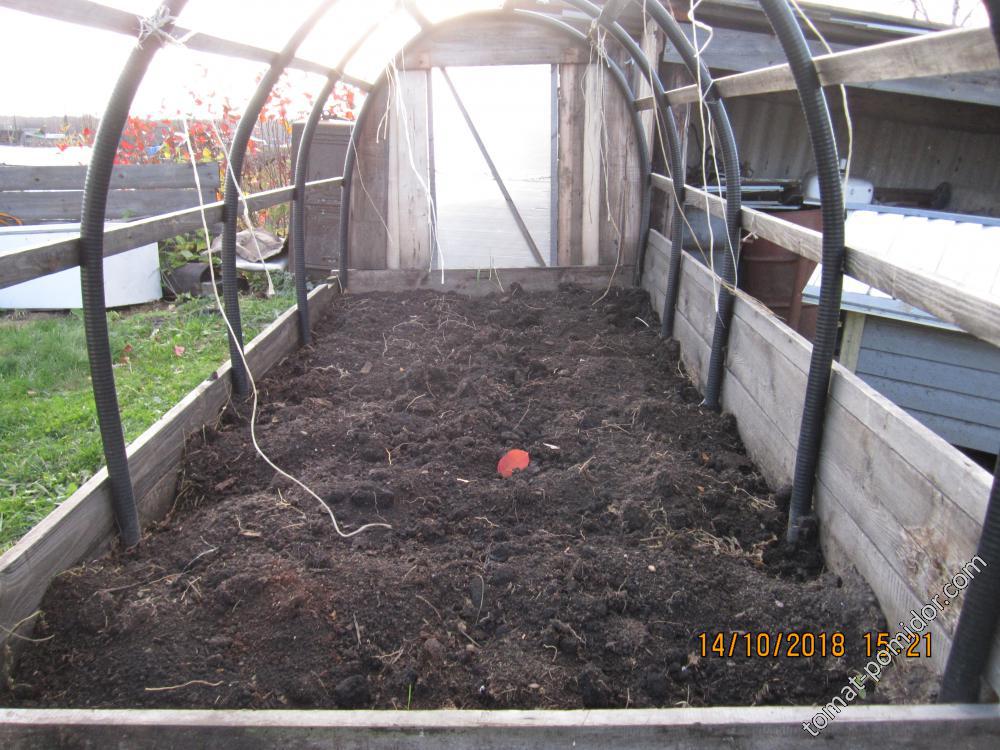
For tomatoes, my greenhouse setup works a bit like low-volume growing. Along the beds on both sides of the center path, I dig out a narrow trench of old soil about 1.5 spades wide and 1 spade deep (12-15 in wide by 10-12 in deep / 30-40 cm by 25-30 cm). I fill just that trench with fresh blonde Vitebsk sphagnum peat limed to pH 5.5-6.0 (nowadays they sell it plain limed alongside pre-fertilized mixes). I add my own base nutrients and liquid feeds straight into that trench, while the old dirt stays along the outer edges. Not perfect, sure, but wilt diseases and root rot don’t build up nearly as fast in fresh peat trenches as in old soil.
There are slicker ways to do this, like “peat sausages.” You fold poly sheeting into troughs about 24 in (60 cm) wide and 12-14 in (30-35 cm) tall, fill them with peat, run drip tape on top, and swap the peat every couple of years. Too much hassle for me to build, though it’s a cleaner system. As for rockwool, you need full-on fertigation for that: timed irrigations synced to growth stages and solar radiation, exact mineral ratios, balancing cations against anions. Otherwise nutrients go sideways and you spend at least two weeks fixing the imbalance. Peat is way more forgiving thanks to its high buffering capacity, it’ll let you get away with two or three feeding mistakes.
Best Ways to Lower Soil & Irrigation pH: Key Takeaways
- ⚗️ Why Acid Drenches Don’t Fix Alkaline Soil Long-Term: Pouring acidified water onto soil loaded with calcium carbonate (or wood ash) triggers a brief fizzing reaction that neutralizes the acid within hours. Elemental sulfur works, but takes months to oxidize. For immediate relief, growers recommend consistently acidifying every irrigation/feeding or growing in peat trenches/containers.
- 🍋 Vinegar vs. Mineral Acids (Real Dosing): While vinegar and citric acid are safe and cheap, DRYGAN notes vinegar’s pH effect is unstable and neither adds plant nutrition, whereas nitric acid (adds nitrate) and phosphoric acid (adds phosphate) pull double duty. Irina193 shared her exact per-2.5-gal (10 L) bucket rates to drop water from pH 7.8 to 6.4: 1.5 tbsp (20-25 ml) vinegar, 1/2 tsp (2-2.5 g) citric acid, or 3/4 tsp (3-3.5 g) urea phosphate.
- 🌿 Does Sphagnum Peat Moss Last? Yulia Orenburg found commercial peat broke down in a single season in worm-rich beds, preferring black topsoil/sand mixes plus acidified drip water (sulfuric acid or PeKacid). DRYGAN counters that true high-moor blonde peat lasts 3-4 years as airy fluff, and uses fresh peat-filled trenches inside greenhouse beds to cut root rot and simplify feeding compared to rockwool.
- 🫐 Blueberries & Acid-Lovers: Both growers agree blueberries need steady water acidification (pH 4-5) plus fresh acidic peat mulch, with DRYGAN adding elemental sulfur at 1.5 oz per sq yd (40-50 g/m²) every two years.
In Eastern Europe, some berry growers buy automotive electrolyte (dilute ~36% sulfuric acid) as a budget water acidifier for blueberries, and use brand-name feeds like Fertika or Aquarin. Because automotive battery acid is not food-grade and poses serious handling risks, US home gardeners typically stick to elemental sulfur, vinegar, citric acid, or ag-grade phosphoric acid (widely sold as pH Down in hydroponic shops). Also mentioned here: PeKacid (ICL 0-60-20) and urea phosphate, both commercial water-soluble fertilizers designed to lower irrigation pH and prevent calcium clogging in drip lines.