📌 Quick Summary: The Tomato Blight Debate
- 🍅 The Standard Advice: When tomato leaves develop yellow halos and dry brown spots, most gardening books say it is a fungal disease (like Early Blight or Anthracnose) and you must reach for fungicides immediately.
- 🥶 Our Community’s Insight: Veteran growers from cold climates (Zone 3 and 4) noticed something different. These fungal infections almost always start as Chlorosis (a micronutrient deficiency). But the lack of nutrients isn’t because the soil is poor, it’s because cold spring soil and planting out too early severely stunt the root system.
- 🧪 The Verdict? Before you spray harsh chemicals on your tomatoes, read the discussion below. Learn how the leaves actually control root growth, and why a simple Iron Chelate foliar spray (feeding through the leaves) might be the first step to saving a stressed plant.
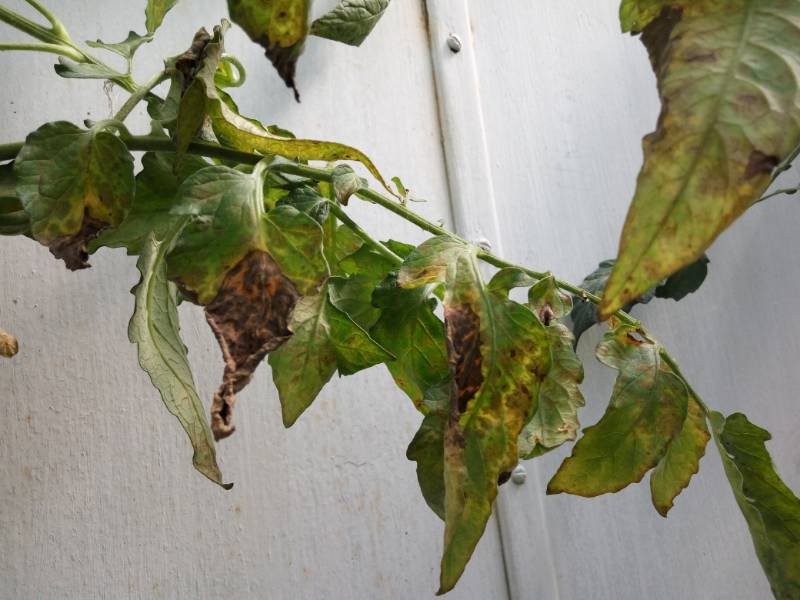
Luda, is this Early Blight (Macrosporiosis) or what? It’s literally giving me nightmares…
Look who landed on my phlox.

Svetlana-Kr wrote:
Luda, is this Early Blight (Macrosporiosis) or what? It’s literally giving me nightmares…
Greetings folks! 🌞
Mind if I share a few thoughts here? Of course, the leaf in the photo is pretty far gone and you can’t fix it, but you CAN prevent this from happening to the new leaves. This applies to nightshades and legumes alike. ALL these fungal blights usually start with CHLOROSIS – a lack of trace minerals (micronutrients) in a chelated form.
You need to take action the moment you see even a tiny dry edge on the foliage or a slight color change. Chlorosis can evolve FROM a simple nutrient deficiency into a full-blown fungal disease, and that’s when a gardener goes into panic mode – what do I do? what disease is this?
A lack of trace minerals usually messes up the photosynthesis process, and the result is obvious… yellowing and drying of the leaves, especially the older lower ones.
It’s hard for me to judge the exact cause right now from this photo because it’s too far gone. If there WAS a photo at the INITIAL STAGE of the disease, I could give specific advice. But I have a lot of practical experience with the causes of chlorosis and its consequences, mostly on tomatoes and potatoes. My conclusion is this: if you can spot it early, a micronutrient deficiency and a fungus look different. But the consequences later on are hard to tell apart because nutrient deficiencies “pave the way” for fungal diseases to take over.
In my experience, chlorosis primarily happens from both an excess and a LACK of iron. Sometimes there is plenty of iron in the soil, but the plant just can’t absorb it… but in ANY case, the plant will ALWAYS absorb it if you do a foliar spray.
I always keep Iron Chelate in my arsenal. The shelf life is UNLIMITED.
Well, I’ve talked your ear off here… plant diseases and fighting them is such a tedious and long topic…. 👴
MADanilich wrote:
A lack of trace minerals usually messes up the photosynthesis process…
Andrey Danilych, thanks for the wisdom.
I can see my mistakes now:
1. I didn’t pot up the seedlings into larger containers in time.
2. The roots of this plant were heavily damaged by a shrew. I should have stimulated root growth, but I didn’t.
3. My watering and feeding was inconsistent. I fed it with a balanced water-soluble fertilizer with micros, but I probably should have used more.
I should probably just pull this tomato plant, but I kept it as an experiment. I treated it with a Copper fungicide today, and I’ll give it microelements and Iron Chelate.
Svetlana-Kr wrote:
Luda, is this Early Blight (Macrosporiosis) or what?
Sveta, this actually looks more like Anthracnose to me. But the root cause for both of them appearing is exactly the same: planting out too early into cold soil, and as a result, a terribly weak root system.
Svetlana-Kr wrote:
Andrey Danilych, thanks for the wisdom.
Good morning everyone! 🌞 What wisdom!??? It’s just conclusions based on theory and practice. I just want to pass on SO MUCH to you all, to share my mistakes so you don’t repeat them.
But I have one golden rule! Many gardening conclusions rely heavily on specific climate conditions and soil parameters. If you don’t know the climate context, advice turns into useless blah, blah…
Aleksan9ra wrote:
…planting out too early into cold soil, and as a result, a terribly weak root system.
Ludmilka, I agree with you here 100%%, but…. YOU MUST understand ONE THING!!!! Roots develop ON COMMAND from the LEAVES…!!!!! THIS is the chain of dependency for ALMOST any plant development….
The leaf is the LANGUAGE of any plant….. leaves will tell you EVERYTHING…..!!…???…. 👋 when it’s happy, and when it’s stressed…