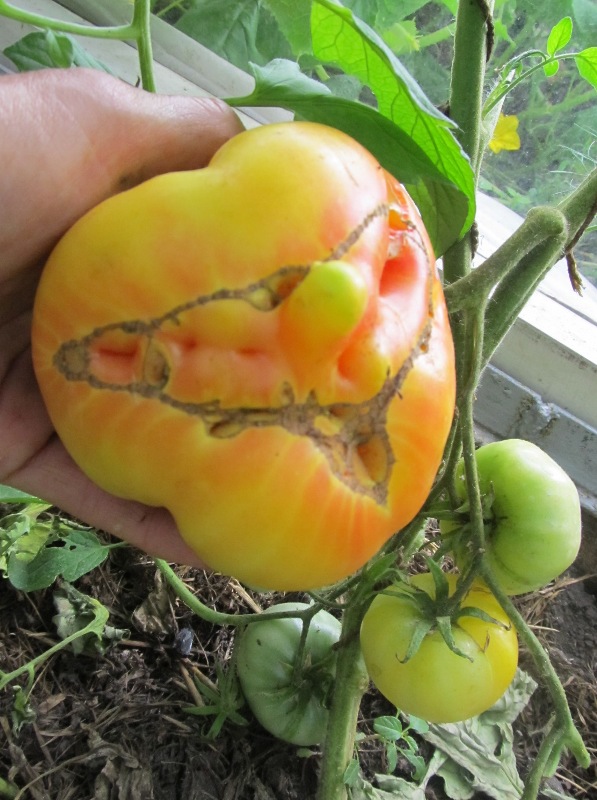
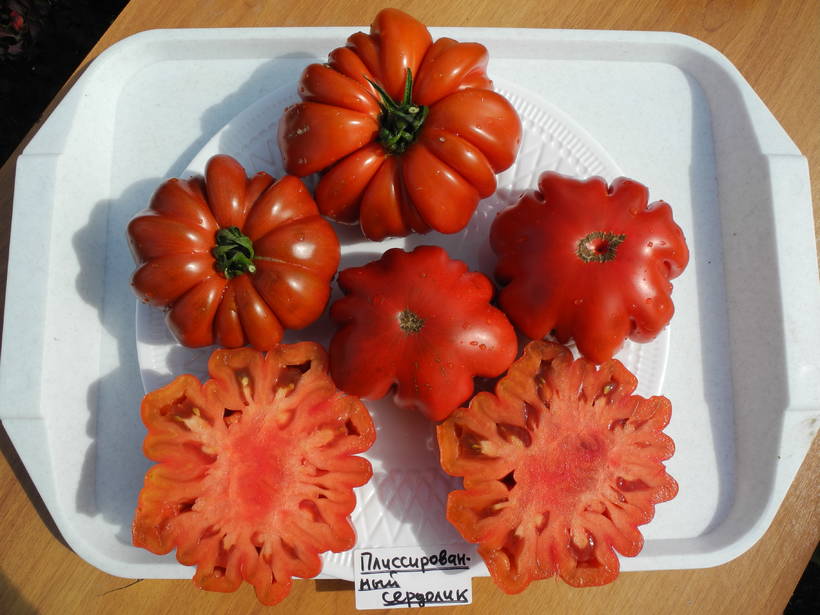
Growers’ Notes and Photos (USDA Zones 4-6 Experience)
Description from the seed packet: Mid-early variety. Days to maturity from germination is 115-120 days. Bushes are medium-height, sprawling, 2.3-2.6 ft (70-80 cm) tall. Yield is 13-15 lbs/sq m (6-7 kg/m2). Fruits are oblate, large. The first fruits can reach 25-28 oz (700-800 g) or more, with subsequent ones weighing 5-7 oz (150-200 g). The variety has low disease resistance.. Valued for its large fruit size.
Photo credit: Galya-64


I grew it in 2011. It was just like Galya’s, very productive. The flavor is classic tomato with a nice acidic tang, and it’s extremely early. The only downside is that it catches diseases really easily. I want to grow it again this year specifically for an early harvest.
Yeah Marina, even the seed packet explicitly mentions that it has weak disease resistance, which is surprising for a commercial description.
Marina wrote:
The only downside is that it catches diseases really easily. I want to grow it again this year specifically for an early harvest.
That one flaw outweighs everything else. Why bother planting it if it’s just going to succumb to disease again?
Andrey_K wrote:
That one flaw outweighs everything else. Why bother planting it if it’s just going to succumb to disease again?
You plant it early, pull the harvest off, and then yank the plant out of the garden bed! 😆
If I started my seeds around March 20th, where is the best place to put it? The greenhouse?
Blondi wrote:
If I started my seeds around March 20th, where is the best place to put it? The greenhouse?
It’s actually much better suited for outdoors in the dirt.
Regarding the diseases: In 2013 we had early late blight, and it got sick right along with everything else. Last year it didn’t get sick at all.
It looks more like a light raspberry-pink color to me. Overall, I’d say it’s a 3 out of 5 tomato.
This year I planted “King of the Earlies and Productive” from Angelina, I think it’s the exact same variety. Sown on Feb 29, potted up into 3-liter pots, and planted out in the greenhouse in early April. The first photo is from the greenhouse (we already pulled 2 ripe ones off the bottom truss before taking the photo). The second photo is outdoors in the dirt. In the greenhouse, it’s already about 5.5 ft (1.7 m) tall, but outdoors it’s only about 2 ft (60 cm). Crazy difference, right? 😲
As for taste: rich tomato flavor with a nice tang. I brought some to work and everyone loved them.
Sorry about the second photo, our resident wagtail flew in to check on the garden bed. That same bird family has been living here for four years 😂


I also grew King of the Earlies and Productive this year. Thanks to Angelina for the seeds. It really is both early and productive! I sowed it on March 5th, just like all my indets. Had two bushes side-by-side in the greenhouse, pruned to a single leader each. They surprised me right away: the bottom trusses had 3 to 4 massive tomatoes each. Then they threw out another 2 trusses with 4 fruits each. Maxed out at 2.6 ft (80 cm) tall. It definitely acted like a determinate. I will absolutely plant it again, but outdoors under row covers next time. I waited for my daughter to come visit to take the picture, so the plant looks a little wilted here.

Full Summary: Plant, Yield, Taste and Disease Resistance
- 🌿 Plant: Determinate to semi-determinate. When grown outdoors, it stays true to its packet description, forming a compact, sprawling bush around 2.5 ft (70-80 cm) tall. However, when grown inside a greenhouse and pruned to a single leader, it can stretch up to 5.5 ft (1.7 m).
- 📈 Yield: Extremely heavy early production.
- 👅 Taste: Classic, rich tomato flavor with a noticeable acidic tang. Some growers rate it highly, while others find it average (a 3 out of 5).
- 🍅 Fruit Size: Oblate, light pinkish-red beefsteaks. Famous for throwing out absolutely massive fruits (up to 25-28 oz / 700-800 g) on the bottom trusses, with the upper fruits sizing down to a more standard 5-7 oz (150-200 g).
- 🛡️ Disease Resistance: Very poor. The seed packet and the growers both confirm it is highly susceptible to late blight. The standard strategy is to enjoy the massive early harvest and then pull the plants.