Growers’ Notes and Photos (USDA Zones 8 Experience)
Another grower, Radanad, absolutely nailed the description of this variety:
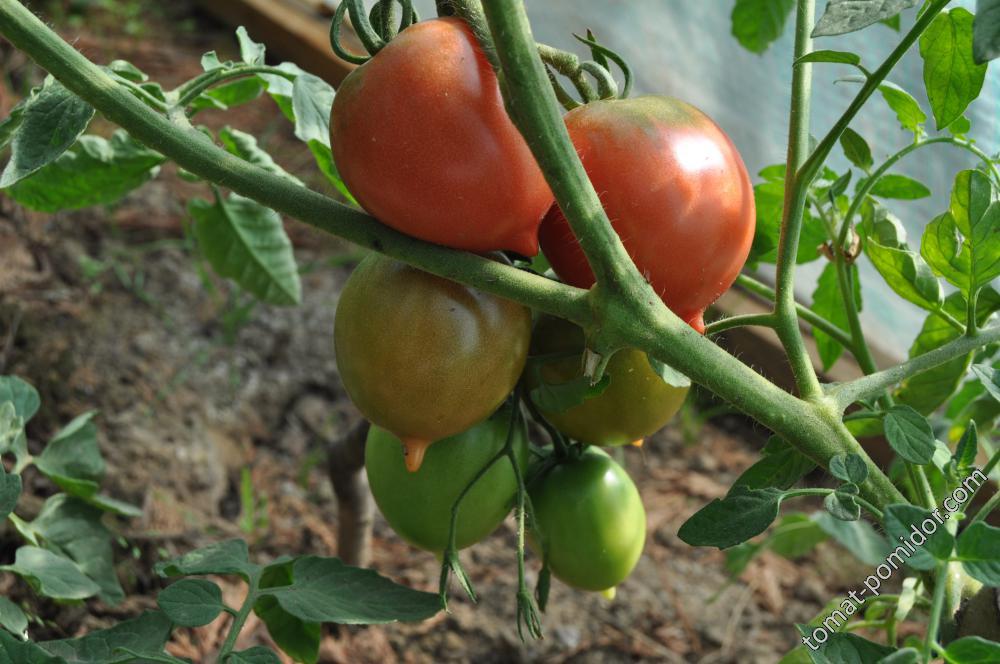
Pink Monisto isn’t quite a cherry tomato – it’s a clustering cocktail type. The fruits are an elongated oval shape with a little beak on the end. The clusters are small, the flesh is a bit mealy, and the skin is soft. It lacked juiciness for me. The plant is sturdy; I pruned it to a single stem, though it could easily handle two. I haven’t tried canning them yet, but they look beautiful in a jar and don’t seem prone to cracking.
The Gavrish seed packet markets this as “highly beautiful and ornamental, with huge branching trusses of over 50 fruits.”
What we actually got: clusters of just 6-8 tomatoes (absolutely all of them were this size). The fruit weight did match the package at around 1.4 oz (40 g), and it was a mid-season producer. We let the plant grow wild without pulling suckers, and it topped out at about 4 feet (1.2 m) tall growing under a high tunnel. Overall, the flavor was just average.
Full Summary: Pink Monisto (Monisto Rozovoe)
- 🌿 Plant & Foliage: A sturdy, robust plant that reaches around 4 feet (1.2 m) tall when left unpruned in a hoophouse. It can be easily trained to 1 or 2 stems for a tidier footprint.
- 🍅 Fruit & Shape: Cocktail-sized pink tomatoes weighing roughly 1.4 oz (40 g). They feature a distinct elongated oval shape ending in a cute, pointed little beak. The skin is soft, but they hold up well without cracking.
- 📈 Yield & Health: Yields are highly contested. Commercial seed packets claim breathtaking, cascading trusses holding over 50 fruits. However, real-world growers report standard, small clusters containing just 6 to 8 tomatoes each.
- 👅 Taste: Flavor is universally rated as average. The flesh tends to be a bit spongy or mealy rather than juicy, making it underwhelming for fresh eating. However, its crack resistance and attractive shape make it an excellent candidate for canning whole.
The word “Monisto” refers to a traditional Eastern European women’s necklace made of overlapping coins or beads. Seed companies use this name to evoke the image of heavy, cascading, jewel-like fruit clusters.