Quick Summary of Rozovyi Gay (Pink Grove)
- 🌍 Origin: A fantastic early commercial Russian variety. The name translates to “Pink Grove” (though English speakers often mistakenly read it as “Pink Guy”).
- 🌿 Plant Habit: Determinate (bush). In a greenhouse, it typically stays compact around 60-70 cm (2 – 2.3 ft), though in very rich, heavily amended soil, it can reach up to 1 meter (3.3 ft). It has a sprawling habit and requires sturdy staking due to the heavy fruit load. Growers note that you can get away with little to no pruning (suckering).
- 🍅 Fruit Characteristics: Perfectly round, smooth pink tomatoes. They are very uniform, generally weighing between 70-110g (2.5 – 3.8 oz).
- 👅 Flavor: Universally praised for having an exceptionally good, sweet taste for such an early ripening variety (early tomatoes are often criticized for being bland, but not this one).
- ⏱️ Maturity: Extremely early! Growers report that it frequently beats other famous early varieties (like June/Iyunskiy and Duckling/Utenok) to the finish line, making it a perfect choice for those craving the first fresh tomato of the season.
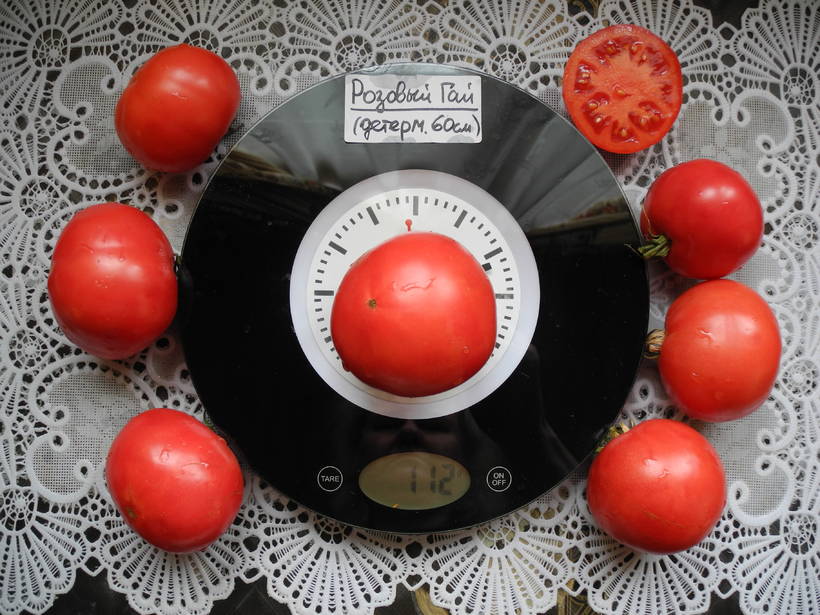
Rozovyi Gay (Pink Grove). An early, short variety. In the greenhouse, the bush is about 60 cm (2 ft) tall; you can skip pruning the suckers. The fruits are pink, round, up to 110g (3.8 oz), with a very good taste for an early variety.
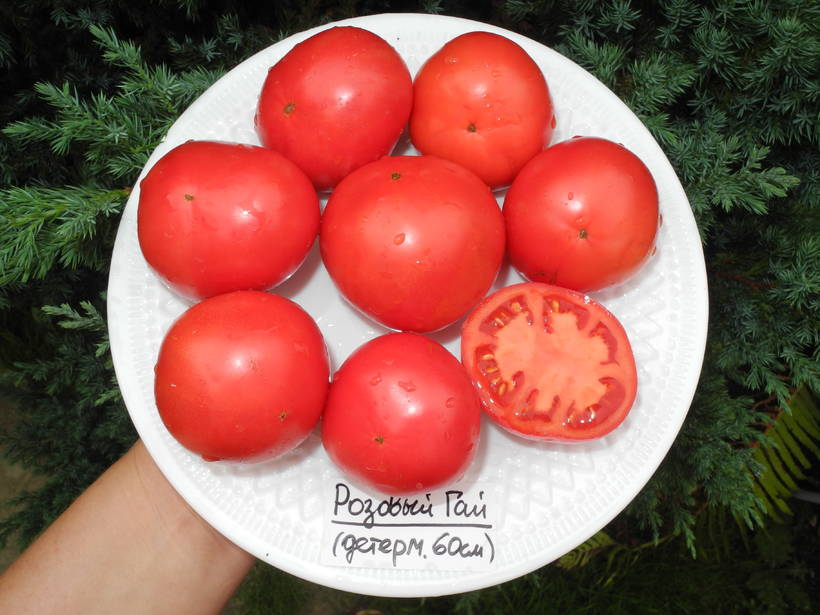
Svetikk said:
…you can skip pruning the suckers.
Sveta, do we not need to remove the suckers even up to the first flower cluster? It is pushing out so many suckers for me, from every single leaf. Maybe I should restrict it to a few stems anyway?
Tanyusha, do it however is convenient for you. I might remove some of the suckers on determinate plants after planting them out if the suckers look weak or if the bush is getting too crowded/dense.
Rozovyi Gay. I repeated this wonderful early variety. It grew in the greenhouse, I didn’t prune the suckers, height was about 60-70cm (2-2.3 ft), quite sprawling and very productive for a determinate, requires good tying/staking. It set a large number of very tasty, round fruits weighing 70-100g (2.5 – 3.5 oz).
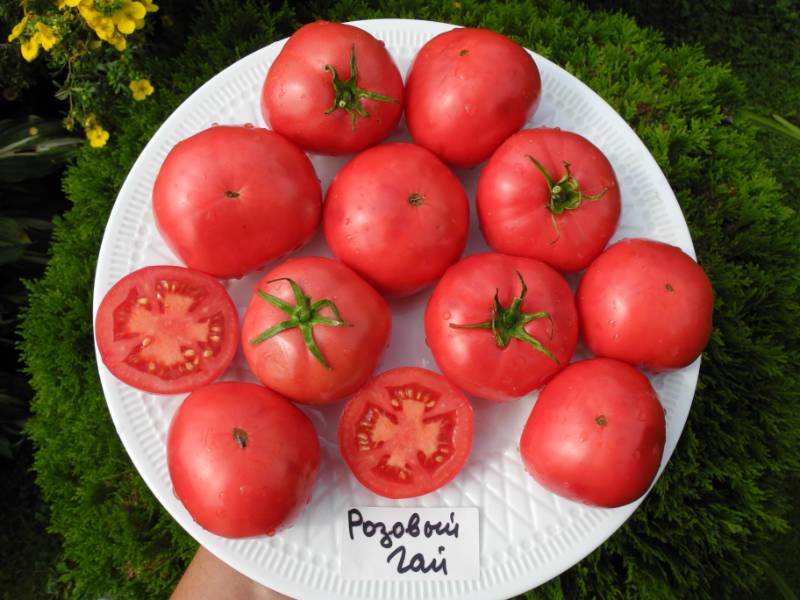
I also really liked this variety, both for its yield and taste. I grew it outdoors in open ground for early production. It ripened absolutely first, overtaking the other early determinates I had — Sibiryak Tosya, Koster, Iyunskiy (June), and Utenok (Duckling). I will try growing it in the greenhouse next time.
And here is my Rozovyi Gay:

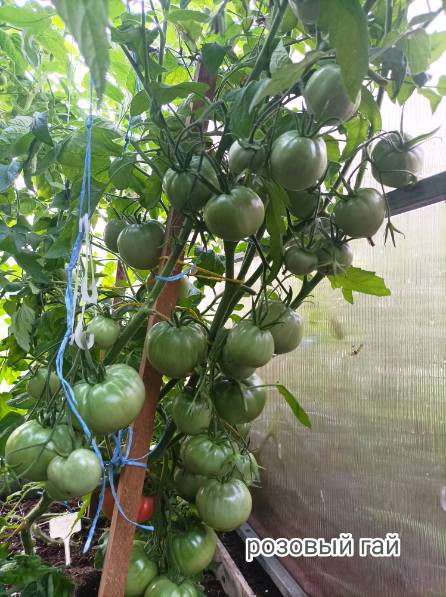
My Rozovyi Gay in the greenhouse was never 60 cm; it was a solid meter (3.3 ft) for sure. Perhaps the difference in soil is showing here. My soil was originally pure clay, followed by annual amendment/cultivation. As a result, all my plants turn out taller than their stated height.
I grew it for the first time, and I plan to repeat it and Tetushka (Auntie) for early production.
Plena said:
Perhaps the difference in soil is showing here. My soil was originally pure clay, followed by annual amendment/cultivation…
Elena, could you please share how you cultivate/amend clay? Our newly acquired plot is solid, heavy clay. We don’t know how to process it to make it comfortable for plants. Just dumping a thick layer of fertile topsoil over 300 square meters (3,200 sq ft) is not an option. It’s very expensive. Is there another way?
Initially, I set up the garden beds using the “warm bed” (Hugelkultur) method. I dug a trench about two spade-blades deep, laid branches and plant debris at the bottom, and covered it with the native soil.
I bought a truckload of good (non-clay) sand and mixed it into the soil. And I buy compressed peat in 250-liter bales (though lately I only see 100-liter ones). I add that in.
I add sand and peat to the flower beds as well. Once, I bought a whole truckload of bulk peat, and I swore never to do it again — there were so many weed seeds, it was a nightmare.
Well, and my own compost, plus I mulch for the winter with leaves, and in the summer with grass clippings.
I think this is standard technology. I don’t buy topsoil by the truckload; I don’t risk it, plus it’s extremely hard work to shovel that volume all at once.
Oh, and before you start developing an area, if you have a whole season to spare, you can cover the future garden bed with something like roofing felt or slate to cut off the light and water. A year later, you will have loose soil underneath. Then proceed as above: sand acts as a loosening agent, and peat loosens the soil while providing organic humus.
Elena, thank you! You’ve helped me a lot) I will start working on it. For the cherries and pumpkins, I’ll probably have to dig deeper than 2 spade-blades and wider as well.