📌 Quick Summary (TL;DR): Heatwave Transplant Shock
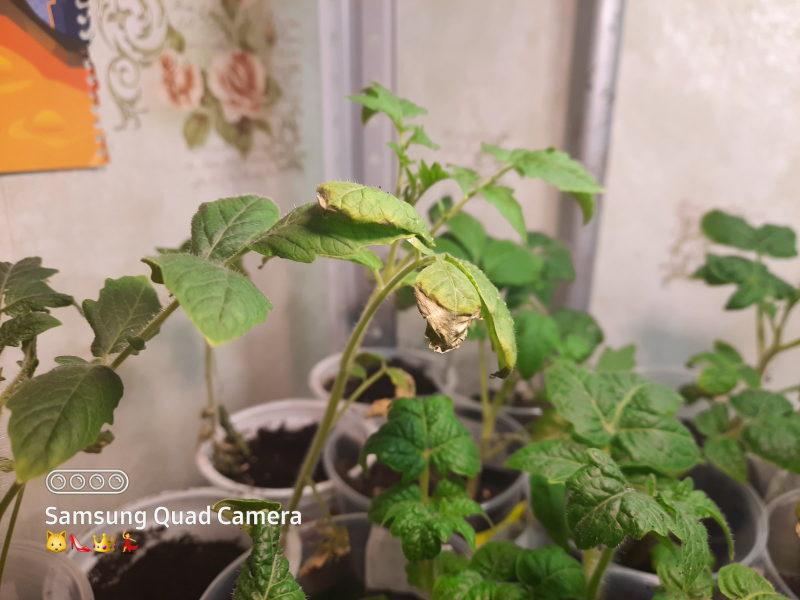
- 🥀 Wilting is Normal: If newly planted tomatoes droop in the afternoon sun, it’s because their disturbed roots can’t pump water fast enough to keep up with evaporation. Provide temporary shade (shade cloth or row cover) for the first 3-4 days.
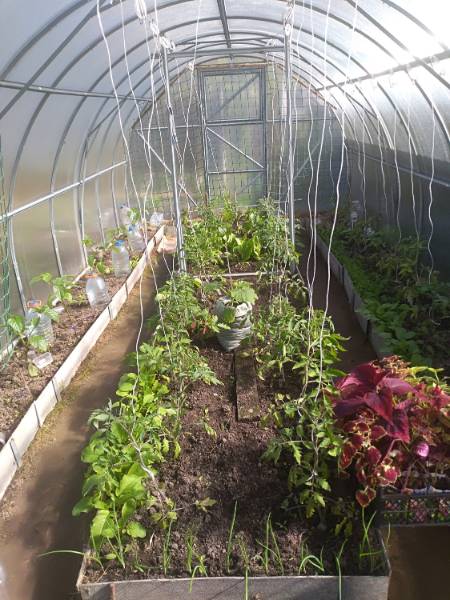
- 💦 The Misting Hack: In extreme heat, you can mist the tomato leaves with a hose early in the morning while they still look perky. This keeps them cool. But if the leaves are already drooping in the afternoon, do NOT wet the foliage. Instead, wet the soil and the greenhouse paths to raise ambient humidity.
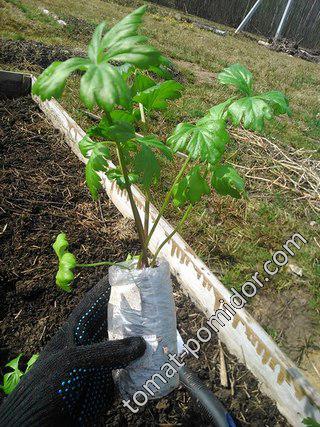
- ⛰️ Hold Off on Hilling: Do not mound soil (hill up) around the stems immediately after planting. Let the soil warm up first. Just tie the plants to their stakes and remove bottom leaves touching the ground.
- 💊 The First Feeding Schedule: Wait 3 to 5 days after transplanting, then feed with Calcium Nitrate to boost cell wall strength. Wait another 3-4 days, then apply a balanced granular fertilizer (like Tomato-tone or 10-10-10).
Photo author: Russi
Good evening, Luda! I finally planted my overgrown, leggy tomato seedlings. I have a question: should I hill them up (mound soil around the stems), or leave the soil level flat?
Some of the roots got slightly damaged when I was pulling them out of their pots. Should I water them with a root stimulator to speed up root growth? It is incredibly hot in the greenhouse right now. During the day, everything is wide open. Should we close the vents at night, or leave them open? 🥵🍅
Meggi (Tatiana) wrote:
should I hill them up… Some of the roots got slightly damaged…
Tanya! Do not hill them up right now! Tie them to their stakes (or however you trellis them) immediately. It’s also best to pinch off the lowest leaves that are touching the dirt.
Don’t worry about the damaged roots; with the weather being this warm, they will quickly grow new ones. It would be a good idea to put up some shade cloth for the first few days after planting so they establish better without burning.
Since they are predicting night temperatures around 62°F (17°C), you don’t even need to close the vents or doors at night. Water them in the morning or early afternoon so the greenhouse is dry by nightfall.
Fertilizer Schedule: Wait 3 to 5 days after transplanting, then feed them with Calcium Nitrate. Wait another 3-4 days, then sprinkle a little balanced granular fertilizer (like a Spring-Summer mix) under each bush and water it in. That will be plenty for now! Just keep pinching off the suckers. Good luck! 🌿
Luda, your help to us newbies is priceless. Thank you! It is SO HOT right now!!!
My peppers are standing tall and looking perky, but the tomatoes are wilting and drooping their leaves badly. I put shade cloth on the sides of the greenhouse, but the sun is beating down directly from the top. Not a single cloud in the sky. I really hope they survive. Should I feed the peppers on the exact same schedule? 🥀
Meggi (Tatiana) wrote:
…the tomatoes are wilting and drooping their leaves badly…
Tanya, it’s going to be even hotter tomorrow. There is a great hack for this: early in the morning, while the tomatoes still look perky, take a watering can or hose and mist them from above so the leaves are wet. As soon as they start to dry, mist them again—basically, don’t give them a chance to wilt. 🚿
HOWEVER: If the leaves are already drooping and wilting, do NOT water them from above! If they are wilting, you should only wet the ground around them and water the pathways to raise the ambient humidity.
As for the peppers, you can feed them the same way, or you can give them organic liquid feed (like manure tea) a couple of times first, and then switch to balanced granular. It depends on how the peppers look. In this extreme heat, peppers and eggplants absolutely love getting a “shower” (misted foliage). Just don’t do it during the peak scorching hours—do it before 11:00 AM or after 4:00 PM. Same goes for cucumbers. You don’t need to flood them, just mist the leaves with cool water. 🥒💦
Meggi (Tatiana) wrote:
My peppers are standing tall and looking perky, but the tomatoes are wilting…
Potassium is what helps tomato leaves maintain their turgor (cell pressure) and stay perky. But since your peppers and tomatoes are in the same greenhouse, and the peppers have enough Potassium to stay upright, it means there is plenty of Potassium in the soil… it must be a transplant shock issue for the tomatoes. 🧪
The thing is, the greenhouse is new and the soil is new. The beds were just filled in May. It’s partly my own dirt and partly commercial potting soil. The planting holes for the tomatoes got compost, worm castings, and an Organic-Mineral fertilizer. But for the peppers, I put a different balanced fertilizer in the holes.
I planted the peppers on May 14th, and the tomatoes on May 16-17. The greenhouse walls are covered with spunbond row cover, but the sun is roasting them from the roof.
Tomorrow morning I will give them the “shower” Luda suggested, and in 3 days I’ll feed them Calcium Nitrate. I also have pelletized chicken manure and liquid Humic Acid.
Does anyone use biological products like EM-1 (Effective Microorganisms) or compost teas? When is the right time to apply herbal “weed teas”? 🌿
Meggi (Tatiana) wrote:
When is the right time to apply herbal “weed teas”?
It’s better to use herbal compost teas a little later, once the seedlings have fully overcome transplant shock and start actively growing. Herbal teas are especially fantastic for peppers, eggplants, cucumbers, zucchini, pumpkins, and cabbage.
Liquid Humates (diluted to a light yellow color) can be used on all crops constantly. As for the chicken manure pellets, you can steep them in water separately to make a liquid feed. 🐔💧
Several popular fertilizers are mentioned in this thread. Here is the US/Canadian equivalent:
- Fertika / OMU: These are popular Russian brands of granular fertilizer. In North America, the equivalent would be Tomato-tone (Espoma), Jobes Organic, or any balanced 10-10-10 granular mix.
- Humates: This refers to Liquid Humic Acid or Kelp/Seaweed extract. It is widely used in Eastern Europe to reduce transplant shock and boost root growth.
- Herbal Tea: A classic homesteader fertilizer often called Weed Tea or Comfrey Tea. It is made by fermenting green weeds (like nettle or dandelion) in a bucket of water for a week, resulting in a free, highly potent liquid Nitrogen fertilizer.
- Baikal EM-1: A commercial probiotic for soil containing “Effective Microorganisms” (Lactic acid bacteria, yeast, etc.) used to speed up composting and improve soil health.