Quick Summary of Chernyy Mavr (Black Moor / Black Mauri)
- 🌍 Origin: A highly popular commercial Russian variety bred by Mashtakov in the Rostov region. Widely distributed internationally as Black Moor or Black Mauri.
- 🌿 Plant Habit: Officially classed as semi-determinate, but practically grows as a vigorous indeterminate for most gardeners, easily reaching 1.5 – 2 meters (5 – 6.5 ft) and producing heavily until frost. Performs exceptionally well in both greenhouses and open ground.
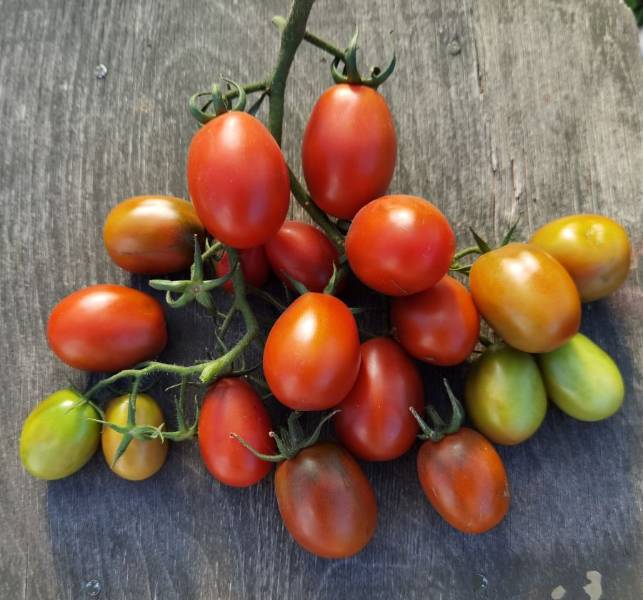
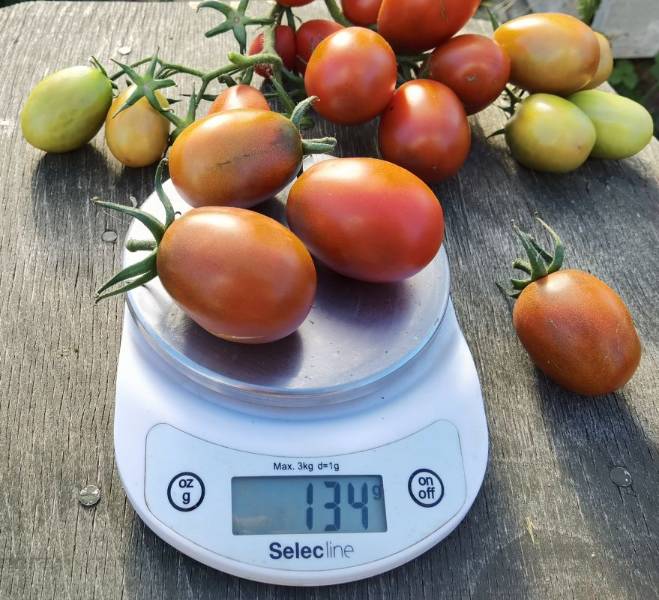
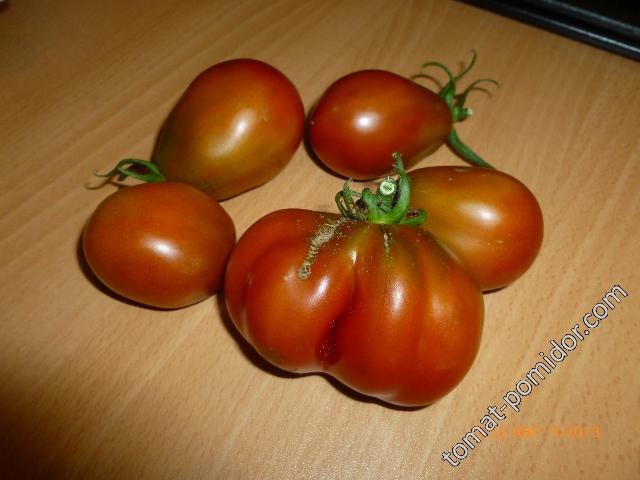
- 🍅 Fruit Characteristics: Dark chocolate/brown plum-shaped tomatoes (sometimes throwing round or heart-shaped variants on the same plant). They grow in massive, cascading trusses of up to 18 fruits. Average weight is 30-50 g (1-1.8 oz).
- 👅 Flavor Profile: Very climate-dependent! Bred in the hot, dry south of Russia, it develops deep sweetness and thick walls in warm weather (especially with adequate potassium/ash). In cooler, wet climates, it can be juicier, softer, and more acidic.
- 🥫 Canning Controversy: It is highly debated as a canning tomato. Pro Tip: If you want to can them whole, you must pick them slightly underripe (at the breaker stage) and pierce the stem end with a toothpick. Fully ripe fruits will burst and turn to mush in the jar!
- 🔄 Comparisons: Frequently compared to Black De Barao (Moor is earlier and more productive) and Chocolate Bunny (growers consider them near-identical twins).
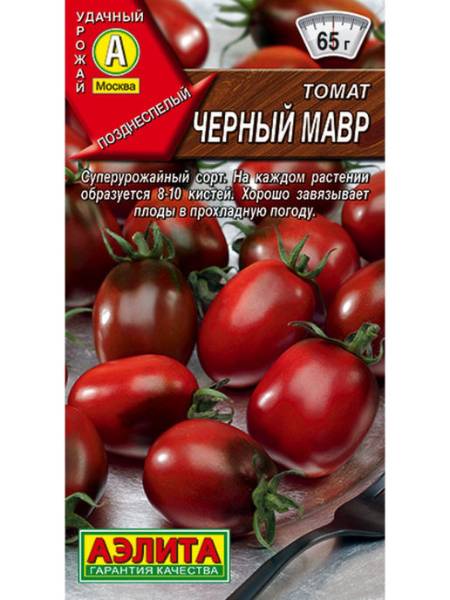
Description from the seed packet:
Mid-season (120-125 days from full emergence to fruiting) semi-determinate “truss” variety, intended for growing in greenhouses or open ground. The plant is 100-120cm (3.3-4 ft) tall, forming up to 18 fruits on a single truss. The fruits are plum-shaped, weighing 30-50g (1-1.8 oz), with thick walls. The color of unripe fruit is green with a dark green spot at the stalk, and brownish-chocolate when ripe. They possess a wonderful, rich taste. Very sweet. Yield is 4.8-5.3 kg/sq.m. Excellent for fresh use, salads, snacks, and whole-fruit canning.
Edited January 25, 2015 by Drosera
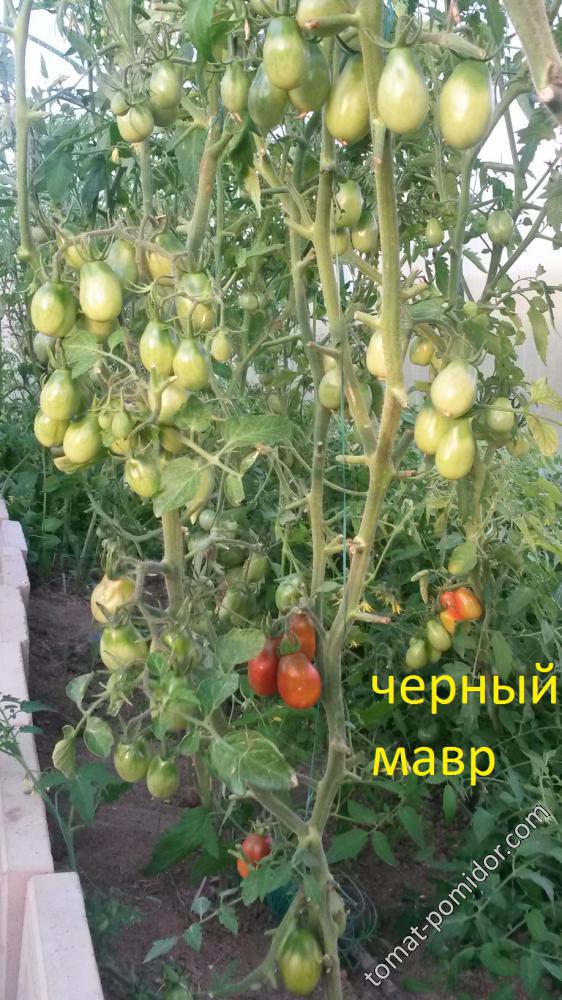

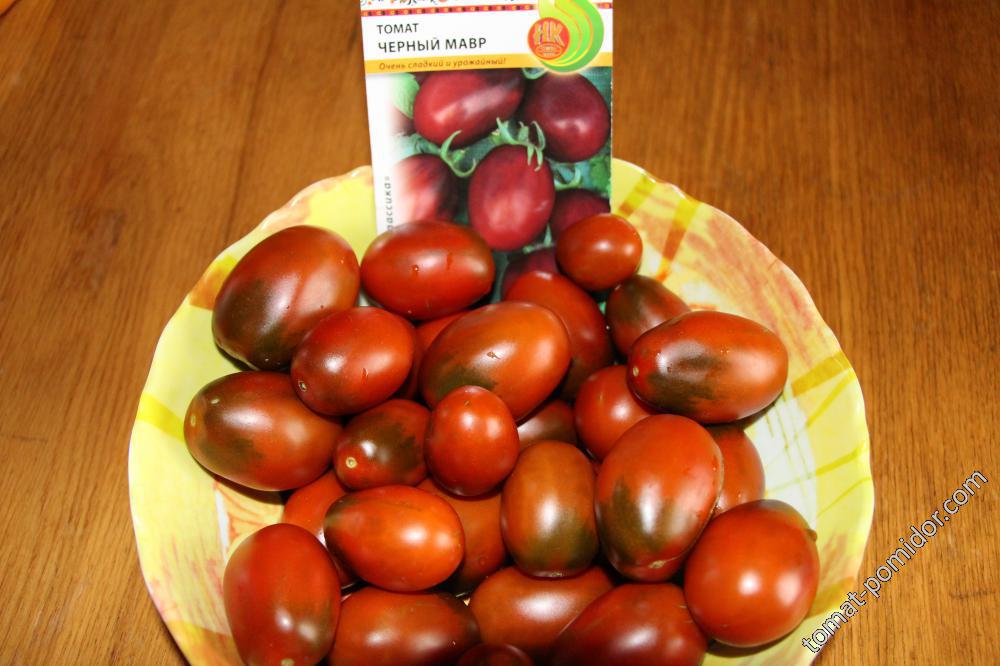
For me, it has always been over 150 cm (5 ft) tall. And it would have kept growing if autumn hadn’t arrived.
I got the seeds through a seed exchange.
– Bush appearance: mid-late season, medium-spreading.
– Fruit set: reliable, without skipping; the uppermost trusses manage to ripen.
– Height outdoors in open ground: around 1m to 1.1m (3.3 – 3.6 ft).
– Trusses: 4-6 fruits each.
– Overall yield: above average.
– Fruit: chubby little plum, chocolate color.
– Density of ripe fruit: high.
– Taste: dense, juicy, sweetness rating 4+.
First impression: a great tomato for canning.
My overall rating for the variety – 4 out of 5.
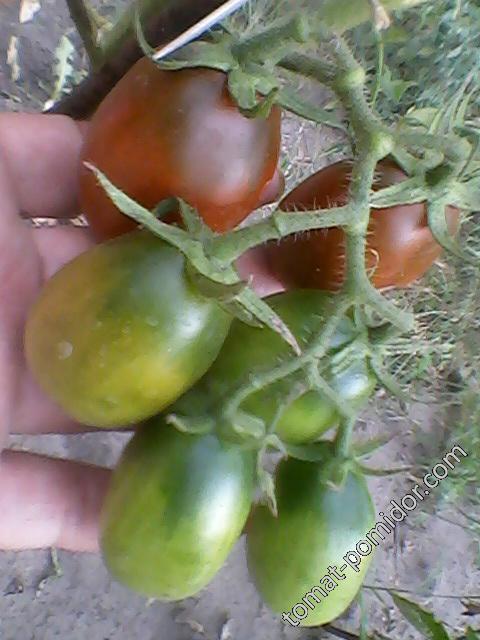
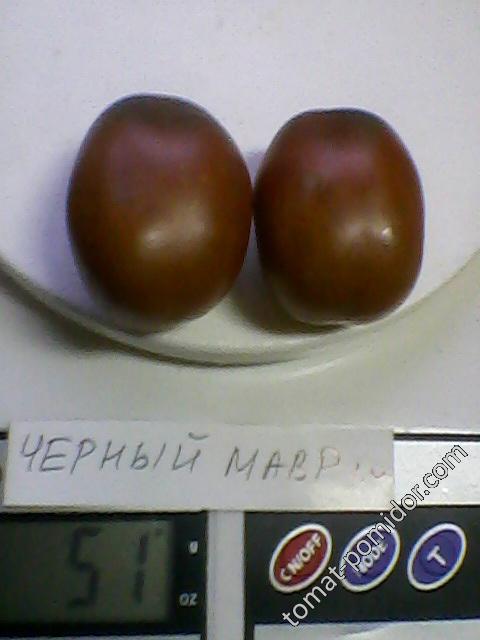
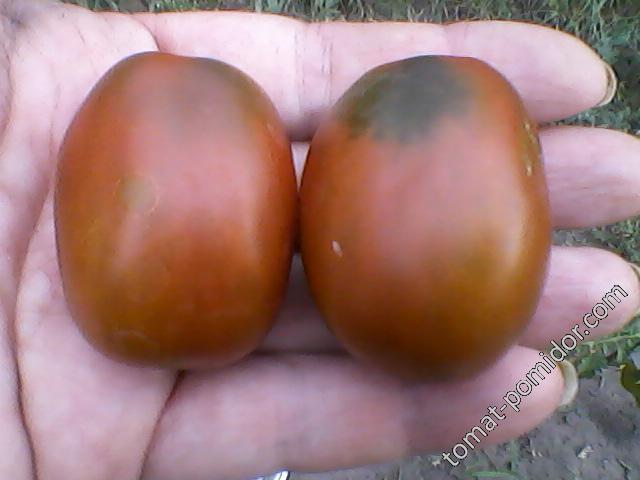
I really loved this variety! Sweet, and if you let it sit on the counter for a bit after picking, it develops an even more magnificent, tender sweetness.
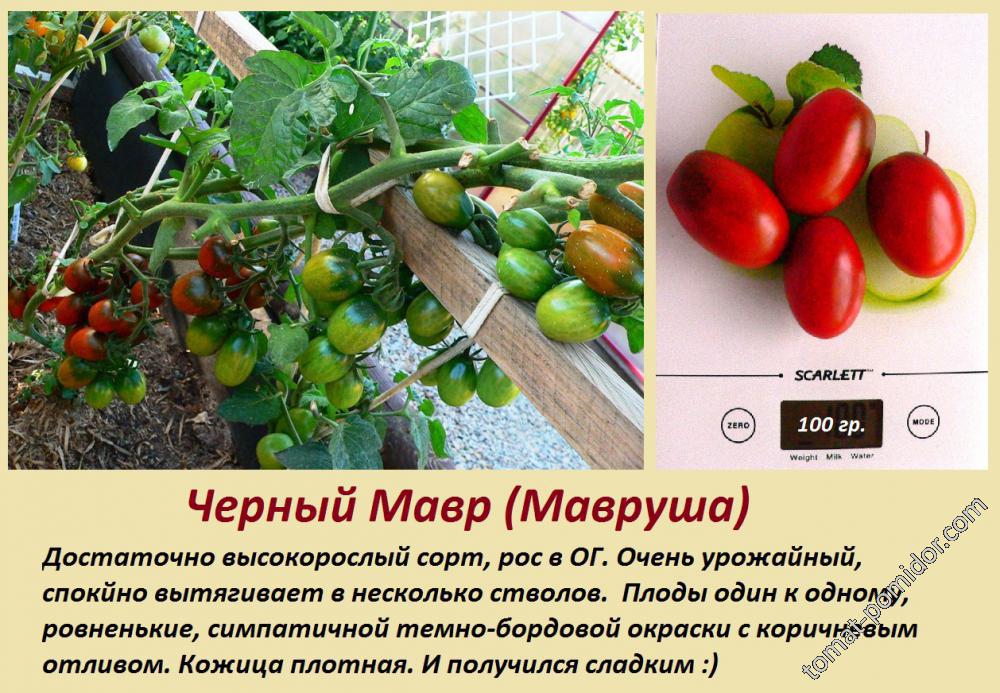
Mine grew much taller. Fruit set is excellent, fruits are identically sized on both the lower and upper trusses. I grew it in open ground and in the greenhouse—I liked it better in the greenhouse, they were larger. Didn’t catch any diseases. It was one of the first to start ripening in early July. I liked the taste—it’s not just purely sweet; there is a nice balance of tartness and sweetness, very aromatic and rich. All in all, it has earned a permanent spot on my grow list.
Viktoria, you probably tied it up vertically? I tied mine horizontally.
Semechka said:
Viktoria, you probably tied it up vertically? I tied mine horizontally.
Yes, vertically. How do you tie it horizontally in a greenhouse? Got a photo? 🤷♀️
My Black Moor grew in open ground, using beds with horizontal trellises for tying. I lay the indeterminates down and tie them horizontally along the strings.
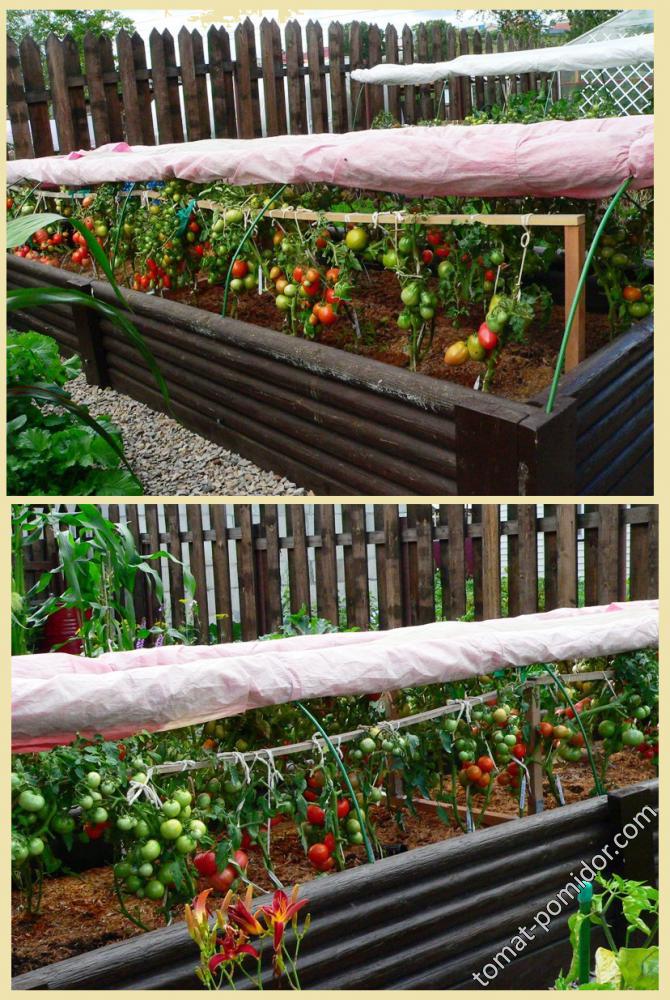
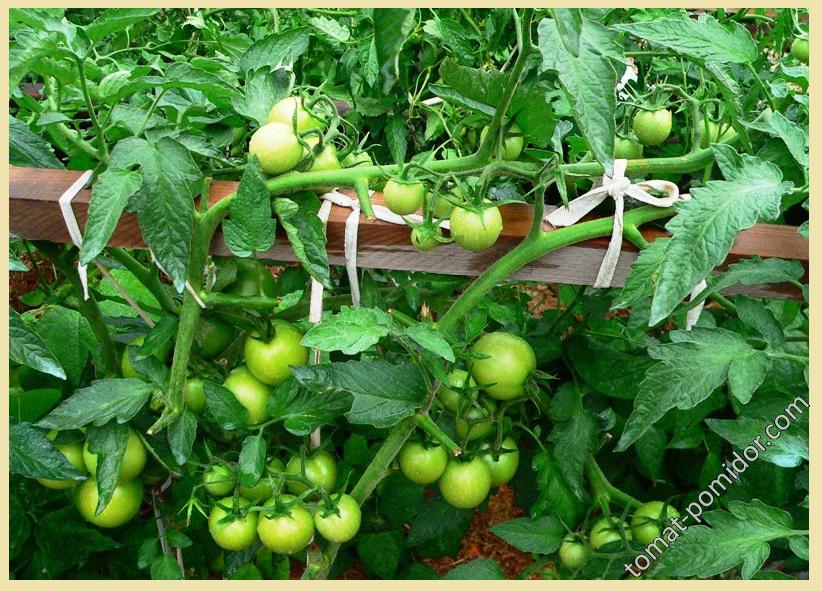
That looks gorgeous, I need to try that in open ground too. I could probably plant one like this in the greenhouse too, at the feet of the other tall varieties. Thanks for the idea! 📝🌺
Girls, am I the only one whose Black Moor cracked from the stem all the way to the tip with a single crack? 😡 The crack didn’t ooze, it was dry, but practically all the fruits had this defect when they ripened (( Unfortunately, no photos. 😢
I blame my watering schedule, but all the other tomatoes were watered on the exact same schedule, and only Black Moor had this problem.
My seeds were from this packet.

Strange… I had no cracked ones at all, neither in the greenhouse nor in open ground… 😲
I liked the variety, it didn’t catch any diseases, grew to 1.7m (5.5 ft), and set identical-sized fruits all the way to the top. They were sugary on the break. We ate them all fresh, they didn’t even make it to the canning jars… although they were planted for that purpose. Overall, a trouble-free variety. Mine didn’t crack.
I had no cracks either, just beautiful little tomatoes!
I second every word of that! P.S. Sveta, your photo report on Mavrusha is super!
Oksana, thank you for sharing the seeds with me!!! It is definitely on my repeat list.
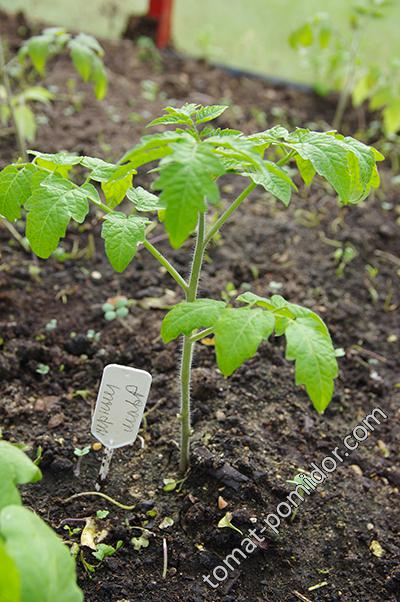
Hello. I planted Black Moor and Apples on the Snow in the same seedling tray. I didn’t label them. Black Moor sprouted uniformly, while the Apples sat there for a long time, so I thought I wouldn’t mix them up. I rotated the tray several times, and now I can’t tell what is what ((((((( One batch of seedlings has leaves with purple veins, the other has pure green leaves.
Hello! It is difficult to determine the variety at that age. Purple veins can appear for various reasons—usually, the seedlings were just cold.
Apples on the Snow is determinate, Black Moor is indeterminate. But despite this, in the seedling stage, both can be equally vigorous.
You’ll just have to identify them later when you plant them in the beds by the development of the bush, the flower trusses, and the shape of the tomatoes.
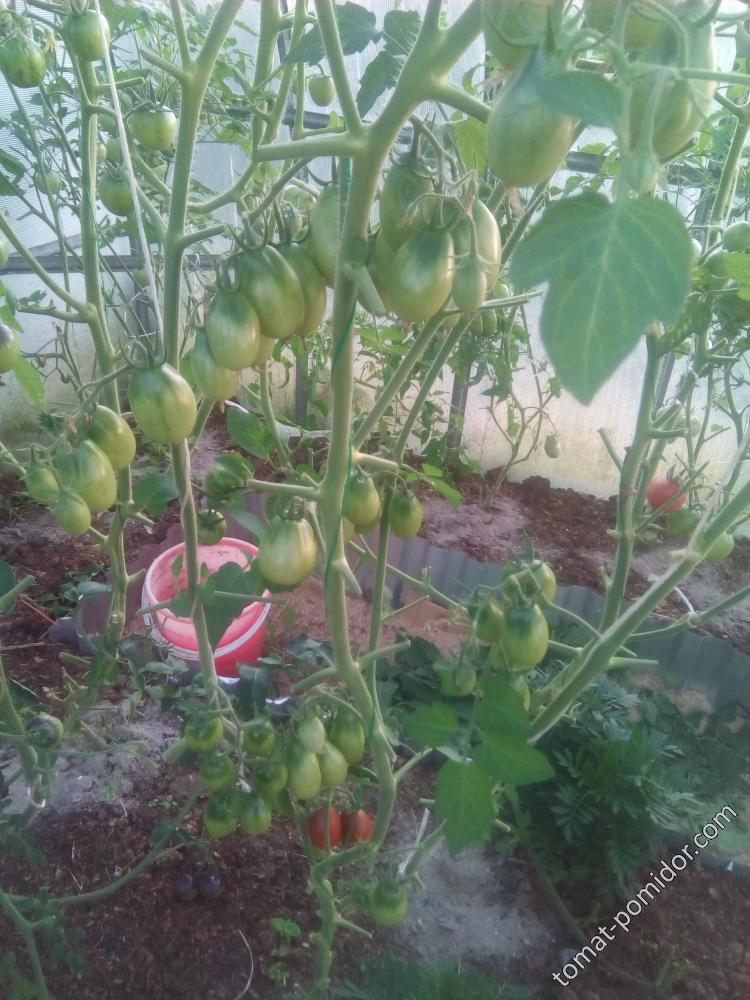
My Black Moor:
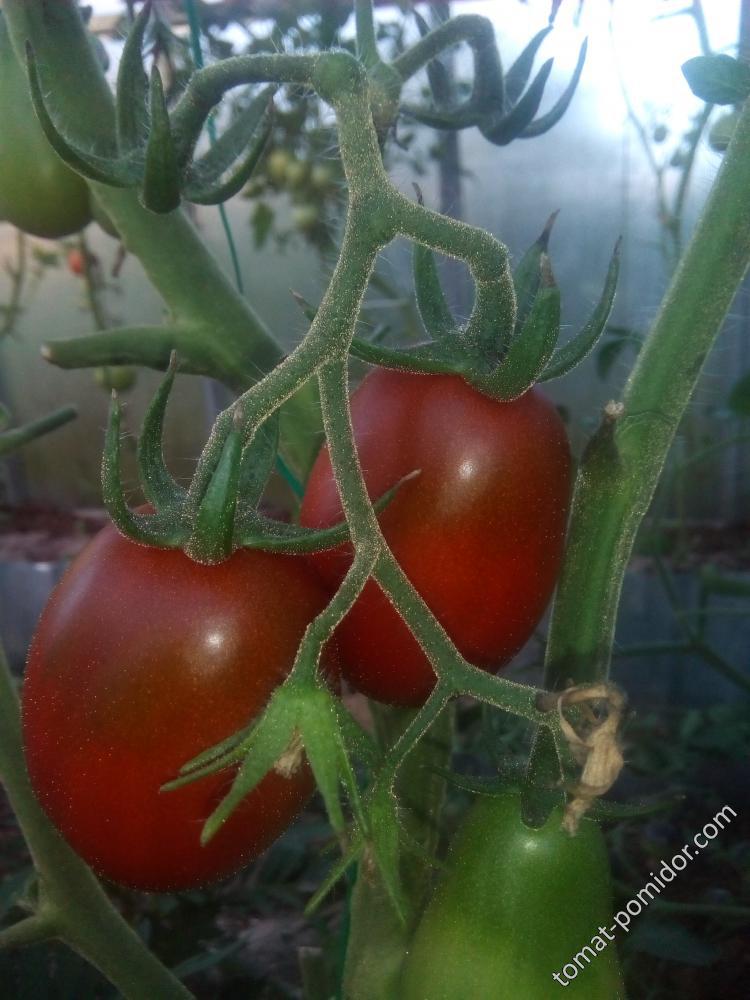
I will praise this variety for its yield, but it really didn’t shine in taste for me. The taste is quite simple, uninteresting, with acidity predominating. And when ripening off the vine, it keeps that exact same flavor profile.
I also have to disagree with Alena about the density of the fruits. They are quite juicy and soft, with relatively large seed cavities. There are a lot of seeds, and they are large for such a small fruit.
Girls, can anyone compare Black Moor with Black De Barao? The shape is similar. I wonder which variety is larger and more productive?
In practice, they turned out absolutely identical for me. Granted, I didn’t compare the deep botanical traits.
I planted Black Moor about four years ago in open ground. It was a heavily loaded determinate. I planted Black De Barao two years ago in the greenhouse—it was indeterminate. The fruit shape was very similar for me. I don’t remember the taste difference. But I really loved Black Moor both for fresh eating and for canning.
Olvia said:
I will praise this variety for its yield, but it really didn’t shine in taste… I also have to disagree about the density…
Black Moor was bred by Mashtakov in the Rostov Region. Alena described the variety in the conditions of the dry, hot South, while you grew it in the conditions of your humid, cool summer. Hence the difference in taste and texture.
I want to support the positive reviews about Black Moor. Everyone’s tastes are different, and conditions change from year to year. For me in 2016, it performed 5 out of 5. The yield is staggering, the taste cannot be called simple or acidic, it has a great aroma both fresh and canned 👍 The density is also impressive despite the seeds (which are indeed large). When I wasn’t feeling lazy, I sliced it crosswise for salads, and it didn’t turn to mush. Even in simple brine fermenting, it doesn’t leak; the skin is tough and takes a long time to absorb the brine, so if you poke them in the butt (stem end) with a toothpick before putting them in the jar, not a single one will burst. So for me, everything is peachy 😉
I have been growing Black Moor for five years now (seeds from the Poisk brand, bought accidentally at Auchan). This truss tomato never fails. Unlike Black De Barao, it always produces a harvest. Last summer we couldn’t even wait for De Barao to ripen, but this little tomato didn’t let us down even in such a bad summer. In summary: it is earlier, much more productive, and tastier because it actually manages to ripen compared to De Barao.
Maybe I had the wrong Moor. But it looks so ugly in canning jars, and the taste is absolutely nothing special.
galka68 said:
Maybe I had the wrong Moor. But it looks so ugly in canning jars…
I support this. I also planted it hoping for good canning. And every single one burst in the jars and turned into semi-mush. It just absorbed the taste of the brine and didn’t differ from anything else in the jar. Trash it.
Super productive variety, set fruit non-stop up to the ceiling until the very end when I ripped the plant out )))
Taste is nothing out of the ordinary—normal tomatoes, both sweetness and acidity are present. I got very worried when I read the previous reviews about canning, as I like firm canned tomatoes. At that moment, I had already canned several jars purely of Mavrusha… The day before yesterday I opened one—and it’s not so scary—a few were soft, but the rest were fine. In general, you just need to can slightly underripe tomatoes.
This year I grew two bushes, next year I’ll definitely plant more. Sveta, thank you so much for the seeds!!!
Edited October 23, 2017 by Dona70

This one is more like Chocolate Bunny. Black Moor is slightly rounder and larger, but CB is even denser for me than BM, and they are both dark brown. There is more sweetness in them if you give them more potassium—I fed them diligently with wood ash this year, and even the ones that used to be acidic changed their taste noticeably. And yes, you must can firm fruits at the breaker stage (blushing stage). Once fully ripe, no matter what you do, they will still be mushy. Otherwise, just use dedicated hard paste tomatoes for canning.
I really liked the variety. I grew it alongside Chocolate Bunny. They are twin varieties.
Early, productive, tasty. I hunted specifically for it for salads, so it didn’t even survive until canning season. Height 1.7m (5.5 ft). It grew and fruited until the bitter end. Ripens well off the vine. I didn’t remove the suckers completely—I just pinched them off above the formed truss. It stays on my permanent grow list.
I repeated Black Moor this year. Early, tasty, productive. The year turned out to be very hot. It grew on sandy soil, practically without watering in a polycarbonate greenhouse. The height of the bush reached the ceiling. I didn’t hold back on adding rabbit bedding/manure in the spring.
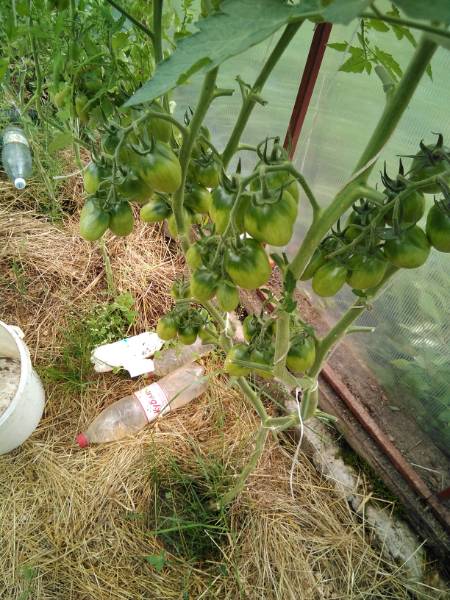
In 2020 I planted Black Truffle, it was early and quite sweet, but the yield was disappointing. My mom noted that it tasted similar to Moor, so I found seeds for Black Moor. I’ll take a picture when I go visit my mom, they should be ripe, but the ones we tried are already tastier than Truffle, and there are so many of them! I will plant it next year, but further apart—I had to let it run horizontally because the branches were falling over. Oh, and for some reason the fruits are of different shapes: round, plums, and the first ones were 7-8 cm (3 inches) in diameter. Deeelicious.
For a long time I resisted this variety and didn’t want to grow it. But this year I was given 2 leftover bushes. It was a pity to throw them away, so I stuck them outdoors without any shelter. And I haven’t regretted it once. The clusters were a sight to behold. The only thing I didn’t like was that the tomatoes would fall off the vine at the slightest awkward movement during picking (
Black Moor, showing different fruit shapes on a single bush. I saved seeds from the round ones, the plums, and the little hearts.
For me, Moor turned out to be productive, uniform in size, and beautiful, but with an ordinary tomato taste without pronounced sweetness. Didn’t crack on the vine. It all went to canning. I planted seeds from the Aelita brand.