📌 Quick Diary Summary: The No-Rotation Method
- 🔄 The Crop Rotation Myth: You are often told never to plant garlic or onions in the same spot for 3 years. But if you have a small garden, you can break this rule—if you understand soil depletion.
- 🧄 Heavy Feeders: Garlic and onions have massive fibrous root systems that aggressively strip Nitrogen, Phosphorus, and Potassium (NPK) from the soil. If you plant them in the same spot again without rebuilding the soil, they will fail.
- 🛑 The Nitrogen Warning: Never dig fresh manure into a garlic or onion bed! It contains too much Nitrogen, which encourages pests and rot. Instead, use aged compost and rely on Phosphorus and Potassium for bulb development.
- 🧪 Old-Timer Soil Prep: If you must reuse a bed, drench the soil with a strong pink Potassium Permanganate solution to sanitize it, dig in one bucket of rich, aged compost per square meter, and sow a cover crop (like Lupine) between seasons.
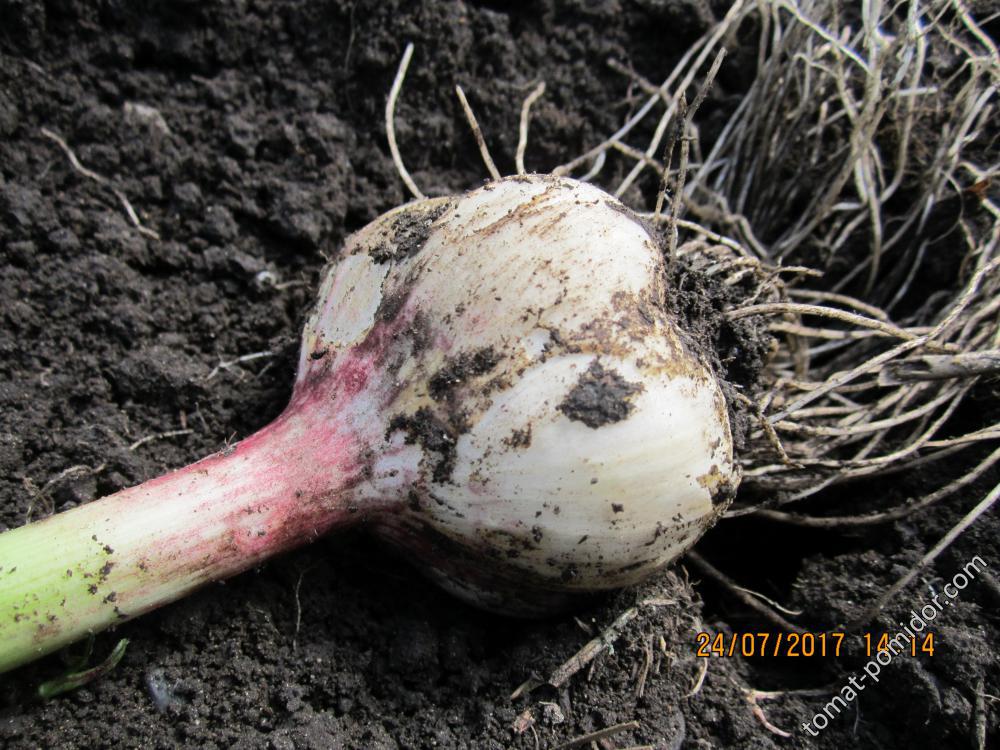
Photo: MADanilych.
Luda, I have a question for you:
What comes to your mind when you need to disinfect/prep the soil right after harvesting garlic and onions? I literally have nowhere else to plant them next year, so they have to go right back into the same bed. ((((
Tatunya wrote:
…they have to go right back into the same bed.
Tanya, I don’t even know what to tell you. I never have this problem because I strictly rotate my beds every year.
If you are growing multiplier (shallot-type) onions, the problem usually isn’t the soil – it’s the onion itself. They accumulate viral and fungal diseases very quickly; after 2 or 3 years of saving your own seed, they are done for. I think the same thing happens with garlic, especially if you bought commercial bulbs instead of local seed garlic.
Here’s a trick to clean your garlic genetics: take a couple of whole garlic bulbs this fall and plant them deep in a loose, rich compost pile. In the spring, when the stalks are about 8 inches (20 cm) tall, dig the whole clump up, separate the individual cloves, trim the roots just a bit, and transplant them into a warm garden bed (plant them shallow, like onion sets).
Aleksan9ra wrote:
They accumulate viral and fungal diseases very quickly…
Mine were just regular onions. I planted them in the fall, and they looked fine this spring. I harvested some early as green onions with a young bulb attached. But then… I think the rains hit, and the bulbs got covered in mold! (((
Everything has dried out now, so I dug them up. The bulbs are tiny. It looks like a massive outbreak (at least 70% of the crop), but now that they are dry I can’t even tell if the mold is still there, or if the sick ones just rotted entirely in the ground. The harvest is pitiful. 🤷♀️
Mind if I chime in here, folks? I just felt the itch to shoot the breeze in someone else’s garden thread!
I know Ludmila is a top-notch gardener, but nobody can know every single detail about everything; that’s just a fact of life! So, let’s look at your problem. You read almost everywhere that you CANNOT plant onions and garlic in the same spot for more than 2 or 3 years – they tell you crop rotation is the law!
But have you ever stopped to think *why* all these agronomists (and the wannabe-agronomists) say that?
The reason is actually quite basic, and not nearly as scary as it sounds: Soil Depletion. Specifically, the depletion of your primary NPK (Nitrogen-Phosphorus-Potassium) elements.
Both onions and garlic have MASSIVE, fibrous root systems. Every single clove of garlic you plant grows its own dense mop of roots, and they “eat” sOOO much of those primary nutrients that you wouldn’t believe it in your wildest dreams! (I’m half-joking here, but you get the point).
===
Let’s talk garlic. It needs loose soil with a neutral pH of 6.5. BUT!!! It only needs NITROGEN right at the beginning, when the first 3 or 4 little green shoots pop up… After that, Nitrogen needs to be cut down to the absolute MINIMUM.
How do you do that?
Us old-timers have two ways:
— Prep that neutral pH soil with a thick layer of well-rotted, rich compost humus.
— After you plant it (or in the spring if it’s overwintering garlic), lay down a good mulch layer at least 1.5 to 2 inches (3-5 cm) thick. That compost and mulch will provide the initial kick of Nitrogen it needs.
(Oh boy, I could ramble about this until morning :)) you don’t even have to feed me! You’re probably thinking: “Here comes this old guy into my thread with his endless chatter…” But I’ll keep going just a bit more).
===
Whatever you do, absolutely DO NOT dig fresh manure into that bed!!! It dumps way too much Nitrogen into the soil. Once the plant is growing, you only want to do light feedings over the mulch using your secondary group (Micronutrients + Phosphorus and Potassium).
And the absolute most critical thing for both onions and garlic: STABLE SOIL MOISTURE. Overwatering is a death sentence for both of these crops.
As for onions, the rules are pretty much the same – -NO AZOTE (Nitrogen) later in the season. Their main diet is PHOSPHORUS and POTASSIUM plus micro-elements. If you dump Nitrogen on them, the tops will dry out fast, and all sorts of nasty little bugs and parasites will move in because you created the perfect cozy environment for them.
===
To sum up my rambling: YES, YOU CAN PLANT THEM IN THE SAME SPOT FOR YEARS without losing your yield.
You just have to meticulously rebuild the soil before you plant, watch your moisture levels, use light feedings, AND… most importantly, fight off the pests (wireworms, onion flies, nematodes, root mites, moths, etc.).
A great old-school trick to disinfect that soil before you turn it over is to drench it heavily with a dark pink solution of Potassium Permanganate. Let it dry out a bit, dig the bed over, and drench it with the pink water one more time. AND… most importantly… dig in a full bucket of rich compost for every square meter!
===
Just scribbling down a bit of my tiny, humble experience for you all, so don’t scold me too hard… This was my two cents for Tatunya! Good luck to everyone!
MADanilich wrote:
Just scribbling down a bit of my tiny, humble experience…
Hello, Andrey! I actually plant my alliums back-to-back in the same spot too, but in the short break between harvests, I sow Lupine as a cover crop. Exactly as you wrote!
galka68 wrote:
…in the short break between harvests, I sow Lupine as a cover crop.
HOWDY, Galinka!
There are so many little details, you just can’t fit everything into one forum comment. But YES – Lupine is a fantastic green manure (cover crop). It doesn’t dump excessive amounts of Nitrogen into the soil, but it fixes *just enough* for what these crops need, while letting you focus on the Phosphorus and Potassium for the main feeding.
Same goes for mulching… throwing down mulch when it’s constantly raining is a terrible idea! It just waterlogs the soil, which leads straight to rot on your garlic and onions, and forces the onions to “cure” prematurely. Everything in moderation.
Of course, a lot of this is out of our hands. You can’t fight Mother Nature!
Good advice never hurt anyone, Andrey. We are all going to be scratching our heads over these exact soil questions the minute we pull our onions and garlic. So your rambling was right on time! Thank you!
LavandaN wrote:
Good advice never hurt anyone…
When you finally have a minute to browse the internet… man, there is a SEA of “advisors” out there! But when you actually sit down and analyze what they’re saying… half of it is just snake oil.
You can’t call it all hogwash, there’s definitely good info out there, but you absolutely have to use your own “filter.”
I just want to toss you folks a few nuggets of practical knowledge from my own dirt. So many people nowadays read something online and just blindly copy it, never stopping to ask: “Wait, does this actually work for my climate and my soil!?” People don’t realize that garden soil gets exhausted, and nobody thinks about how to put back what the plants ate.
Ah well… My friends, EVERYTHING will be alright!!!! Once you get the hang of it, it runs like a well-oiled machine.
👨🔬 Editor’s Botanical Note: Alliums and the Nitrogen Trap
Andrey hits on one of the most destructive mistakes beginner gardeners make with garlic and onions: Over-applying Nitrogen late in the season.
Alliums (the onion and garlic family) need Nitrogen early in their life cycle to build their green leafy tops. But once mid-summer hits and the plant shifts its energy into swelling the bulb underground, Nitrogen becomes its enemy. If you use a high-Nitrogen fertilizer (like fresh manure or blood meal) in the summer, the plant will push out thick, soft, sappy green growth instead of building a tight bulb.
Even worse, this soft, sappy growth acts as a dinner bell for pests like Onion Maggots and Thrips, and the excess Nitrogen makes the final bulbs highly susceptible to fungal rots in storage. If you must reuse the same garden bed year after year, follow Andrey’s advice: amend the soil heavily with finished compost before planting, and rely on cover crops (like Lupine or Clover) rather than synthetic Nitrogen!