In this thread:
Why Graft Vegetables? Disease Resistance and Vigor
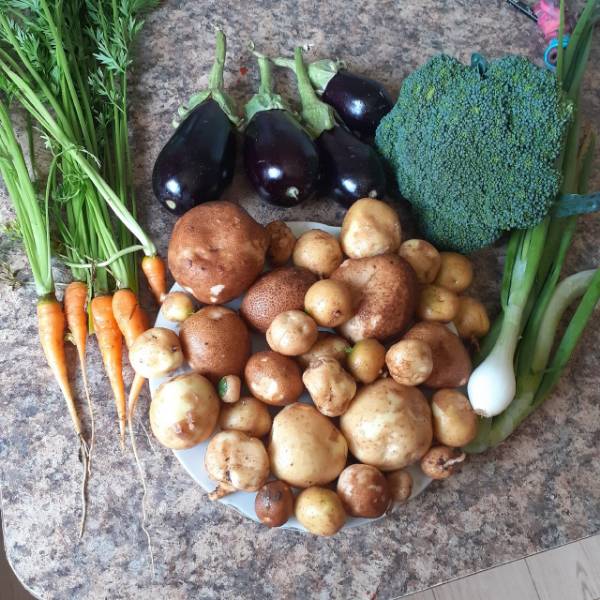
Hey everyone! Honestly, I’ve just been lurking and reading about your vegetable grafting experiments. I just don’t get the point. Eggplants, cucumbers, tomatoes??? Why bother, when even without grafting, I have so much harvest I don’t know what to do with it all.
Grafting melons? I planted 5 bushes in the greenhouse, and my husband and I could barely finish eating them before they started spoiling.
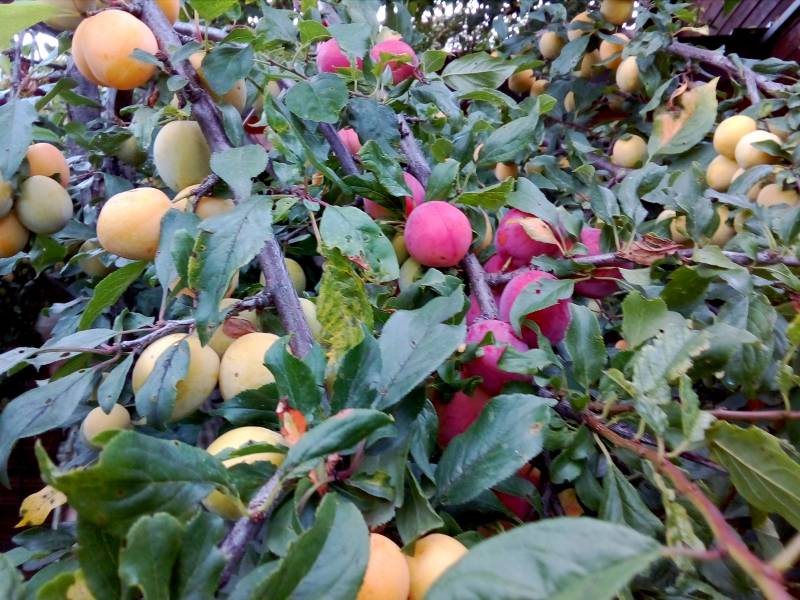
I totally get grafting fruit trees, that makes sense. I have limited space and can’t plant a dozen different varieties, otherwise I’d be drowning in fruit again. So, I have 1 plum tree with 2 other varieties grafted onto it. Two sweet cherry trees, one of which has multiple varieties grafted from my neighbors’ yards. My apple trees are multi-grafted too. Here is what my cherry plum (alycha) looks like:
I grafted eggplants to dodge Verticillium wilt. They still wilted eventually, but not nearly as fast as the ungrafted ones.
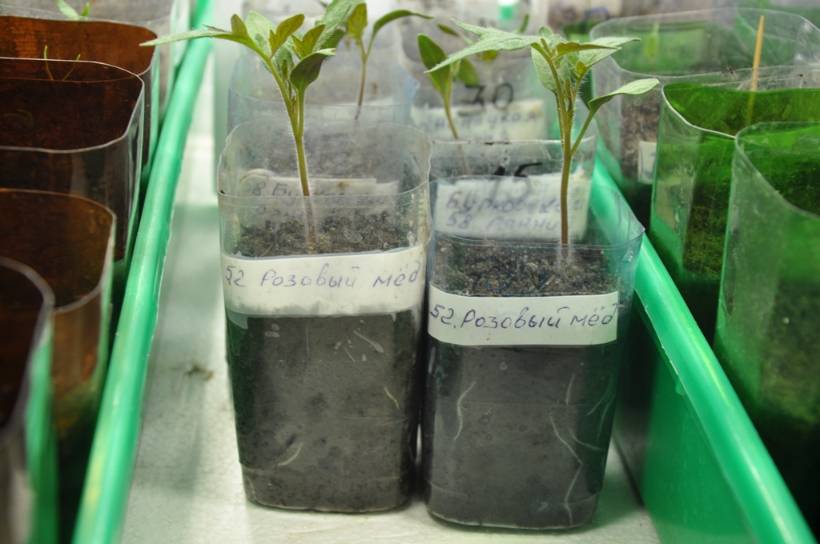
I tried grafting tomatoes to trick Edema, since it runs rampant in my apartment during the seedling stage. It didn’t work—the professional Emperador rootstock caught Edema first. I also hoped that grafting my favorite variety, Vater Rhein, would fix its naturally scrawny, weeping foliage. That actually worked! It turned into an absolute monster of a vine. Unfortunately, I didn’t plant an ungrafted one next to it for comparison. Maybe it would have grown well anyway in this hot summer.
I grafted cucumbers just out of curiosity. I definitely won’t do that again. As you rightly pointed out, there’s always an overabundance of them anyway.
But watermelons and melons on rootstock entirely escape Fusarium wilt and pack on much larger fruits in our cold St. Petersburg weather. Here, I am 100% on board with grafting! I suspect our summers won’t always be as hot and “watermelon-friendly” as this year, and that’s when those grafted roots will really save the day 😉
P.S. That cherry plum tree is awesome!
My grafted eggplants totally dodged Verticillium wilt! I grafted them onto Rugantino F2 and De Barao tomatoes using different methods. The ungrafted ones suffered again. I drenched them with a strong hydrogen peroxide solution, which helped, but the plants were already weakened.
I had an interesting result: I grafted 4 eggplants onto the exact same rootstock (Slivka Bendrika tomato). Two were Clorinda (round shape) and two were Samurai (long shape). The Clorinda was finicky and started wilting, while the Samurai held strong until the bitter end)) The grafted eggplant bushes were way more vigorous in terms of height and foliage, but I didn’t notice any real difference in the actual harvest yield.
You really need to observe these things for more than one season to draw any solid conclusions. But for now… I’m just playing around 😁
Grafted vs. Ungrafted Melons in Cold Climates
I’m from St. Petersburg too. I planted a melon in my greenhouse without grafting. It grew beautifully, flowered heavily, but didn’t set a single fruit. I pinched the vines exactly as recommended, but no luck. I think up here, it just won’t work without grafting.
Galya, my neighbor has been growing melons without grafting for 3 or 4 years now. Our greenhouses are practically right next to each other. She does get melons, but they are tiny, no more than 3.3 lbs (1.5 kg). Granted, this year the weather was so favorable that some of hers reached about 6.6 lbs (3 kg).
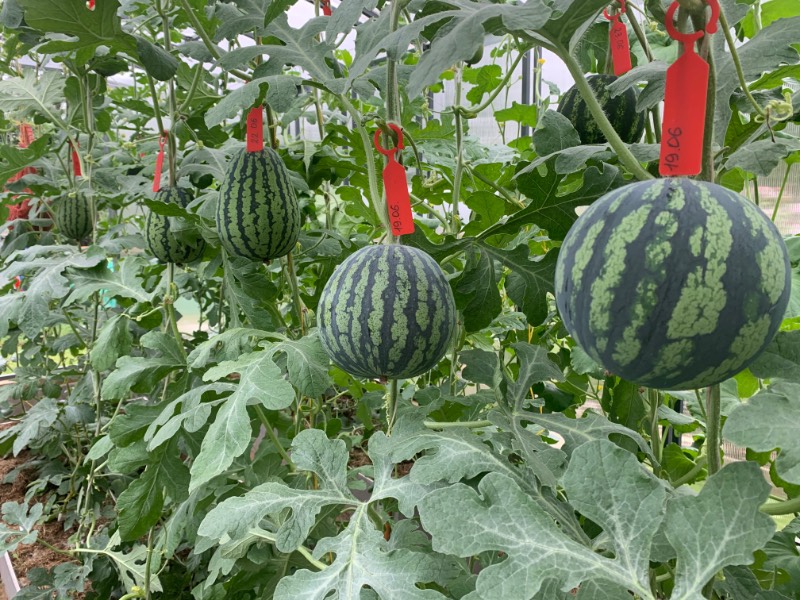
My grafted ones grew to 9-11 lbs (4-5 kg). And my biggest grafted watermelon was nearly 22 lbs (10 kg)!
Oh, I even managed to attach a photo 😊
Supporting Heavy Fruit in the Greenhouse
Tatyana, where exactly are you located? Those watermelons are amazing! 👏 But I don’t understand what they are hanging in.
Girls, sorry for barging into someone else’s journal like this! But Lyuda’s thread is so warm and cozy, I’ve been lurking and reading you all for a long time))
My garden is about 18 miles (30 km) south of St. Petersburg. I’ve been gardening independently for 18 years (I don’t count the forced labor in my mom’s and grandmas’ gardens 😁). I am deeply passionate about roses and, of course, tomatoes! But pretty much everything else grows here too.
My husband hangs the watermelons and melons in vegetable mesh bags. You can save up mesh onion bags over the season, or just buy them online.
Looking back at my photo, the mesh nets aren’t on them yet. That means the watermelons weren’t quite heavy enough to snap off the vine yet. The red tags attached to them mark the exact date the fruit set (not the pollination date).
It’s a good thing you mentioned writing down the date! I need to remember that for summer. Otherwise, it’s impossible to know when to pick a watermelon. One year I let it hang too long and it tasted like grass 🙄
Oh, checking ripeness is still a dark art for me. I read how people can tell just by thumping them or listening to the sound, and I’m amazed. The dried tendril and spoon-leaf tricks have never worked for me either. And the ripening timeline can vary wildly.
The hotter it is, the faster they ripen. This past summer, my icebox varieties (the ones bred to be 4-5 lbs / 2-2.5 kg) managed to hit full sweetness in just 30 days! If an overripe watermelon tastes like grass, that’s weird, usually, overripe ones just turn to mush inside. Maybe yours lacked fertilizer?
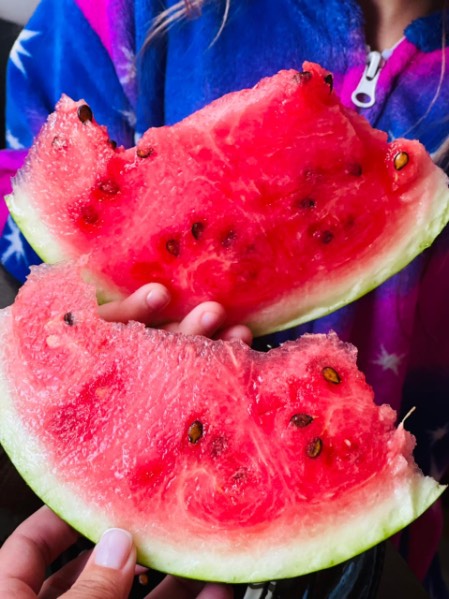
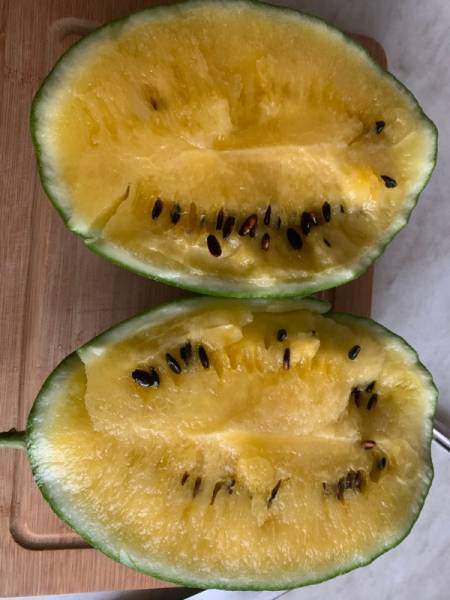
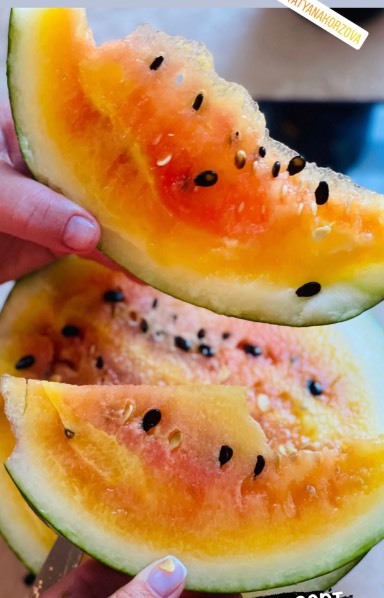
Here are photos of a bicolor variety called Chameleon. Highly recommend it!
Seed Starting Timelines & Lagenaria Rootstock Tips
Could you share a bit about your timeline? When do you sow the seeds, when do you transplant into the greenhouse, and do you use special fertilizers? I want to try growing watermelons for the first time this year.
It’s hard to explain in a few words when I’m still figuring it out myself.
Timelines are tricky here in St. Pete. You can never guess when the soil will finally warm up. Some folks cover their beds with clear plastic to speed up the process, but I haven’t gone that far. Last year, I sowed in early April, and my seedlings got way too leggy and overgrown. This year, I sowed them about 10 days later, and it was perfect–the soil only warmed up to 57-60°F (14-16°C) by the end of May. But I ended up having to do the grafting out at the property, which felt weird, but I couldn’t exactly transport fragile, freshly-grafted plants in the car… Next year, hoping for an early spring, I want to start in early April again.
Generally, if you move plants into your greenhouse around the same time every year, you should start the melon process about 25-30 days before your planned transplant date.
You sow the scion (watermelon/melon seeds) first, and then about 5-7 days later, you sow the rootstock. BUT! That only applies if you are using professional rootstock seeds or your own saved Lagenaria or Ficifolia seeds, because those sprout quickly and evenly. If you are using cheap store-bought Lagenaria seeds, they take forever to sprout and you really have to jump through hoops to get them going. In that case, you have to sow the rootstock earlier than the watermelon.
I gave up on using Lagenaria because of its terrible germination rates.
Galya, it does sprout! Almost at 100%! Out of 5 packs, I only had 2 or 3 seeds fail.
But you really have to baby them: soak the Lagenaria seeds in hot water, then keep them on a warm radiator for 24 hours before burying them in the soil. They will sprout, but very unevenly. That unpredictable behavior drove me crazy, which is why I tried growing my own Lagenaria gourd this year to harvest fresh seeds. I haven’t cracked it open yet, so I don’t know what’s inside.
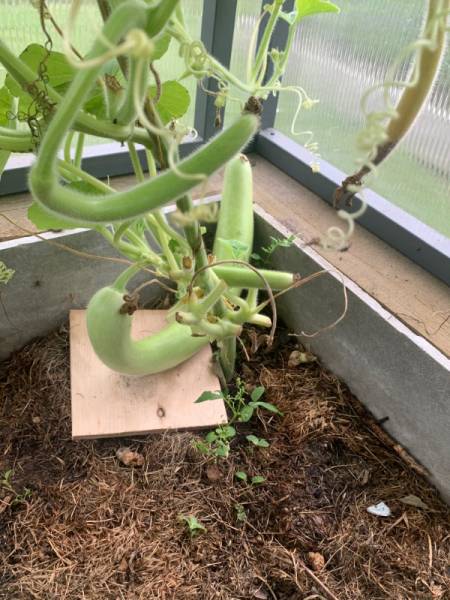
Greenhouse Spacing and Yield Expectations
Tanya, could you write down your watermelon greenhouse spacing? How many roots do you plant per bed?
Katya, the principle is almost identical to spacing tomatoes 😁 I just plant them “by eye” now.
In my 26-foot (8 m) greenhouse, I grew 30 watermelons on the center bed. The bed is about 2.8 ft (0.85 m) wide and 22 ft (6.7-6.8 m) long. On the side beds, I can fit 16-17 vines, but those beds are very narrow, only about 21 inches (52-54 cm) wide, with 18-inch (45 cm) walking paths.
You can plant watermelons closer together if you don’t plan on keeping a second vine. I couldn’t get a second leader to work on the giant varieties anyway. It works for the small icebox types, but not the big ones.
Look at this photo from August 20. The spent vines have already been removed, so it looks almost spacious. You can see the melons peeking through the watermelons))
On the left side bed, I am growing peppers. Next year I’m evicting them to the tomato greenhouse. I’m cutting back on tomatoes 🙈
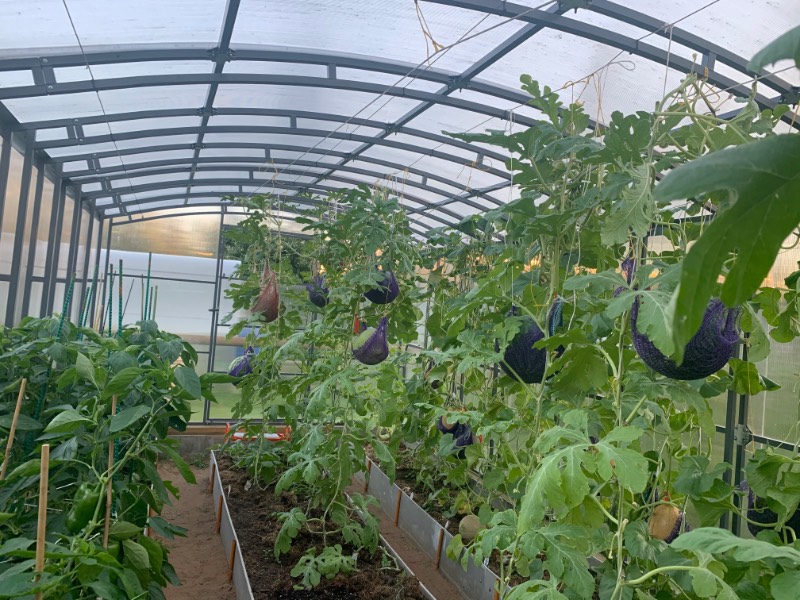
That is quite the scale! How many watermelons do you get per plant on average?
ONE! Exactly one.
If you want to grow a single watermelon weighing 22+ lbs (10+ kg), you must prune the plant to a single vine. It’s exactly like tomatoes. If you want giant beefsteaks, you prune to 1 or 2 leaders. If you don’t prune suckers, you’ll get the same overall weight, but it’ll be a bunch of tiny fruits (assuming the genetics are actually for a large variety).
There are also icebox varieties (like cherry tomatoes in the tomato world). Those you can immediately prune to 2 or 3 leaders. You’ll get multiple watermelons weighing 2 to 4 lbs (1-2 kg) each.
There’s another factor. If you have a long, hot summer, you can let watermelons sprawl on the ground outside, and they will self-regulate. You get what you get. But up here in the North, we prefer a guaranteed result. Therefore, we grow greenhouse watermelons on a single vertical vine. The vine will naturally abort the second fruit anyway…
You can let a second vine grow after you harvest the first massive watermelon. But personally, I’ve only ever had time for a second fruit to ripen twice in my life. More experienced melon growers manage it more often though.
Sorry for rambling, hope that made sense! 😵
👨🌾 Editor’s Notes
- Mesh Hammocks: When growing watermelons vertically on a trellis in a greenhouse, the vines cannot support the weight of the fruit. Growers use nylon mesh bags, old pantyhose, or specialized melon nets tied to the heavy overhead greenhouse rafters to cradle the fruit as it grows.
- Lagenaria Rootstock: The Bottle Gourd (Lagenaria siceraria) is the most common rootstock used for grafting watermelons in cold climates. Its massive root system is highly resistant to Fusarium wilt and continues pulling nutrients even when soil temperatures drop well below what a natural watermelon root system can tolerate.
- The One-Melon Rule: In short-season Northern climates (USDA Zones 3-4), a greenhouse watermelon plant only has enough solar energy and time to ripen a single large fruit. Growers ruthlessly prune all side vines (suckers) and pinch off any subsequent flowers once the primary fruit is set, forcing 100% of the plant’s energy into sizing up and sweetening that one melon before autumn frosts arrive.