📌 Quick Summary: Yellowing Spring Garlic
- 🧄 The Permanent Yellow: Once the lower leaves of a garlic plant turn yellow, they will never turn green again. If you applied fertilizer, look at the new growth coming from the center. If the new leaves are green, the fertilizer worked!
- 🥶 The Cold Factor: Garlic that sprouts very early (pushing through the snow) is often subjected to freezing spring nights. Cold soil locks up Nitrogen, causing the lower leaves to yellow regardless of how much fertilizer you apply.
- 🧬 Varietal Differences: Different garlic varieties react to Nitrogen deficiency differently. Some varieties will instantly yellow, while others in the exact same bed will stay perfectly green.
- 🥬 Bonus Cabbage Prep: When transplanting cabbage, dig a hole a full spade deep. Put aged chicken manure (deep litter), a pinch of wood ash, and a tablespoon of balanced fertilizer at the bottom. Mix it with the soil, plant the cabbage, and water heavily.
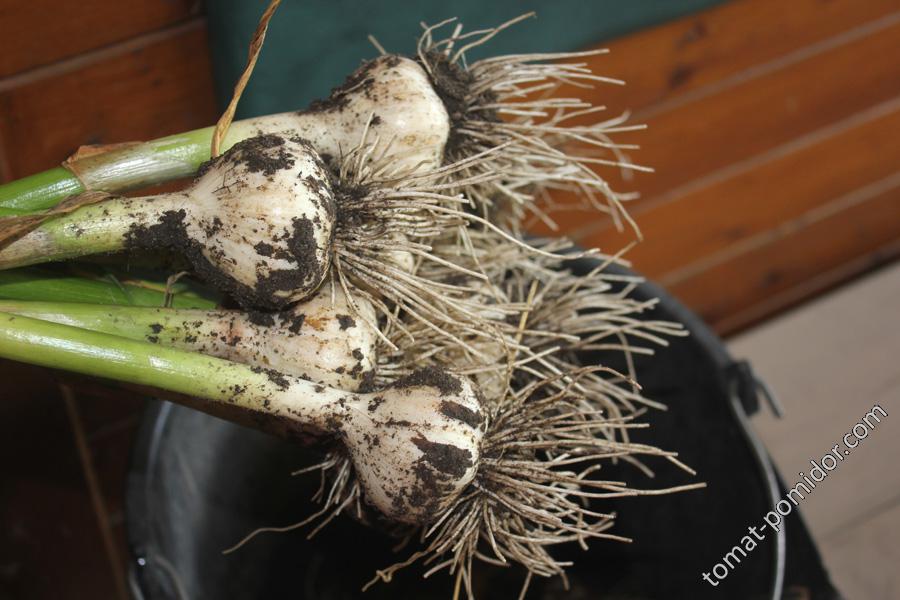
Photo author: Russi
Ludmila, hello! Could you please give me some advice?I fed my garlic with Nitrogen fertilizer (Ammonium Nitrate) about 2 weeks ago. I dissolved 1 tablespoon in 2.6 gallons (10L) of water. (I probably did it wrong by pouring it directly at the roots, I remember you wrote that it should go into trenches between the rows).
Anyway, the garlic still has yellow leaves! Do I need to feed it again right now, and if so, with what?
Also, when you are planting cabbage seedlings, what kind of fertilizer do you put into the planting holes? Thank you in advance to everyone who replies!
YANGUN (Irina) wrote:
…the garlic still has yellow leaves!
I’ll answer for Ludmila: the leaves that are already yellow will stay yellow forever. You need to look at the new leaves growing from the center—after a successful feeding, the new growth will come in green!
YANGUN (Irina) wrote:
Do I need to feed it again right now, and if so, with what? Also, when you are planting cabbage seedlings, what kind of fertilizer do you put into the planting holes?
Irina! Here is what I’ve noticed about garlic.
My neighbor plants a very large, powerful, late-maturing garlic variety. I grow a medium-sized, early-maturing variety. In the early spring, the moment the snow melted, my neighbor’s garlic was already 3-4 inches (8-10 cm) above the ground. My garlic wasn’t even visible yet.
Fast forward to today: our garlic plants are now the exact same height. But her bottom leaves are completely yellow, and mine are perfectly green!
I only fed mine once with Ammonium Nitrate, I just sprinkled a little bit around the plants right before it rained. She probably fed hers too, but the results are drastically different. I don’t know exactly what causes this difference, but I suspect it’s the timing of the sprouting and the cold temperatures.
I don’t think you should feed yours again right now, wait for the weather to actually warm up. When it gets warm, it is great to water the roots with a compost tea (like steeped chicken manure) and spray the leaves with a mix of Urea and Magnesium Sulfate.
As for the cabbage:
When planting, I put loose, fully rotted deep litter from the chicken coop, a pinch of wood ash, and a spoonful of balanced granular fertilizer into each hole. I dig the hole a full spade deep, mix everything thoroughly at the bottom (so the manure stays deep), plant the cabbage seedling, and only water it after it is planted.
Aleksan9ra (Ludmila) wrote:
…her bottom leaves are completely yellow, and mine are perfectly green!
Luda, good afternoon! I plant several different varieties of garlic in my garden. I’ve noticed that different varieties react to Nitrogen deficiency completely differently! Under the exact same conditions, some will immediately turn their leaves yellow, while others won’t yellow at all.
Hrizantema57 (Ludmila) wrote:
I’ve noticed that different varieties react to Nitrogen deficiency completely differently!
It also depends heavily on how early they sprouted! The ones that sprout later stay green much longer. I have different varieties growing in the exact same bed (just in different rows), meaning they all got the exact same fertilizer, but the ones that sprouted early through the cold ground are yellow, while the late ones are green.
👨🔬 Editor’s Botanical Note: The Cold Soil Nitrogen Lockout
If you plant overwintering hardneck garlic (planted in the fall for a summer harvest), yellowing lower leaves in early spring is incredibly common. Tanya and Ludmila have correctly identified the main culprit: Cold Soil.
Garlic needs high amounts of Nitrogen in the spring to fuel its vegetative growth before it begins forming a bulb. However, roots cannot absorb Nitrogen effectively when the soil temperatures are near freezing! If your garlic sprouts very early and gets hit by cold spring nights, the plant will pull Nitrogen out of its lowest, oldest leaves to feed the new growth at the top, turning the bottom leaves yellow.
The Fix: Applying granular fertilizer to freezing soil won’t help, because the roots still can’t absorb it. You must wait for the soil to warm up. If the plant is severely struggling, a foliar spray (spraying liquid fertilizer directly onto the leaves) is the fastest way to bypass the cold roots and deliver nutrients straight into the plant tissue!