“Azorean Canopy” – To Laugh or To Cry: The Translation of Foreign Tomato Names
Editor’s Note: In the early 2010s, as foreign heirloom tomatoes flooded the Russian market, local seed sellers heavily relied on crude automated translation (like early Google Translate). This resulted in absolutely hilarious, botched Russian names for classic American and European varieties. In this legendary 2013 forum thread, Russian growers formed a task force to decipher what these tomatoes were actually supposed to be called.
In the original language, the variety I used for the title of this thread is written as: Neves Azorean Red. It should be translated roughly as Azorean Red of Neves. Seeds from a tomato bought in the Azores were brought to America by a certain Anthony Neves, who created this variety through selection.
However, simple seed sellers blindly write whatever Google Translator gives them. As a result, Neves [which sounds like the Russian word for “Canopy” / “Awning”] was translated as “Azorean Canopy.” These translated names are such gems that you don’t know whether to laugh or cry, and they rarely provide the original English name on the seed packet.
Take, for example, the variety that recently appeared here called “Brandy Wine” [translated literally into Russian as Vino Brendi – “Wine made of Brandy”]. It is clearly an illiterate translation of the American variety Brandywine. Illiterate because, firstly, an educated person would never call brandy a wine, and secondly, because the variety is named after Brandywine Creek and the town of the same name, and you cannot chop up and translate parts of a proper noun!
Or the variety Българска хала (Bulgarska Hala). It translates from Bulgarian as “Bulgarian Dragon” or “Serpent.” But sellers just transcribe it blindly.
I am a proponent of writing the variety name using transliteration (reproducing its pronunciation with Russian letters) and providing its original language name in parentheses. For example: Pyorpl Rashen (Purple Russian).
Alas, this won’t work in all cases; illiterate names have spread too widely, and most gardeners simply do not want to break their tongues over incomprehensible foreign words. But let’s try to at least correctly translate the names where homegrown translators clearly messed up. In this thread, I want to present our translation options for certain tomato varieties—the fruit of the joint efforts of an amateur tomato grower and a professional translator.
Let’s start with the “Azorean Canopy” and move on to the catalog of Valentina Redko…
1. Original Russian Seller Name: Навес Азорского (Azorean Canopy)
Actual Name: Neves Azorean Red
Recommended Russian Name: Azorean Red of Neves.
3. Original Name: Couilles De Taureau (France/USA)
Notes: Pronounced “Cooy de Toro”. Sounds unpleasing to the Russian ear.
Recommended Russian Name: Kuys de Toro [Instead of translating it literally to “Bull’s Balls”].
6. Original Name: Magnum Beefsteak
Notes: Magnum – a large bottle, a powerful cartridge, something great (e.g., magnum opus). Beefsteak – beefsteak.
Recommended Russian Name: Magnum Beefsteak.
7. Original Name: Mule Team
Notes: Sold here as “Mule’s Team” (Команда Муле) as if Mule was a person’s name.
Recommended Russian Name: Myul Tim (Mule Team).
8. Original Name: Dinner Plate
Notes: Dinner = formal dinner / holiday meal. A direct translation to Russian would be too clunky (“A plate for a holiday meal”).
Recommended Russian Name: Dinner Plate (Transliterated).
My translation seed packet said – Neves of the Azoreans Red.
Here are the next 10 items:
11. Original Seller Name: Фатер Рейн (Water rain)
Notes: In German, “Father Rhine” is written as Vater Rhein. The seller somehow reverse-engineered this into English as “Water rain”, which is meaningless.
Recommended Russian Name: Prolivnoy Dozhd (Pouring Rain) or just Vater Rhein.
12. Original Seller Name: Чесновы томат (Garlic tomato)
Notes: Actually Reisetomate (Traveler’s tomato). It was introduced to Russia via a Bulgarian collector who called it “Garlic tomato” because you can pull it apart into cloves like garlic. Also known as Pocketbook, Purse, Voyage.
Recommended Russian Name: Garlic tomato (Traveler’s tomato) (Reisetomate).
13. Original Name: Azoychka
Notes: This variety has been known here for a long time and is traditionally called Azochka, from the female Russian name Aza (Azochka is the diminutive/affectionate form).
Recommended Russian Name: Azochka (Azoychka).
While we haven’t moved far from Aunt Ginny’s Purple, I want to quote my correspondence with Tatiana Kouchnareva (Tatiana’s TOMATObase) regarding the English word PURPLE in tomato names.
Alexander: What is Cherokee Purple like in taste and color? The word “Purple” confused me. Purple Russian turned out to be from the category of what we call “black” tomatoes, while Eva Purple Ball is simply pink.
Tatiana K.: Alexander, Cherokee Purple is a typical black tomato. Eva Purple Ball is indeed pink – because in America at that time, some pink varieties were called ‘purple’. They don’t do that anymore. Now, ‘purple’ (or ‘purple/black’) is used for black tomatoes where the outermost layer of skin is clear/transparent. If this skin layer is yellowish on a dark tomato, then it is called ‘Brown/black’ or ‘chocolate/black’ here.
So, formally Aunt Ginny’s Purple translates as “Purple of Aunt Ginny”, but factually it will be pink, or rather, a pink closer to raspberry. The description says: “oblate fruits of deep pink color, Brandywine type.”
From the Aunt Ginny’s Purple Tomato seed packet:
Fruits ripen to a deep red-pink, sometimes tinged with green.
So, dark red-pink with green tints?
Marisha asked me if I knew whether Chyorny Velikan (Black Giant) and Chyorny Gigant (Black Giant) are the same variety or different.
I went on the Internet. It turns out, the variety “Chyorny Velikan” is only found from Mr. Fech, and he lists the “original” English name: Black Giant. I searched for this and found it on Tatiana’s TOMATObase.
And there it says that the variety is Russian and in Russian it is called Chyorny Gigant!
This is how, through reverse translation from English, clones of an already existing Russian variety are created! (Though in reality, it could be something else entirely).
37. Original Name: Casady’s Folly
Notes: Folly translates to madness, a whim, an expensive caprice.
Recommended Russian Name: Prichuda Kesidi (Casady’s Whim).
38. Original Seller Name: Конфеты вирджинии (Virginia’s Candies)
Notes: The original name was most likely Virginia Sweets.
Recommended Russian Name: Virginia Sweets (Translated properly).
46. Original Name: Lime Green Salad
Notes: Tatiana Kouchnareva reports that the variety was bred by Tom Wagner, who named it Green Elf. But it was introduced by Tim Peters. Tim Peters didn’t realize Tom had already named it, and gave it the name “Lime Green Salad”.
Sasha, a couple of years ago a forum member gifted me the variety “Big White Stripes” (Большие белые полосы). I understand that the correct translation of Big White Pink Stripe should be “Large White-Pink Striped”, but I’ve already sent it out to so many people under the initial botched name… our people are already used to it, it’s a pity to change it.
I usually keep the name under which I received the seeds, even if I don’t like it.
Aleksander wrote:
37. Original Name: Casady’s Folly
Recommended Russian Name: Prichuda Kesidi (Casady’s Whim)
I have this variety from Popenko under the translated name “Casady’s Madness” (Безумие Касади). And I’m already used to it 😲 Does the word “madness” fit the translation? If so, I will continue to call it Casady’s Madness.
Sasha, could you please advise what we can call this Italian variety in everyday conversation? I liked it a lot and shared seeds, but you just can’t pronounce it normally: Costoluto fiorentino sel. canestrino di Lucca?
Esme wrote:
…you just can’t pronounce it normally: Costoluto fiorentino sel. canestrino di Lucca?
Galya, Elena (who is from Italy) explained to us that they selected the Costoluto fiorentino variety from the Canestrino di Lucca variety. Why do we need the history of its origin in the everyday name? Let’s just call it Costoluto fiorentino for conversation, or Ribbed Florentine.
My daughter and I call all the ribbed tomatoes she brought from Italy and Switzerland “costolutos” (костолютные), but that’s obviously just in household slang.
The dictionaries say: from Italian, costola means: rib, sirloin part, spine.
Sasha, I wouldn’t say it’s ribbed at all, it looks more like a large pear:
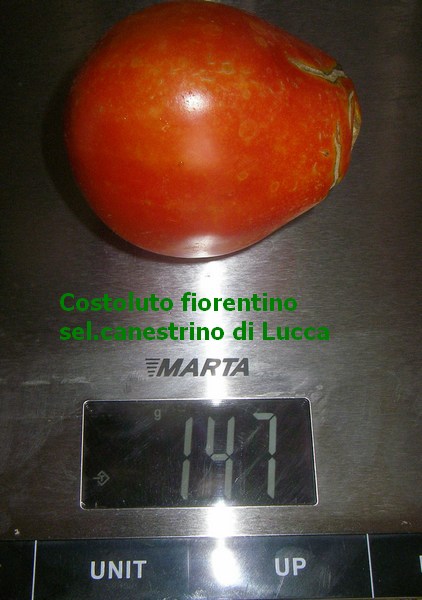
If I understood correctly, Lucca is a region. Maybe then we should call it – “Meaty from Lucca”? (Мясистый из Лукки)
Absolutely correct, Lucca is a city in Italy, and the region around it. “Meaty from Lucca” works perfectly!