📌 Quick Summary (TL;DR): Pruning Melons for Short Seasons
- ✂️ Open Ground (Heirlooms): Most heirloom melons produce male flowers on the main stem and female flowers (the ones that make fruit) on tertiary vines. To force early fruiting in cooler climates, you must pinch the vines:
- Pinch the main stem after the 3rd or 5th true leaf.
- Let secondary vines grow. Keep the 2 strongest ones and pinch their tips after they grow 5 leaves.
- Tertiary vines will now emerge—do not pinch these yet! This is where your female flowers and fruits will form.
- 🛑 After Fruit Set: Once the melons are growing and sizing up, pinch the vine exactly 5 leaves past the last fruit to focus all the plant’s energy on ripening rather than growing more leaves.
- 🏡 Greenhouse (Hybrids): Many modern F1 hybrid melons are bred specifically for greenhouse growing and will actually set fruit on the main primary stem. These are usually pruned to a single leader (main stem) to save space.
- ☀️ Climate Differences: Southern growers with long, hot summers don’t need to prune their melons at all. Short-season growers *must* prune to force the plant to fruit before the frost arrives!
How to Pinch and Prune Melons in Open Ground (Zones 3 & 4)
Good day everyone! Lyuda, I have a question about pruning/training melons outdoors in open ground. After you pinch off the growing tips of the secondary vines, do you just stop? Or do you continue to prune them later on so the plant doesn’t waste all its energy on pure foliage?
Irina, first we pinch the main stem. If you want to push them earlier, pinch above the 3rd true leaf. If you wait a bit longer to have a better selection of secondary vines, pinch above the 5th leaf.
Secondary vines will immediately start pushing out. We keep the two strongest ones. As soon as those two form 5 leaves, we pinch their top growing tips off, and that’s it. Tertiary vines will now start growing from them. There might be two or three of these. We do NOT pinch these. This is exactly where the female flowers will appear and the melons will set.
Once the melons have set and gotten relatively large, you can start removing small, useless weak shoots. You can also “top” the fruiting vine by leaving a specific number of fruits on it, counting exactly 5 leaves after the last fruit, and pinching the rest of the vine off. Also, any vines that try to escape the boundaries of your garden bed should be constantly pinched back by snapping off their growing tips.
Aleksan9ra wrote:
In greenhouses, it’s standard practice to train them to just a single main stem. It’s not entirely clear why?
Maybe because they are mostly growing F1 hybrids in greenhouses? Those hybrids are bred to produce fruit directly on the main stem.
Yes, that’s probably exactly it. If you look at how they grow melons down in the hot South, they don’t pinch or prune anything at all—there’s no need. They have plenty of heat, sunlight, and a long enough season for everything to ripen naturally. But up here in the North, we have to step in and force the plant to do it faster.
I want to run a test this year: I’ll pinch some after the 3rd leaf, some after the 5th, and leave some pruned to a single main stem. Then I’ll draw my own conclusions. Like they say, nothing beats trial and error in your own garden! 😁
Lyuda, I’m planning to plant a melon outdoors in open ground this year. I watched some videos of people growing them in greenhouses, saw the absolute jungles they turn into, and completely lost the desire to do it indoors. But outdoors, they absolutely need to be kept under a cover, right?
Growing Melons in a Greenhouse: Spacing, Yields, and Trellis Netting
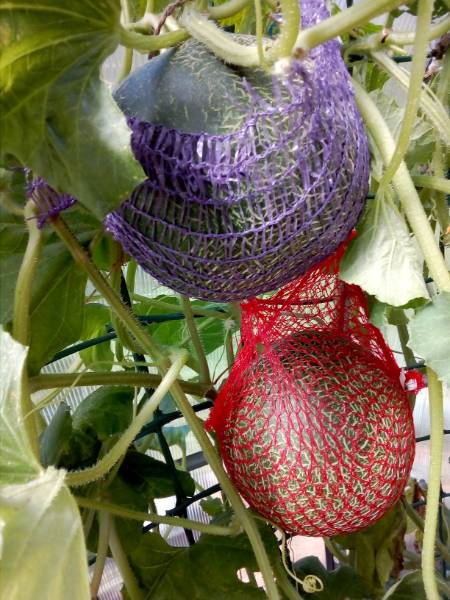
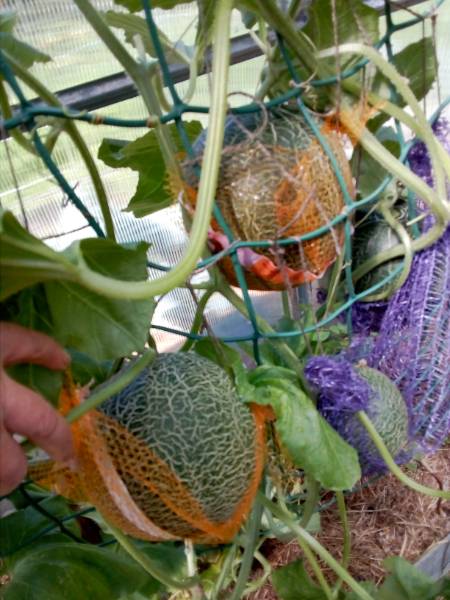
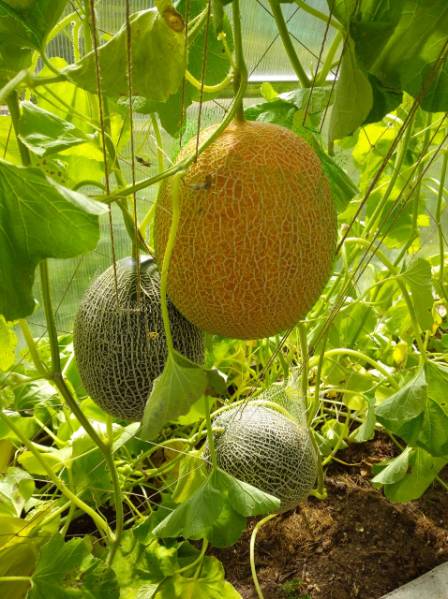
I really loved growing melons in the greenhouse last year. I planted Manuela and Aikido. I practically didn’t prune them at all, just spaced them about a meter (3 ft) apart. I got 6 melons off Manuela and 4 off Aikido. They all ripened at basically the exact same time, averaging about 1.5 kg (3.3 lbs) each. We absolutely gorged ourselves on melons! The only downside was that they all ripened at once and started to spoil, so next time I need to stagger varieties with different maturity dates.
This year I want to cut back on tomatoes even more (all those jars of canned tomatoes just sit there, nobody eats them) and dedicate one entire side of the greenhouse exclusively to melons. I bought Agnes, Dalmatin, Kamar, Miron, and Radmila seeds. Here are last year’s melons:
gala7496 wrote:
But outdoors, they absolutely need to be kept under a cover, right?
Galya, planting just one is risky, you never know what might happen. You can plant two in one hole and then train the vines in opposite directions. It’s best to plant them on raised mounds. Bottomless containers or grow bags (like in the videos above) work great. But it is crucial that when you plant in those containers, you put an insulating layer underneath to separate the warm potting soil from the freezing ground below. Once the weather warms up and the ground thaws (after 10-12 days), you pull that insulation out.
You should immediately set up hoops and cover them with spunbond (agrifabric), and then throw a sheet of clear plastic over that. You can’t use just plastic—it will cause condensation, and melons need dry air. And to prevent them from frying in the sun, the plastic should only go over the top like a roof, while the ends of the low tunnel should just be breathable spunbond.
Russi wrote:
I bought Agnes, Dalmatin, Kamar, Miron, and Radmila seeds. Here are last year’s melons…
Anya, your melons look fantastic, I’m so jealous. Do you have a wide shot of the whole melon bed?
I pre-sprouted my melon seeds in warm sawdust (actually, wood pellet cat litter) on April 13th. I really love this method—you don’t have to worry about them getting overgrown or breaking the roots when transplanting. I moved them to the greenhouse on May 5th under cloches (cut plastic bottles). They were on the west side of the greenhouse. I hand-pollinated everything, and constantly mulched them with fresh grass clippings, just like cucumbers.
By the way, I absolutely loved growing them vertically on a plastic trellis net. I splurged and bought it once, but it lasts forever, I don’t even take it down for the winter.
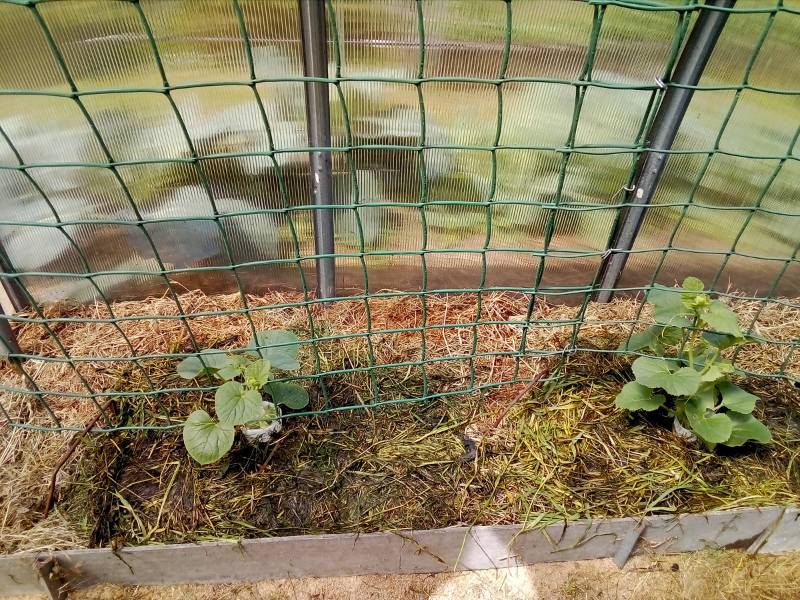
No, I don’t have a wide shot of the bed… it’s impossible to take a panoramic photo in there because the middle bed is full of tall indeterminate tomatoes, there’s nowhere to step back!
How to Tell When a Melon is Ripe (The “Full Slip” Method)
Russi wrote:
I planted Manuela and Aikido.
Anya, how did Manuela taste? I grew Aikido last year and really liked it. I left the first one on the vine too long though, I just didn’t know when to pick it.

Katya, telling if a melon is ripe is super simple. If you try to pull the stem off an unripe melon, you practically won’t be able to. But a fully ripe melon will reach “full slip”—you just touch it, and it detaches from the vine right into your hands. Plus, you’ll be able to smell the sweet melon aroma from across the yard.
Aleksan9ra wrote:
…a fully ripe melon will reach “full slip”—you just touch it, and it detaches from the vine right into your hands.
Lyuda, I actually asked you about this last year, I remember your advice, thank you! The thing was, they smelled incredibly strong even when they were still green! That’s why I kept doubting myself. But it was absolutely delicious, the juice was literally running down our hands 😋. Our friends from Tashkent, Uzbekistan (a region famous for growing the world’s sweetest melons) were completely blown away when they tasted it!