📌 Quick Summary (TL;DR): Purple & Yellow Garlic Leaves
- 🍄 The Worst Case (Fusarium Rot): If your garlic leaves are yellowing and drying out, pull one plant up. If the basal plate (bottom of the bulb) is soft, pinkish, or covered in white mold, and the roots are rotting off, your garlic has Fusarium root rot. The soil must be treated with a strong fungicide.
- 🟣 The Good News (Phosphorus Deficiency): If the tips of the leaves turn a distinct purple or reddish color, this is almost always a Phosphorus deficiency.
- 🥶 The Cold Soil Factor: Garlic often shows purple tips in late May because spring cold snaps drastically lower the soil temperature. In cold soil, garlic roots physically cannot absorb Phosphorus.
- 💊 The Quick Fix: Do not add more Nitrogen! Instead, spray the foliage with MKP (Monopotassium Phosphate). A foliar spray bypasses the cold roots and delivers Phosphorus and Potassium directly into the leaves.
Luda, could you please help me figure out what is wrong with my garlic?
The tips of the leaves have turned a reddish-purple color. The rest of the leaves are turning yellow and drying out. What could this be? I fed them with Ammonium Nitrate (pure Nitrogen) about 3 weeks ago, and haven’t given them anything else since. 🧄🥀
Irina, it’s hard to say for sure without seeing it, but it sounds very much like Fusarium. This is a severe root rot.
If it is Fusarium, you won’t be able to save the sick plants. You’ll have to treat the remaining healthy plants AND the soil with fungicides. People say Quadris (Azoxystrobin) gives a good effect. You can also drench the soil with Maxim or a copper-based fungicide.
But first, you need to establish an accurate diagnosis! Try digging up the most severely affected plant and look at the roots. The bulb might feel soft or have a pinkish/yellowish fungal coating on the bottom. It would be great if you could post a photo! 📸
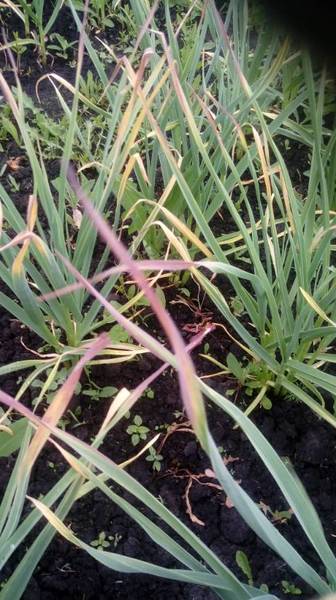
Here is a photo of the garlic in the bed:
Luda, this is my “family heirloom” garlic variety, and it’s the only one in the garden that got sick!
Asdva (Irina) wrote:
…this is my “family heirloom” garlic variety, and it’s the only one that got sick!
There is nothing strange about that. Over the years, family garlic varieties accumulate viral and fungal diseases, just like multiplier onions do.
Honestly, looking at the photo, I don’t even know what to say. But I think the right move would be to treat it for both diseases and pests just in case. Loosen the soil between the rows, and drench the soil deeply with whatever fungicide you have (make sure the soil is already damp before you pour fungicide on it).
Then, snip off all the yellow tips, and in a few days, feed it with Urea (Nitrogen). It won’t make things worse, but keep in mind you can’t eat the green tops after applying chemicals!
This experience just shows that planting whole garlic bulbs or saving the same cloves year after year is risky. You need to carefully inspect cloves before planting and treat them with fungicide in the fall.
Aleksan9ra (Ludmila) wrote:
Over the years, family garlic varieties accumulate viral and fungal diseases…
Luda, I honestly can never understand this whole “accumulating diseases over the years” theory.
I grow a garlic variety I got from my son-in-law’s late grandmother. It has been growing in my garden for 14-15 years. Before that, it grew in her garden for decades (and I know for a fact she never renewed the genetics by planting bulbils/seeds). I plant it from cloves year after year. It grows perfectly with zero extra effort, and no diseases at all! 🧄
The same goes for our potatoes. We’ve been planting the same domestic potatoes since some builders gave them to us back in 2010. 🥔
Anya, I used to collect and plant different potato varieties—up to 40 varieties at once! I kept buying new ones, thinking I would find the ultimate heavy-yielding and best-tasting varieties. Eventually, I came to the conclusion that collecting hybrid potatoes makes no sense.
Garlic is a very interesting story too. All our lives we grew our own family garlic. They were small, round cloves with very thin skin. But over the last few years, we started planting a few bulbs of “new” commercial varieties every fall. As a result, we practically lost our old family heirloom garlic entirely, and the new commercial varieties completely failed to adapt to our soil!
Only this year did I finally manage to plant three rows of a new variety, which I painstakingly propagated from just 2 bulbs I bought from a sweet old lady at the market. 🧑🌾
While Fusarium root rot is a major threat, looking at the photo provided, this garlic is not dying from rot. The reddish-purple tips combined with yellowing lower leaves in late May is a textbook symptom of two interconnected problems:
1. Phosphorus Deficiency (The Purple Color):
A distinct purple or anthocyanin tint on garlic leaves is a glaring red flag that the plant is starved of Phosphorus. But why? Because of the weather! Late May often brings cold snaps. When soil temperatures drop below 50°F (10°C), garlic roots practically stop absorbing Phosphorus, even if there is plenty of it in the soil.
2. Nitrogen Imbalance (The Yellow Tips):
The grower applied pure Nitrogen (Ammonium Nitrate) 3 weeks prior. The garlic absorbed the Nitrogen and started growing vigorously, but the lack of Phosphorus and Potassium caused a severe nutritional imbalance, leading to “tip burn” (drying, yellowing tips).
The Quick Fix:
Do not apply more Nitrogen! The fastest way to fix this is a foliar spray using MKP (Monopotassium Phosphate). Mix 1/2 oz (10-15 grams) per 2.5 gallons (10 L) of water. Spray the leaves directly. This bypasses the cold soil and delivers Phosphorus (to cure the purple) and Potassium (to stop the yellowing) straight into the plant tissue.