📌 Quick Summary (TL;DR): Seedling Leaf Removal & Watering Issues
- 💧 Misdiagnosing Deficiencies: Yellowing between leaf veins and drying green edges in young seedlings is often misdiagnosed as magnesium deficiency or edema. In reality, it is usually just severe underwatering! Good starter soil rarely runs out of nutrients in the first few weeks.
- 🌱 Cotyledons as Indicators: Some growers leave the seed leaves (cotyledons) on the plant because they act as a “water meter.” If they are firm, the plant is hydrated. If they go limp but the soil is wet, it warns of root rot (damping off).
- ✂️ Pruning to Stunt Growth: If seedlings are growing too tall too fast indoors, some growers intentionally snip off the cotyledons and lower true leaves. This temporarily stunts upward growth and forces the plant to thicken its main stem.
I just potted up my test Rozovyi Myod (Pink Honey) seedling — 1 plant, 20 days old.
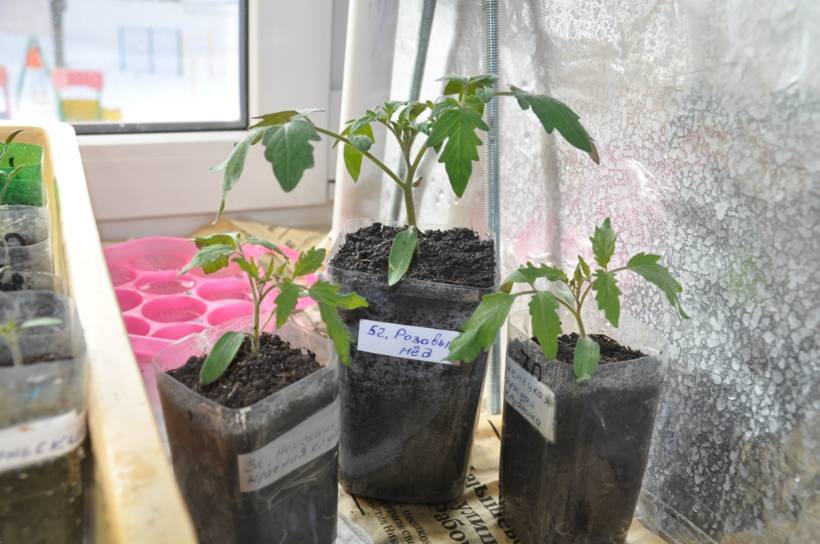
My second test Pink Honey died a stupid death… First, it showed signs of a magnesium deficiency, then maybe edema, and when the edges of the leaves started drying out while still green, I got scared and threw it away. When I dumped it out, the soil was bone dry. It simply dried up… Well, now I have this experience, even though I’ve been planting for years and this has never happened to me. It showed a magnesium deficiency strictly due to a lack of moisture… Which completely misled me into thinking it was a disease.
Valery, good morning! Honestly, I don’t believe in nutrient deficiencies during the seedling stage. If we do everything more or less correctly with the soil, where would a deficiency even come from?
Otherwise, your tomato looks great. Personally, I would have snipped off the cotyledons (seed leaves) by now.
Aleksan9ra (Ludmila) wrote:
Personally, I would have snipped off the cotyledons by now.
Good afternoon Ludmila, what is the purpose of removing the cotyledons? I always try to preserve them, and when they dry up and fall off naturally, I start worrying that I didn’t provide enough nutrients or light in my indoor setup.
Everyone decides what works best for them. I always keep them because the cotyledon leaves act as a watering indicator for me. If they are firm, I know I can hold off on watering. They also show the overall health of the seedling. Sometimes they go limp, but the soil is wet. That means something is wrong with the seedling, maybe the roots are rotting from excess moisture. Etc…
Aleksan9ra (Ludmila) wrote:
Honestly, I don’t believe in nutrient deficiencies during the seedling stage.
I agree with you… That’s how we learn from our mistakes. Little yellow spots appeared between the leaf veins—where did they come from? If I had this experience before, I would have checked the soil moisture immediately. But I was sure I had watered it… Apparently, I didn’t, I just forgot and assumed I did. And since I thought it was watered, the symptoms looked exactly like a magnesium deficiency and edema (which I’ve actually never seen in real life, by the way). I even hit it with a foliar spray of magnesium sulfate… The solution was so simple all along.
As for the cotyledons, I’m keeping them in reserve for now. I’m actually planning to top (prune the head off) this tomato on April 9th—4 weeks before planting out in the greenhouse (planned for May 7th). So I’m not trying to stunt its growth too much right now. I’m hoping potting it up will slow it down for 3-5 days. After that, we’ll see, maybe I’ll get to snipping the cotyledons too.
Plena (Elena) wrote:
What is the purpose of removing the cotyledons?
Elena, the pros consider the cotyledons useful and active only until the 4th or 5th true leaf starts growing. After that, they basically aren’t needed anymore. They cut them off to intentionally stunt the seedling’s upward growth.
There is a growth-stunting method by Mittlieder: first, you remove the cotyledons, 7 days later you cut off 1/3 of the lowest true leaf, 7 days later you leave only 1/3 of a leaf, and 7 days later you remove the rest of it. I used this method for years before I had the ability to move my seedlings out to the greenhouse in April. When we plant out in the greenhouse, we usually have to snap off a couple of bottom leaves that touch the soil anyway, and doing it all at planting time causes more stress than doing it gradually beforehand.
Though nowadays, Mittlieder’s followers do it a bit differently: when the 4th-5th leaf starts growing, they immediately cut off all the lower leaves, leaving only the top crown.
1. Misdiagnosing Deficiencies: Valery is right—when a plant is severely underwatered, it cannot transport mobile nutrients (like magnesium) from the soil up into the leaves. This causes interveinal chlorosis (yellowing between the veins) that looks exactly like a soil deficiency, even though the soil has plenty of nutrients.
2. Pruning to Stunt Growth: Removing lower leaves (including cotyledons) reduces the plant’s photosynthetic surface area. This temporarily starves the plant of energy to grow taller, forcing it to focus on thickening its main stem and developing roots. It is a harsh but effective way to manage leggy seedlings if you are running out of room under your grow lights!
But what for? Just to stunt the development? How do they explain doing that?
Very interesting. Why remove all the leaves and just leave the top? I, for example, just bend the tall stem down to the soil and bury it (trench it) so the plant is shorter. Then in April, I take it to the greenhouse, and it becomes sturdy, thick-stemmed, and stocky, without needing to remove any leaves.
I don’t follow Mittlieder 😆, but I also sometimes cut off all the lower leaves on my tomatoes when they shoot up way too tall, leaving only the stem and a tuft of leaves at the very top crown. It really does stunt the upward growth, and the stem starts packing on thickness. After this manipulation, it honestly looks like the tomatoes enjoy it 😆.
By transplant time, they are normal, bushy seedlings again. I have a south-facing balcony, and with regular watering and strong sun, my tomatoes can grow several inches a day. If they have a lot of leaves, they shade each other out and stretch even more to fight for light.
Galya, as many people as there are, there are just as many opinions. The main thing is that whatever you do, it does good and not harm!