📌 Quick Summary (TL;DR): Diagnosing Spots on Eggplant Leaves
- 🔦 Light Burn vs. Pests: Many growers mistake tiny white spots on indoor seedlings for LED light burn. However, true light burn usually causes larger, solid bleached patches on the topmost leaves.
- 🦠 The Invisible Enemy: A fine, speckled “mottling” or “stippling” pattern is the hallmark signature of spider mites or thrips. Spider mites are so small that a standard jeweler’s loupe often misses them.
- 📄 The White Paper Test: If you suspect mites but can’t see them, hold a piece of crisp white paper under the leaf and flick the leaf hard. If tiny “dust specks” on the paper start crawling, you have spider mites!
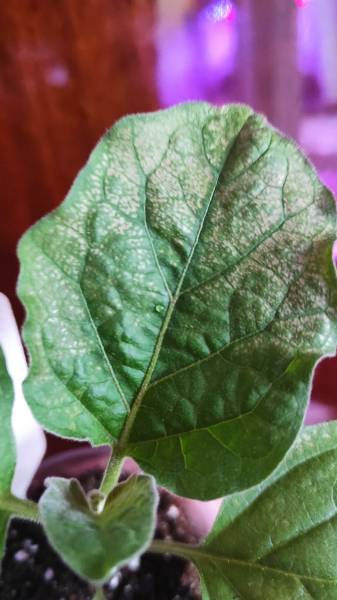
Good evening everyone!Please help! A friend sent me these photos of her eggplant starts. Out of 12 plants, 3 of them have developed this weird spotting nonsense on the leaves.
I looked at them under a magnifying glass but couldn’t find a single bug. They haven’t been sprayed with anything recently, and they are growing indoors under LED grow lights. Any ideas?

Plena (Elena) wrote:
Out of 12 plants, 3 of them have developed this weird spotting…
Elena, were those specific 3 eggplants sitting directly under the center of the lamp with their leaves too close to the diodes? It really looks like light burn to me.
VeraV (Vera) wrote:
were those specific 3 eggplants sitting directly under the center of the lamp…
I don’t think it’s a selective light burn. All 12 plants are sitting at the exact same height, and it’s a flat LED quantum board, so the diodes are evenly distributed across the entire canopy. 🤷♀️
Zulfiya wrote:
Honestly, that looks like spider mites to me.
Thanks for the reply! Spider mites were our very first suspect, but we inspected the leaves thoroughly with a magnifying glass and couldn’t see anyone moving. So frustrating! 🤦♀️
Looking closely at the photos provided by Elena, the picture becomes much clearer. The damage on these leaves is textbook stippling (chlorotic mottling).Unlike edema (which creates raised, crystal-like blisters on the underside of the leaf), stippling almost always points to pests with piercing-sucking mouthparts.1. Spider Mites (Most Likely Culprit)
Why it fits: They suck the sap out of individual epidermal cells, leaving this exact “micro-mesh” or mottled look.
Why they couldn’t see them: In the early stages, there is no webbing. The mites (especially eggs and nymphs) are translucent and hide tight against the leaf veins. A cheap 5x or 10x magnifying glass is rarely strong enough to spot them.2. Thrips
Thrips also cause stippling, but they usually leave behind tiny black dots (frass/poop) and larger silvery patches.
3. LED Phototoxicity (Light Burn)
If powerful purple/pink LEDs (visible in the background) are too close, they can destroy chlorophyll. However, light burn usually creates localized, solid bleached patches in the center of the topmost leaves, not a scattered “rash” over the whole plant.
Action Plan:
- The Paper Test: Hold a crisp white sheet of paper under the leaf and flick the leaf firmly. If tiny, crawling “dust specks” (red, yellow, or white) fall onto the paper, you have spider mites.
- Isolation: Immediately quarantine the 3 affected eggplants away from the other 9.
- Treatment: Standard insecticides do not work on spider mites! You need a dedicated miticide (acaricide) containing Spinosad, Neem Oil, or horticultural soaps. Ensure you spray the undersides of the leaves thoroughly.
- Humidity: Spider mites thrive in the hot, dry air created by central heating and LED lights. Bumping up the ambient humidity slows down their reproductive cycle!