Growers’ Notes and Photos (USDA Zones 4-6 Experience)
Monterosa F1 Tomato.
Catalog pitch: “Monterosa is the perfect blend of taste, texture, shape, and color.”
I want this! Anyone else interested in tracking down seeds?
Plant height: can easily exceed 6.5 ft (2 m), depending on cycle length.
First fruit ripens about 60 days after transplanting into the ground. Warmer temps at the start speed up maturity. If direct seeded in containers, first ripe pickings happen 90-100 days after sowing. The earliest fruits are the largest, sizing up to 14 oz (400 g) with pronounced ribbing.
Later trusses will taper down in fruit weight. Warmer weather accelerates ripening. If early fruit or flowers on the first cluster are thinned, the vine redirects energy into subsequent trusses, leveling out yield over the entire season.
Plant has moderate vigor, pruning extra lateral stems is advised to let light into the canopy and cut down humidity issues like botrytis. Heavy calcium feeding is strongly recommended, especially in hot weather.
Bred with solid professional disease resistance:
– Tomato Mosaic Virus (ToMV)
– Tomato Spotted Wilt Virus (TSWV)
– Verticillium Wilt (V)
Looks amazing, but 12 Euros for 25 seeds? 😕 And who is going to haul it back from Barcelona? 🙌
Edited October 11, 2017 by Drosera
On Astero said:
Monterosa is the perfect blend of taste, texture, shape, and color. I want this! Anyone else interested in tracking down seeds?
Is this a real lead, or just idle forum chatter? Olga, please shed some light here.
Edited October 11, 2017 by Drosera
I have it. Grew it this season.
Edited October 11, 2017 by Drosera
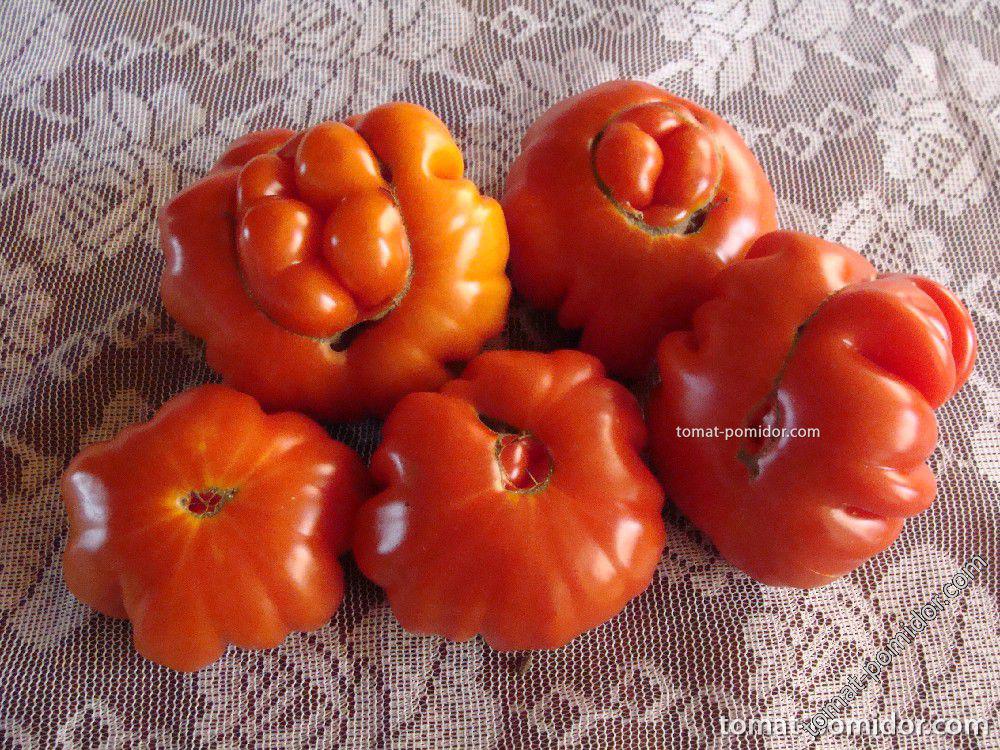
Delicious tomato, definitely not hollow inside. A true wild rose look. My own photos are scarce, but I tracked down Natalya’s photo.
Another big plus: it was one of my earliest to color up. And no disease issues. Natalya had massive yields on hers; mine produced a giant first cluster, but later clusters were smaller, likely because I underfed it. Need to dial in my feeding next time. And the shape is not hollow pleating, but really charming, rounded fluting.

Looking at that photo immediately reminds me of Rebellion. They grew looking just like that: flattened and ribbed. Taste was completely lifeless, tough with a hard white core. Trialed them for two seasons and gave up, worst hybrid I ever grew. Well, except maybe Red Sky plum, which also turned out rock-hard with a white core. Those ribbed commercial types just don’t like my soil.
Breeders note that Monterosa was born in June 2012. The mother was Pera de Girona, and the paternal grandfather was Costoluto Genovese. Here is how the lineage looks///
Grew it this season. Seeds came from Estonia (thanks Natalya!). Good variety, vine is not overly massive, strong growth, solid yield for such a weird weather year. Flavor was standard tomato, but no white core, no green shoulders, no hollow air pockets, and no defects. Beautiful fruit. It caught leaf mold eventually, but was far from the first to get infected.
Anna, is a single seed really worth fifty rubles?
On Elena iz Chekhova said:
Anna, is a single seed really worth fifty rubles?
And you need backup seeds too, can’t just buy one. Plus it is an F1. And it demands heavy feeding. Bottom line: these tomatoes end up costing their weight in gold! 😉
This tomato is not an F1 hybrid. This season I planted both commercial Spanish packet seeds and seeds saved directly from store-bought fruit. They grew completely identical. The commercial seed pack has no hybrid F1 logo, only the registered trademark R symbol.
Yep! That is the exact packet my seeds came from! Elena, I don’t know anything about paying 50 rubles, I’ll bring some to our club meetup for free! 😆
Anna, Natalya, Olga from Pskov, could you share more growing details? When did you sow? When and from what container size did you transplant? How many stems, and what was your spacing? How many clusters, fruit count, and weights did you harvest? When did they start coloring? Did you let them hang ripe to sweeten up? How was the flavor on fruit ripened off the vine indoors? And what diseases showed up by late season?
On Nataliya said:
This tomato is not an F1 hybrid. I planted both Spanish pack seeds and seeds taken directly from fruit…
Natalya, that would be wonderful if we can save seeds without issue!
Does the packet have the letter “H” after the variety name (the SKU is blurry on my screen)? In some European countries, “H” designates a hybrid. F2 plants frequently look identical to F1 parents, but underlying disease resistance packages can drop out in later generations without you noticing if that specific pathogen isn’t present in your soil. It would be smart to grow out an F3 generation to see if any genetic segregation shows up.
After the tomato name it reads: HB101153
Alright, here’s my breakdown:
Sowed with the rest of my batch around March 6-8. Transplanted out of 16 oz (0.5 L) pots into the greenhouse on April 21-22. Seedlings were vigorous with beautiful foliage.
In June, disaster struck: major flooding. My garden sits low, and water stood in the greenhouse walkways until mid-July. The tomatoes were stuck deciding whether to die or try setting fruit. The delicate varieties collapsed; Monterosa survived.
Then July brought more bad luck. It was planted next to Orange Orangutan, which turned out to be an aggressive rogue, a giant 8.2 ft (2.5 m) monster branching into 6 stems that completely overshadowed Monterosa. I was away and only freed it two weeks later.
Monterosa naturally split into 2 stems and produced at least 8 trusses. Lower fruit were large with softer ribbing; upper fruits were smaller and looked picture-perfect like the packet. Missed peak harvest while away on a fishing trip, my friend picked them, so ripening began around early August.
Flavor on trusses 2 and 3 didn’t blow me away, just a solid, good tomato. Ended up using them for sauce. Leaf mold and gray mold showed up in September, but mild. It definitely behaves like a hybrid. Saved seeds, running F2 next season.
Mine didn’t have extreme hollow ribbing like Costoluto Fiorentino, which meant no empty air pockets inside.
Zulfiya, I will post more detailed specs shortly, though I already have plenty of good things to say about it.
Edited October 9, 2017 by Olga
On Rugantino F1, heavy ribbing only develops when you thin the cluster down. When you leave 5 fruits per truss, the ribbing only shows at the shoulders. But when thinned to 2-3 fruits, they take on a totally different, deeply fluted shape. Same rule applies here.
On Nataliya said:
This tomato is not an F1 hybrid… The commercial seed pack has no hybrid F1 logo, only the registered trademark R symbol.
Thanks Natalya! Grew mine from that exact packet. Ribbing was moderate, not flat discs, but taller fruits. Early in the season I gave it a 4/5 for a mild, slightly sweet profile. But it loaded up with intense sugars late in the season once I cut off irrigation. Definite fruity undertones.

Personally, Mushroom Basket (Gribnoe Lukoshko) covers all my needs: very high yielding, sturdy plant, tasty fruit, virtually no hollow locules, pure solid meat, perfect for stuffing or market platters. Been growing it for 8 years. There are plenty of similar heirlooms: Lorraine Beauty, American Ribbed… did y’all just discover ribbed tomatoes yesterday?
Monterosa F1 is an engineered hybrid. Local greenhouse market growers ordered seeds from me specifically for fresh commercial shipping to offer something eye-catching with decent shelf life. I will trial it next season to assess fruit appearance, flavor, and disease tolerance. Here is Mushroom Basket for comparison, also pink:
O
Nobody dropped from the sky here. We all know there are dozens of ribbed heirloom varieties. But ribbed hybrids? Most commercial greenhouse hybrids look like identical red tennis balls. That is why Monterosa caused a stir.
Zulfiya, here are my details:
Sowed February 27. Emergence was uniform. Gorgeous, sturdy seedling, textbook ideal growth. Leaves didn’t stretch or drop, even though seedlings were stuck on the windowsill during our freezing May. Handled transplanting like a champ, survived 17°F (-8°C) frost under row cover in the center bed. Bounced right back and flowered among the very first.
I admit I am terrible at cluster thinning, and my first truss set over 10 fruits. Because of that, sizes were uneven, mostly 5.3-7 oz (150-200 g). Ripened among the earliest, around late July. Upper trusses were lighter, definitely needs more fertilizer.
On Olya Pskovishna said:
Nobody dropped from the sky here… Most commercial greenhouse hybrids look like identical red tennis balls. That is why Monterosa caused a stir.
I still don’t get the mania. Commercial growers planting acres need shippable hybrids, they don’t grow heirlooms in the South. But for backyard hobbyists, isn’t it easier to grow true-breeding heirlooms and save your own seed instead of paying 50 rubles per seed every single spring? Folks assume it’s bulletproof for greenhouses, yet growers are already reporting disease. I will run my own side-by-side trial with Mushroom Basket and see.
On vikysia said:
I still don’t get the mania…
How can you read this marketing pitch and not want to plant it? 👍
Catalog excerpt:
Who am I? I am Monterosa. Born on a cool June morning in 2012 in Cabrera de Mar on the Maresme coast of Catalonia, Spain. My mother is a pear tomato from Girona, and my paternal grandfather is Costoluto Genovese. This blend of Catalan and Italian blood gives me my Mediterranean presence. Born from a passion for the Mediterranean diet and a commitment to reviving historic tomatoes…
Allow me to seduce you: asymmetric and ribbed, velvety skin, prominent sepals giving me a voluptuous shape. Moving from apple-green in youth to deep pink at maturity with an herbaceous fragrance. Those who know me praise my sweetness and fruity finish…
Pure poetry! 👏
In my view, this is purely a tomato for market farms looking to stand out. Most commercial hybrids are round and smooth. Market trends shift: first it was pointed tips, now it’s ribbed heirlooms to supply fancy restaurants.
I am not paying 50 rubles a seed. Backyard growers have a sea of ribbed heirlooms available without buying expensive hybrid seed. Trialed Rebellion F1 and Mushroom Basket before, flavor was unremarkable. Smooth slicers are way easier to wash, process, and my family prefers eating them anyway.
The breeding company won major innovation awards for this hybrid. Seed is sold at premium prices across Spain and European commercial growers are lining up for it. Mine sprouted in just 3 days! 👍
My family devoured them faster than I could take photos, but I managed to snap the last one. Average weight in my indoor container trial was 7 oz (200 g). No synthetic fertilizers, restricted to a 1.3 gal (5 L) pot that turned into pure root mass. In open ground it will easily size up double.
Flavor was excellent, not bland at all, noticeable aroma, nicely juicy. Fast developer: bloomed at 45-47 days, picked the first ripe fruit around day 90, very early. Color was a deep, even raspberry-pink, not pale red. Fluting was well defined with big, decorative sepals. Checked every box for me! 👍
Grew Monterosa from seeds sourced via Kulik. Yield on bottom clusters was exceptional, truly impressive. Upper clusters were lighter, but still very respectable. No blossom drop, sets solid clusters all the way to the top wire. 🙂
Flavor: typical cardboard commercial hybrid, tasted like grocery store plastic to me. Visuals: very pretty and ribbed. Disease tolerance was on par with regular heirlooms.
Strictly for canning paste or market sales where attractive looks sell fast. Not something I want on my fresh salad plate. That said, I am still growing two plants next year for processing!
On trofi said:
Flavor: typical cardboard commercial hybrid, tasted like grocery store plastic to me…
Grew two commercial hybrids in my poly greenhouse this season: Monterosa and Nada. Nada looked prettier for market sales, but on flavor, vine-ripened Monterosa tasted like a real garden heirloom. Nada had that typical bland supermarket taste. Nada’s only advantage was rock-hard firmness, long storage, and total immunity to leaf mold. Monterosa got nicked by leaf mold late in the season. 😆
Bought my Monterosa seeds directly in Spain. Did not like it. Pretty fruit, looks just like a grocery display. And the thick walls remind me of commercial market tomatoes.

On Astero said:
Rosa Pavo (Monterosa F1)
Exactly, mine stayed relatively modest in size like that. On the first truss, only one single fruit grew larger and less round. 😉
Grew genuine Spanish-sourced seed. It hated my soil right out of the gate: threw severe chlorosis, the only variety in the entire greenhouse to do so. Nothing good to say about it, supermarket junk in my book.
Grew it as Rosa Pavo from Olga (Zolushka’s) group buy.
I really liked it. Huge yields, very vigorous vine, factor that in when planning spacing. Huge vegetative push and continuous fruit set. You can tell its homeland is a warm country with endless sun, it acts like it wants to grow and set fruit forever.
The first two trusses were the heaviest: 10 large tomatoes per cluster on the main stem. Once pruned to 2 stems, later clusters settled at 5-6 fruits.
Flavor was quite good for a commercial hybrid. I let them hang on the vine as long as possible to soak up sugars. But peak eating quality actually happened after sitting on the counter indoors for 6-7 days.
Main flaw: tendency to form micro-cracks inside the rib furrows, which hurts long-term storage. Definite keeper for next season.

Did not like it one bit. Completely tasteless, pale, and rubbery plastic. Vine wasn’t particularly robust either, reached about 6.5 ft (2 m), produced barely 15 fruits total, and caught leaf mold right along with everything else. Yanked it out early with zero regrets. Will not repeat.
Full Summary: Lineage, Cluster Management, and Flavor Dynamics
- 🇪🇸 Breeding & Heritage: Developed in 2012 by Semillas Fitó in Cabrera de Mar (Catalonia, Spain). Cross between local heirloom Pera de Girona and Italian heirloom Costoluto Genovese. Protected under commercial registration code HB101153.
- 🌿 Plant Architecture: Vigorous indeterminate vine requiring aggressive lateral pruning and sturdy trellising. Responds strongly to cluster thinning: leaving 10+ fruits per cluster yields smaller 5-7 oz (150-200 g) fruits with light ribbing; thinning to 3-4 fruits produces 14 oz (400 g) deeply fluted beefsteaks.
- 👅 The Great Flavor Polarization: Northern growers report drastically different flavor results. In cold, overcast climates with unthinned trusses, fruit develops tough skins with a mild, commercial “cardboard” profile. Under intense heat, high potassium feeding, late-season water restriction, and 6-7 days of post-harvest counter curing, the fruit develops an intensely sweet, aromatic Mediterranean profile.
- 🛡️ Disease & Vulnerabilities: Resistant to ToMV, TSWV, and Verticillium. However, multiple growers note susceptibility to leaf mold (Passalora fulva) in humid greenhouses, micro-cracking in rib creases during wet spells, and iron/magnesium chlorosis in cold soil.
- 🌎 Who Reviewed It: Trialed across diverse regions: Yalta/Crimea (Zone 8), Pyatigorsk (Zone 6), Lipetsk (Zone 5), and short-season Zone 4/5 gardens (Moscow, Pskov, Leningrad, Tula).


