Quick Summary: Amending Heavy Clay Soil
- 🌍 The Challenge: Heavy, compacted clay soil is a universal nightmare for gardeners. Buying truckloads of topsoil to cover a large plot is incredibly expensive and often impractical.
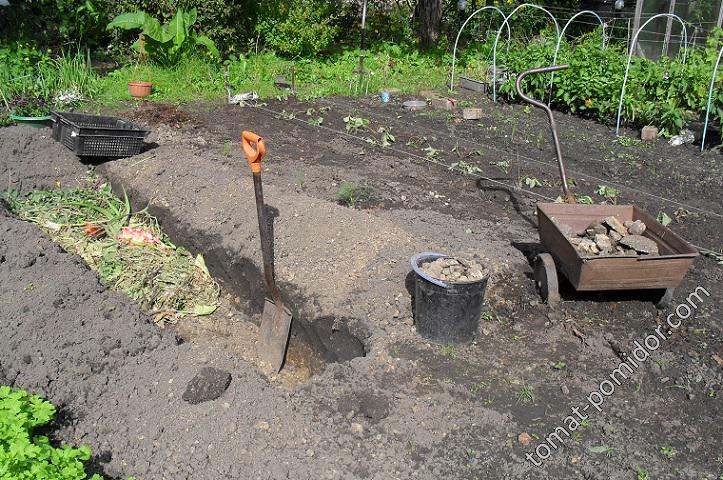
- 🌿 The “Warm Bed” Solution: A traditional Eastern European technique (very similar to trench Hugelkultur). It involves digging a trench, filling the bottom with branches, logs, and plant debris, and covering it with native soil mixed with amendments. As the wood breaks down, it generates heat (hence “warm bed”), creates a sponge for moisture, and loosens the deep clay.
- 🧱 Key Amendments: Coarse builder’s sand (not fine clay-sand) and compressed baled peat moss. Pro Tip: Avoid buying bulk truckloads of loose peat, as it is often heavily contaminated with aggressive weed seeds. Stick to sterilized, compressed bales.
- 🍂 Mulching Strategy: Continuous organic matter is key. Mulch with fallen leaves over the winter, and use grass clippings during the summer to feed the worms and build topsoil.
- 🌑 The Occultation Trick: If you have time before planting a new bed, cover the raw clay with opaque materials (like roofing felt, slate panels, or heavy dark tarps) for a full year. Cutting off light and excess water kills weeds and encourages soil life to naturally loosen the top layer.
Quote by Plena:
My Rozovyy Gay (Pink Grove) tomato in the greenhouse is never just 60 cm (24 inches) tall, it easily reaches a meter (3.2 ft). Perhaps the difference in soil makes itself known; I initially had pure clay, followed by annual soil conditioning/amending. And as a result, all plants grow taller than their stated height.
I grew it for the first time, planned to repeat it and Tyotushka (Auntie) for early season harvests.
Elena, could you please share how exactly you condition/amend your clay? Our nearby plot is just solid, heavy clay. We don’t know how to process it to make it comfortable for the plants. Just burying 3 sotkas (300 square meters / approx 3,200 sq ft) under a thick layer of fertile topsoil is not an option. It’s way too expensive. Maybe there is some other way?
Quote by Arinochka:
Elena, could you please share how exactly you condition/amend your clay?…
I initially laid out the garden beds like “warm beds” (trench composting / Hugelkultur). I dug a trench a couple of spade-depths deep (about 16-20 inches), laid branches and plant debris at the bottom, and covered it back up with the native soil. I bought a truckload of good, coarse sand (not clay-based sand) and work it into the soil. And I buy compressed peat moss in 250-liter bales (right now I only see 100L ones). I add that in.
I also add sand and peat to the flower beds. Once I bought a whole dump truck of loose peat, and I swore never to do it again—so many weed seeds, it was a nightmare.
Plus, I use my own homemade compost, and I mulch the beds with fallen leaves for the winter, and with grass clippings in the summer.
I think this is a pretty standard technique. I don’t buy soil by the truckload, I don’t risk it, and besides, turning over that much volume all at once is backbreaking work.
Also, before developing a new patch, if you have time (like a whole season), you can cover the future garden bed with something like roofing felt, slate panels, or a heavy tarp to cut off light and water (occultation). A year later, you will have loose, crumbly soil underneath. After that, see above: use sand for aeration/loosening, and peat moss to loosen it further and provide plant humus.
Quote by Plena:
I initially laid out the garden beds like “warm beds”… Also, before developing a new patch, if you have time, you can cover the future garden bed with something like roofing felt…
Elena, thank you! You helped me a lot) I will start developing it. For planting cherry trees and pumpkins, I guess I’ll have to dig even deeper than 2 spade-depths and make the trenches wider.