Quick Summary of Bigly
- 🌍 Origin: A stunning striped orange variety closely associated with the lines bred by Fred Hempel (Artisan Seeds), sharing many characteristics with Orange Jazz.
- 🌿 Plant Habit: Indeterminate, tall, and mid-season. Known to be highly productive.
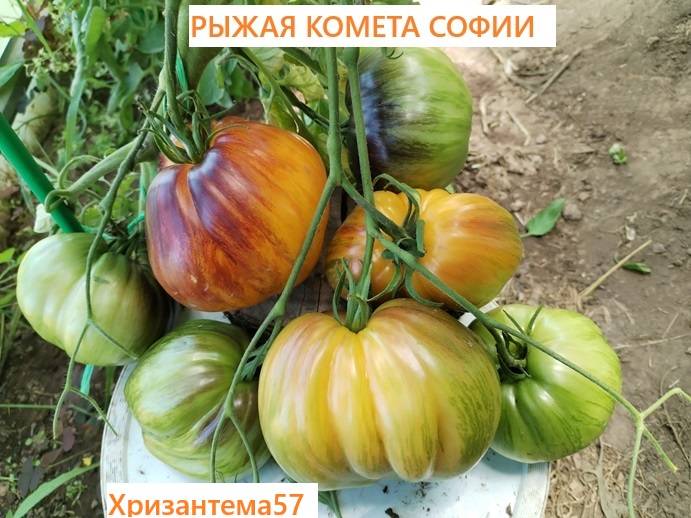
- 🍅 Fruit Characteristics: Massive orange beefsteaks with plump shoulders and light yellow stripes. Fruits are very heavy, frequently weighing 1.1 lbs (500 g) or more. The flesh is dense, juicy, and visually beautiful.
- ⚠️ Known Issues (Tough Cores): Growers report that this variety (along with its “older sibling” Orange Jazz) is highly susceptible to forming hard, fibrous white tissue (“whiskers” or “fish bones”) in the center of the fruit.
- 🧪 Agronomic Tip: This hard core issue is often linked to a nutritional imbalance—specifically a lack of potassium or an excess of nitrogen. If your fruits taste bland or sour and have tough internal fibers, try applying a dedicated potassium feed during the fruit-sizing stage.
Description from the web: “Tall, mid-season. Fruits are orange with plump shoulders and light yellow stripes, weighing 1.1 lbs (500 g) and more. The flesh is dense, juicy, and sweet. An excellent productive variety!”
Copying from my 2020 garden report.
The biggest expectation of this year and the biggest disappointment. (I couldn’t even find a glamour shot of it, probably forgot and didn’t take one). No, no. The taste, the yield, and the beauty are all there… But it had tough “whiskers” (hard vascular fibers) right in the core; by the time you cut them out, you’ve hacked the whole tomato to pieces… Maybe a nutrient imbalance? But then why did it only happen to this one, and didn’t affect the neighboring plants?


Quote from Olya Pskovishna:
The taste, the yield, and the beauty are all there… But it had tough “whiskers” (hard vascular fibers) right in the core; by the time you cut them out, you’ve hacked the whole tomato to pieces… Maybe a nutrient imbalance?
The exact same problem as with its “older sibling,” Orange Jazz. And it’s completely unclear why these “fish bones,” as I call them—though “whale baleen” is probably more accurate—even happen. In 2019, I didn’t have this issue with Orange Jazz grown from Kulik’s seeds. In 2020, I personally didn’t have it from my own saved seeds, but a fellow forum member from Karaganda, whom I shared the seeds with, did! She described it and asked what it was. I didn’t even understand what “tough whiskers” she was talking about back then!
But then, in 2021, this nasty issue showed up slightly in my greenhouse-grown Jazz, and also outdoors in open ground—in both Orange Jazz and Bigly. And it’s characteristic ONLY for them! Maybe there wasn’t enough potassium? Or a nitrogen skew? I don’t know, but it is a fact: this happens in these gorgeous and delicious orange striped varieties bred by Hempel.
A clue might be that the lady from Karaganda wrote not only about the “whiskers” but also that the taste was a bit bland. And in my open ground in 2021, they were a bit sour. This means the fruits didn’t accumulate enough sugars in both cases, which is typically a sign of potassium deficiency. In 2022, I will specifically test this by giving this bush an individual, extra feeding schedule.
Quote from Oksana Evgenievna:
In 2022, I will specifically test this by giving this bush an individual, extra feeding schedule.
Very interesting! I won’t get around to testing it myself, just knowing my personality. You have to feed it separately, then compare… But I would absolutely love to hear about your results…