📌 Quick Summary (TL;DR): Kubiki (Cubes)
- 🌍 Origin: An unnamed Russian family heirloom that has been passed down and grown for over 25 years. The original name was lost to time, so the grower dubbed it “Kubiki” (Cubes) due to its blocky shape.
- 🌿 Plant Habit: A true determinate (bush) variety. It stays short, maxing out around 20-24 inches (50-60 cm). It is incredibly low-maintenance and requires absolutely no pruning or suckering.
- 🍅 Fruit Characteristics: Pinkish-red, distinctly blocky, oval-cube shaped fruits. They are remarkably large for such a compact bush, averaging 3.5-6.3 oz (100-180 g).
- 👅 Flavor & Use: A very traditional, neutral tomato flavor. It lacks intense sweetness or sharp acidity, but packs a massive old-school tomato aroma. Because the flesh is so dense and meaty, it is the ultimate workhorse for canning, fermenting, or pickling.
Read the thread below for a classic tomato forum detective story, as growers debate whether this family heirloom is actually a famous commercial variety in disguise!
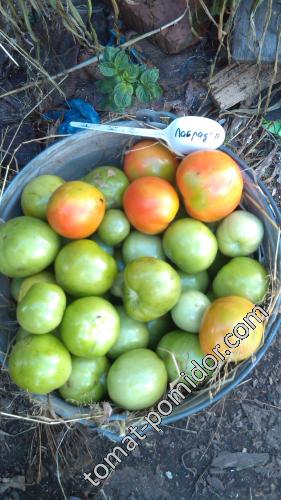
Here are the Kubiki (Cubes) from the catalog on the old forum. This is my 2012 harvest. I planted them outdoors right in the dirt in early May. I covered them with row cover for the first little while. Didn’t prune them at all.


Just look at this yield.


Awesome harvest! What seed company produces this one? And how is the flavor?
They really are almost perfectly cubic cubes. I remember someone on here saying these were their absolute favorite cubes to grow…
Oh, the original name was lost to time, unfortunately, just because we’ve been growing it for so long. These are my own saved seeds. I sent some out to folks on the forum, but I haven’t seen any comments or reviews from them yet. Anyone out there?!?
They look a lot like the variety Solnechnyi (Sunny) – short bush up to 20 inches (50 cm), fruit weight up to 2.3 oz (65 g).
So what do they actually taste like?
I was just looking up photos of the Solnechnyi variety from the Aelita seed company online, and I found the exact same stock photo used for the Ladnyi variety by the Sedek seed company. 🙂 So which is which?
The weight is around 5.3-6.3 oz (150-180 g). They aren’t small. There are a lot of varieties that look similar in pictures.
I would call the flavor neutral. No sharp acidity, but no real sweetness either. However, they have a very pronounced, classic tomato aroma.
Welp, I’m doomed. And here I promised myself I wasn’t going to add anything else to my want list.
This is Stolypin. All the descriptions of your “cubes” fit it perfectly. There was a very detailed thread describing Stolypin on the old forum.


Elena_ wrote:
This is Stolypin. All the descriptions of your cubes fit it perfectly.
There was a very detailed thread describing Stolypin on the old forum.
Stolypin and Kubiki are indeed very similar in both fruit shape and plant height. Though, to be fair, there are quite a few “twin” varieties out there nowadays.
They match in flavor, leaf shape, and those same curled sepals. Plus, Lada doesn’t remember what variety her cubes originally came from.
I will absolutely plant Stolypin to compare, though I honestly don’t think that’s it. We’ve been growing these little guys for at least 25 years. I highly doubt Stolypin even existed back then. We need to dig deeper into the history of older varieties.
Kubiki. A short, heavy-yielding bush up to 24 inches (60 cm), you can skip pruning entirely. Mid-early. Pinkish, oval-cube shaped fruits. Firm, meaty, pretty good flavor, and not small at all—up to 3.5-5.3 oz (100-150 g). They are absolutely perfect for all kinds of preserves, fermenting, and pickling (including canning them in wedges).

In this thread, user Serezha points out a hilarious and all-too-common issue in the Russian seed market: large commercial seed vendors (like Aelita and Sedek) notoriously steal stock photos from the internet—or even from each other—and slap them onto completely different varieties.This makes identifying older “lost” family heirlooms (like Lada’s 25-year-old Kubiki) incredibly difficult when comparing them to modern catalogs. While other users suggest her tomato might be the commercial variety Stolypin, Lada rightly points out that her family was growing this tomato long before Stolypin was ever bred or registered!