Growers’ Notes and Photos (USDA Zones 2-5 Experience)
A true blue tomato. My seeds came from Elina.
Indeterminate vine reaching up to 6.2 ft (1.9 m) in the greenhouse. Fruit set is fantastic right to the top of the trellis, and the yield is right up there to match. The biggest fruit weighed in at 6 oz (170 g). Good classic tomato flavor, with flesh that has a slightly sugary texture. Only showed very minor leaf mold.
Edited January 24, 2015 by Drosera


Adding a few more photos.


This blue is striking and yields like crazy, but the flavor is pretty so-so.
I wouldn’t say that. The flavor is interesting and out of the ordinary. I liked it. But that is just my two cents.
Medium weight, and the flavor is definitely unusual.
tomatinka said:
I wouldn’t say that. The flavor is interesting and out of the ordinary. I liked it. But that is just my two cents.
OSU Blue really has its own distinct, quirky flavor profile. 👍 And on top of that, it is loaded with health perks, packed with anthocyanin which is a potent antioxidant! 😋
Fascinating variety! Wish I had photos on hand, unfortunately I do not.
On top of that, it has very strong indeterminate stamina. The last ones are still hanging out in the garden even though the vines dropped all their foliage. 👍
Talk about quick! Right when I figured I would miss out on this one, Lyudmilka popped in, and boom, OSU Blue is officially mine! 📬
Angelina said:
[Photo]
Looks like that photo was taken with a camera flash, so the true color is thrown off a bit.
Edited November 17, 2013 by Drosera

Outdoors in open ground mine grew just a bit over 3.3 ft (1 m). But tough as nails. We were already out digging potatoes in September, and it still had green fruit hanging without a care.
This is not my first season growing it, and I am still amazed by the color OSU Blue turns about 1-2 weeks after being planted out in the garden. 😮 🙂


I have several varieties looking like that right now. Need to take notes tomorrow. Indigo Rose, Dancing with Smurfs probably. Will check for sure tomorrow.
tomatinka said:
Indigo Rose, Dancing with Smurfs
Well, those are purple/blue varieties too. 🙂
That is exactly my point. I have gone down the rabbit hole trying to spot duplicates. 😉
Vera, Indigo and Smurfs are cherries, if I remember right.
This year, thanks to Lenochka Danko, I have Dancing with Smurfs, Purple Halley’s Comet, Evans Purple Pear from Popenko, Indigo Rose from Tanyushka in St. Petersburg, and some other blue one. I am completely lost in all these blues! 😄
Vera, you sent me seeds labeled Blue Fruit. What is that one, a cherry or a large slicer?
My Blue Fruit came from Popenko. Large, flat-round black tomato. Super tasty! 😋
tomatinka said:
My Blue Fruit came from Popenko. Large, flat-round black tomato. Super tasty!
It is supposed to be potato leaf, but mine threw regular foliage last year. Did not sow it this season.
A bit off topic, but I had both leaf types show up. Must be an off-type mixup. But I only saved seeds from the potato-leaf vine.
Loved it for yield, flavor, and of course that unreal look. 🙂
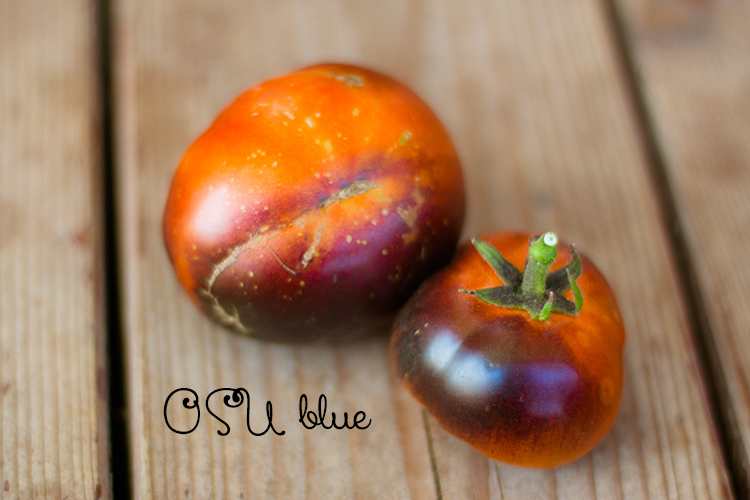
Turned out to be quite early in my garden. Sowed and transplanted Indigo Rose right alongside it, but OSU Blue started coloring up much earlier.
I even managed to accidentally decapitate my OSU Blue vine right above the first cluster! It simply sent out a vigorous sucker, rebounded, and is ripening fruit right now. The first round was eaten long ago, and I have fresh seeds stashed in packets already.
Here is how my OSU Blue did.

And mine:


Grew it this year too. I was honestly just intrigued by the novelty factor. Planted it, watched it grow, sampled the flavor. Curiosity satisfied, won’t be repeating it. At least I can say I tasted it! 🙈
Did not really impress me. Ran one plant outdoors in the dirt. Seeds were from Redko. Production was really low and fruits were tiny, the largest was barely 1.4 oz (40 g). Flavor was enjoyable though.

Sweet, tasty tomato with an exotic look. Running it again next year, and putting in more than one vine.

Here are mine. 🙂 Put in quite a few plants. Solid yielder, large, firm fruits that keep forever on the shelf. Set several aside for seed, left them sitting a whole month, and they barely softened up.
Great for canning and especially good for tomato juice, comes out thick with fantastic deep color. Flavor-wise, there are definitely tastier varieties out there. Still, I will definitely plant it again, and in good numbers. 🙂
Big thanks to Marisha and Yulya (Yulita) for the seeds! 💐

Siniy (that is how it was labeled) grown from Popenko seeds (origin USA).
Tall vine, robust, high yielder, completely disease-free. Fruits start out green-purple, then the shaded side turns red while the sun-exposed side keeps its deep purple hue. Tomatoes run about 3.5 oz (100 g), dense, standard tomato flavor, reddish-pink flesh inside. Quite tasty, zero cracking issues.
Put almost all of mine up in canning jars. Just note that the blue pigment fades away in hot brine and the tomatoes turn into regular reds. A true novelty variety.


Really loved this one. Perfectly uniform, eye-catching tomatoes, right up the alley for folks who enjoy sweet fruit. We devoured them fresh off the vine, only scraps were left over for canning.

Tatunya said:
Grew it this year too. I was honestly just intrigued by the novelty factor. Planted it, watched it grow, sampled the flavor. Curiosity satisfied, won’t be repeating it. At least I can say I tasted it!
Agreed, there are certainly better tasting varieties out there. Productivity is great though, so I will probably stick one plant in next season just as eye candy. 😉
Seeds were sent by our forum buddy elina back in 2012. Grew it outdoors in open ground. Mid-height plant, fairly compact, late maturity.
The fruits looked and tasted a whole lot like OSU Blue, just larger, around 3.5-4.6 oz (100-130 g). Very uniform, beautiful, long-keeping, and exceptionally sweet. One of my top favorites this year. Started ripening in the second half of August, yield was solid. Looks stunning out in the garden beds.

Galina, Lena (elina) had OSU Blue from Popenko.
OSU Blue fruits can easily top 3.5 oz (100 g), especially inside greenhouses or outdoors in regions further south than ours.
Edited December 12, 2014 by Drosera
Svetlana, OSU Blue grew right next to it, and it was definitely a different plant. Different fruit size, vine stature (OSU was smaller), and cluster shape. Elina sent it to me under that specific name.
Did some digging in Popenko’s seed catalog, here is what it says:
“226. Siniy (OSU Blue, USA). Indet. Ultra-rare miracle variety, developed at Oregon State University (OSU). In technical ripeness, fruits are light-purple/blue, turning dark indigo, and when fully ripe the shaded side turns red, creating a bicolor red and dark purple fruit. Flesh is reddish-pink. Firm, delicious, up to 3.5 oz (100 g). These chameleons look stunning in canning jars! Often circulated under the name Indigo Rose.” 😮
Well, mine were genuinely different plants. Galochka Esme gave me my OSU Blue seeds, not sure where they originated. But Siniy was straight from Popenko. The fruit weights differed by double under identical growing conditions!
Galla said:
Elina sent it to me under that specific name.
“Blue” translates directly to “Siniy” in Russian.
Plant height and fruit size can vary quite a bit within a single variety. Unless working with completely stabilized single-plant seed lines, sister plants will show variation across traits.
In my book, OSU Blue and Siniy are the exact same cultivar.
Indigo Rose is just a hair bigger than a standard cherry.
Edited December 12, 2014 by Drosera
My OSU grew out as a large cherry. What on earth was I growing then?
Not gonna argue about it since the vendor himself lists multiple names for the same entry. He has plenty of other varieties looking like Siniy too.
I grew Siniy (OSU Blue, USA) from V. Redko in 2014. Grew exactly like Popenko described. Gorgeous, prolific, but the flavor was a total letdown. 🙁 I was counting on real sweetness.
Later that autumn my husband brought home a smaller purple tomato from work, maybe 1.4 oz (40 g). Said a coworker shared it and praised it to the moon. Taste was downright fantastic with noticeable sweetness, so I scooped the seeds. No clue what variety it was, about half the size of mine.
Tatyana Kemerovo said:
[Quote]
Might have been Indigo Rose. Haven’t grown it myself yet, planning for 2015, but people praise its flavor.
Grew it from Tomatanya’s seeds. 💐
Ran outdoors in open ground, vines stayed right around 3.3-3.6 ft (1-1.1 m), trained to 4 main stems, pinched out all other suckers. Really liked this variety: flashy, exotic, with rock-solid plant health.
Tomatoes are firm, store exceptionally well, and ripen off the vine on the counter without losing quality, turning out plenty tasty. 😋 Great yield. Mid-season for me, about half the crop ripened on the vine outdoors. Salads, canning, or showing off to guests, total multipurpose tomato! 👍


Here is my OSU Blue from Redko. Wish they had more sugar.


Ordered seeds from Natalya Pavlovna (Yaroslavna). Testing it out next season!
I really enjoyed them. Exotic color, absolute lookers 👍, good flavor 😋, and quite early. They were the very first ripe tomatoes I tasted, with decent production. If garden space permits, I will run it again (hard when there are so many novelties to try!). Seeds came from Italy via Lena, huge props to her! 💐
Edited December 25, 2014 by tatyana _F
My OSU Blue from Irochka (irina58). 💐 Performed amazingly well outdoors in the dirt. Delicious, and seemed to have a distinctive fruity undertone to my taste. 👍 😋


Grew it last season as well. 🙂

Galla said:
Ozi blu
Funny bit of mangled slang there! 🙂 OSU Blue stands for Oregon State University Blue, meaning the blue tomato bred within the walls of Oregon State University by Professor Jim Myers and his graduate students Carl M. Jones and Peter Mes.
The original line came out under the working tag Blue P20. Later, in 2012, they released an improved version: Indigo Rose. That was a game changer for hobby breeders, sparking dozens of new crosses and hybrids. With each wave of breeding, flavor improves, fruit size bumps up, and days to maturity shrink. Endless playground for tomato growers!
Ran it last year from Popenko. Loaded up the vine with large cherry-sized fruit, but flavor was dead ordinary. Pretty disappointed on flavor, though the visual appeal is off the charts.
As far as anthos go, I also grew Krasny Ugol (Red Coal) and P20 Blue from Gusev. All were productive and stunning. Red Coal gets reasonably large, but they all ended up tasting rather generic. Giving them another shot this season, just fewer plants, strictly for looks and antioxidant health benefits. Maybe the flavor comes through better with different weather.
fire-cherry said:
Ran it last year from Popenko. Loaded up the vine with large cherry-sized fruit, but flavor was dead ordinary… As far as anthos go, I also grew Krasny Ugol and P20 Blue from Gusev… all ended up tasting rather generic.
I grew Indigo Rose and Bosque Blue (large cherries), and the taste was equally generic. Real letdown, even though both varieties were crazy productive. Neither managed to ripen a single full truss on the vine, had to counter-ripen everything indoors all the way till New Year’s! Won’t be dedicating garden space to them again. That said, I want to try Blue Beauty this season after reading the glowing forum reviews.
First time growing OSU Blue. Had just 4 seeds: kept one plant for myself and gave the other three to gardening friends. As a seedling under lights indoors, it looked totally normal.
Once planted out into the greenhouse, the foliage turned purplish, which folks already warned about. But now the leaves have gone paper-thin, like parchment. They aren’t wilting, just bizarrely thin. We had chilly weather, though I had water jugs laid out as thermal heat sinks. All my other tomato varieties look completely standard, but this one is acting weird. Is that typical behavior for OSU Blue?
mamaGalya said:
Once planted out into the greenhouse, the foliage turned purplish… But now the leaves have gone paper-thin, like parchment. They aren’t wilting, just bizarrely thin… Is that typical behavior for OSU Blue?
Yes, the stems and leaves will keep that distinctive purplish color compared to regular tomatoes all the way through the end of the season.
2015 season update:

Waiting and waiting for this thing to ripen! Sitting in the greenhouse, half the fruit is dark blue, but the underside is still completely green…
Nice tomato, very tasty.
Topped out at just 4.3 ft (1.3 m) outdoors in open ground, but turned out extremely productive and keeps forever off the vine.
Seeds from Kulik (Ukraine).
Vine habit: mid-early, spreading, moderate indeterminate.
Fruit set: sets every single truss without missing a beat.
Height: about 4 ft (1.2 m) by August 5, reached 4.3 ft (1.3 m) by September 6.
Trusses: 4-5 fruits per cluster, dense and gorgeous.
Total yield: high.
Fruit: flattened globes, deep inky-black washing into vibrant red streaks, unreal eye candy! Later fruits size down slightly.
Firmness: medium.
Flavor: delicious, meaty, sweetness rated a solid 5 out of 5.
First impressions: outstanding flavor and uniquely beautiful tomato! Only real downside is the shorter vine stature.
Seedling rating: 4+, plant rating: 4+, fruit rating: 5, overall grade: 5+.


Goes to show, different strokes for different folks! I loved OSU Blue. Set fruit reliably, though it did lean late for me. Very sweet and flavorful. My daughter even remarked: “This tomato tastes like it comes pre-seasoned with basil.” Kept great in storage, lasted a whole month.


Svetlyachok-plyus said:
I loved OSU Blue. Set fruit reliably, though it did lean late for me. Very sweet and flavorful.
Read through this thread and was ready to post the exact same thought, minus having a daughter and photos for now. 🙂
Both my family and I fell in love with this tomato, so I was really surprised seeing how split the reviews are. Taste is subjective, after all.
Tracked down where my seeds came from: turns out they came from Svetikk. Big props to Svetikk and the forum community!
Maturity leaned mid-late for me. Yield was good, not astronomical, but rock steady. Grew outdoors in the dirt with zero pampering: no covers, no fertilizers (treated just like everything else). In spite of rough weather in northern Bryansk, it handled it like a champ.
Fruits are modest in size but very uniform, like little red balls dipped in black paint from a wide brush. When I bit into the first one, the skin looked almost like shiny grocery-store plastic and I figured it would be tough, but not at all: exceptionally sweet and nice and tender. Planting again for sure! None made it to canning jars because we keep eating them fresh, with plenty still hanging on the vine.
Eye-catching, gorgeous variety with solid production. Taste struck me as basic standard tomato, medium fruit size.
Really enjoyed this variety: handsome, heavy cropper, with an intriguing pleasant undertone. Put up one jar of canned whole tomatoes with it. We will see how it tastes come winter.

Ogorod Larionovykh said:
Really enjoyed this variety: handsome, heavy cropper, with an intriguing pleasant undertone.
Total stunner! 👏
OSU Blue proved late and stingy on yield in my garden. But the handful of fruits that did ripen were inhaled so fast by the family that I did not even get to take a bite! Can’t comment on flavor myself, but must have been good.
Folks, enlighten me here: Siniy OSU and Ozi Blu, are they identical twins or completely unrelated? Getting totally mixed up…
Andreevna said:
Siniy OSU and Ozi Blu, are they identical twins or completely unrelated?
Are you serious or just teasing? 😛 Those are just butchered names: a sloppy mix of phonetics, literal translation, and typos.
Drosera said:
Are you serious or just teasing?
Dead serious! I literally received seed packets marked with both those exact spellings, so I was scratching my head. So they really are the same variety?
Andreevna said:
So they really are the same variety?
One and the same variety, just with both packets misspelled.
Ogorod Larionovykh said:
Really enjoyed this variety: handsome, heavy cropper, with an intriguing pleasant undertone. Put up one jar of canned whole tomatoes with it.
I loved it canned in the jar as well.
Drosera said:
One and the same variety, just with both packets misspelled.
My packet was labeled “OSU Blue, Bleve”.
Verchik said:
My packet was labeled “OSU Blue, Bleve”.
The word “Bleve” does not exist in any language, except BLEVE, which stands for “Boiling Liquid Expanding Vapor Explosion”.
Most likely, someone simply botched the spelling of the word “Blue”, and that typo went viral on trade packets.
Drosera said:
Most likely, someone simply botched the spelling of the word “Blue”, and that typo went viral on trade packets.
😄 Quite possible! Seeds originally came from Terentyev in Donetsk.
Drosera said:
One and the same variety, just with both packets misspelled.
Y’all, so what is the proper label for my garden tags? I got packets from two different seed swappers, and each wrote something different.
Andreevna said:
Y’all, so what is the proper label for my garden tags?
The correct name is right in the thread title: OSU Blue.
OSU stands for Oregon State University. Blue is the color.
Drosera said:
The correct name is right in the thread title: OSU Blue.
Thanks a bunch!
Full Summary: Plant Habit, Fruit, Flavor and History
- 🌿 Plant & Stature: Indeterminate vine. In colder open ground patches, it often tops out between 3.3 to 4.3 ft (1-1.3 m), but easily hits 6.2 ft (1.9 m) in greenhouses. Cold spring temperatures cause the foliage and stems to blush distinctly purple, with foliage occasionally thinning temporarily under cold stress. Demonstrates notable resistance to leaf mold (passalora / cladosporium).
- 📈 Yield & Fruit Characteristics: Sets heavily and steadily across every truss right to the top of the plant. Oblate to round saladettes weighing anywhere from 1.4 oz (40 g) to 6 oz (170 g), featuring jet-black anthocyanin crowns where hit by direct sun over rich crimson skin. Completely resistant to cracking.
- 👅 Flavor Debate: Highly polarized. Growers picking fruit at peak maturity describe it as tender, sweet, and complex, with distinct herbal undertones reminiscent of fresh basil. However, fruits picked prematurely or grown in cold, sun-deprived seasons are frequently judged as bland or grocery-store-like.
- 🥫 Storage & Processing: Exceptional shelf life, storing for over a month on the counter without softening. Makes thick, colorful juice. Note that in whole-fruit canning, the water-soluble anthocyanin pigment breaks down in hot brine, turning the dark skins red in the jar.
- 🌎 Who Reviewed It: Extensively trialed across short-season Russian climates spanning USDA Zones 2 through 5, including Siberia, the Urals, Vologda, and the Moscow Region.
OSU Blue represents the groundbreaking foundation of modern purple tomato breeding. Developed in the 2000s by Dr. Jim Myers at Oregon State University using crosses with wild species (Solanum lycopersicoides and Solanum cheesmaniae), it was distributed to hobby breeders and researchers as breeding line P20 before the official release of Indigo Rose in 2012. As seeds circulated through Eastern European heirloom networks, vendors translated or mangled the name into Siniy (Blue), Ozi Blu, and even Bleve (a phonetic typo). Furthermore, anthocyanin pigmentation is water-soluble: when pickled or canned in hot water baths, the blue-purple anthocyanin pigments break down in the acid brine, which is why canned jars turn traditional tomato red.