📌 Editor’s Note: Hardneck Garlic in Cold Climates
- 🌍 Climate Context: This article is written by a grower in St. Petersburg, Russia, which corresponds to USDA Zone 4/5. Fall planting is the absolute best way to grow large, flavorful hardneck garlic in cold winter climates.
- 🌱 Key Takeaway: Hardneck garlic requires a period of cold vernalization to split into individual cloves. Planting in the fall allows the cloves to establish a strong root system before the ground freezes, setting them up for explosive growth in the spring.

Garlic is our natural healer and an absolute must-have in every kitchen. Once you try growing it yourself, even just out of curiosity, you quickly realize that you simply cannot buy such fragrant, robust, and juicy garlic in a store for any amount of money. Getting your own harvest of overwintering hardneck garlic is not difficult at all. You just need to know a few simple planting rules, and caring for it won’t be a burden.
Prepping the Garlic Bed
Garlic loves loose, fertile, preferably neutral soils that hold adequate moisture, but under no circumstances should the bed be prone to flooding. Acidic soils must be limed! If your plot is soggy, use raised beds and dig drainage trenches along the sides. Plus, I find that raised beds “breathe” better, which is very beneficial for garlic. To reduce moisture evaporation, you can mulch them heavily, which also saves you from the endless battle with weeds. It is highly recommended to prep the bed by August.
An important factor when choosing a spot for garlic is crop rotation (preceding crops). Do not plant garlic after potatoes or tomatoes, as is often mistakenly advised, because they are all susceptible to Fusarium wilt, and the pathogen lingers in the soil for a long time. You also shouldn’t plant garlic where onions or garlic were grown for at least 3-4 years.
Good preceding crops for garlic include squash/pumpkins, legumes, leafy greens, and cabbage.
If you are planting garlic after crops that were heavily fed with organic matter, all you need to do is add some wood ash to the soil. If not, generously amend the bed with compost or well-rotted manure, and add ash. Turn the soil over nicely and rake it level. Never apply fresh manure before planting garlic!
When to Plant Fall Garlic?
Another crucial point is the planting time. Garlic needs about a month to establish a solid root system before the ground freezes, but you don’t want it to push up too much top growth. Therefore, the best time to plant is usually October, or late September at the earliest. You need to adjust this timing based on your specific climate zone.
Planting and Care
For planting, we use individual garlic cloves from the current year’s harvest. Plant them about 2-2.5 inches (5-6 cm) deep with 4-6 inches (10-15 cm) between cloves. Personally, I like to space my garlic out much more—about 8-12 inches (20-30 cm) apart. It’s easier to care for, the garlic feels much less crowded, the bulbs grow larger, and the foliage looks much more vigorous during the season.
So, if you have the space, don’t skimp on spacing—you won’t regret it 😉. After we finish planting, we mulch the bed with peat, partially decomposed leaves, or straw. If the fall happens to be unusually dry, make sure to give the planted garlic a good watering.
During the growing season, caring for garlic consists of weeding, light cultivating, and—since garlic has a shallow root system—watering during dry, hot spells. You must snap or cut off the scapes (the curly flower stalks) when they appear, otherwise, your garlic bulbs will end up very small. This is also the perfect time to feed them with a balanced mineral fertilizer.
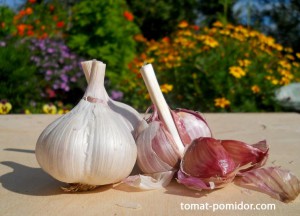
Harvesting and Curing
About three weeks before the harvest (which usually falls in late July or early August), stop watering the garlic completely. How do you know exactly when your garlic is ready? Leave two or three scapes on the plants to act as “indicators.” When those curly scapes stand up completely straight and the wrapper on the bulbil capsule bursts open—it’s time to harvest!
Another sign of maturity is the yellowing and browning of the bottom leaves. Always dig your garlic in dry weather. Don’t delay the harvest; it’s better to dig it a little early than too late. Bulbs left in the ground too long will split their paper wrappers and won’t store well. If possible, leave the dug garlic on the garden bed for a day, and then move it under a canopy (hanging it up or laying it out in a single layer) to cure until completely dry.
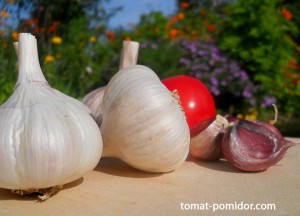
Only trim the tops and roots after the garlic is fully cured and dry. Handle your harvested garlic gently, avoiding bruising or dropping it, and it will store perfectly for you all winter long.
💬 Grower Comments & Discussion
If fall-planted garlic has already sprouted and even has visible leaves by early October, what will happen to it? Is there any point in hoping for a harvest from it?
Uh-oh, why did you plant it so early? What region are you in? A thick layer of mulch might help save the situation, but we are still a long way from real snow cover. If your garlic survives at all, you’ll still get a harvest, but the leaves that have sprouted now will die off and new ones will grow in the spring. I haven’t even planted mine yet, aiming for late October.
The leaves can overwinter just fine under the snow if the winter is mild! If that happens, the yield won’t be affected. But if they freeze to death—then I don’t know.
I planted my overwintering garlic right after pulling my dahlias… is it okay to do that?
Why not? I think it’s perfectly fine.
My garlic grew so well this year! Huge, juicy, and very pungent! 😁
How and where is it best to store it indoors?
I’ll share my experience: Garlic needs more than a month to build a massive root system. I’ve tested this. I plant in the very first days of September (before the 10th). I dug one up a month later, and the roots were only about an inch (2 cm) long. For a great winter survival, it needs a “beard” of roots at least 2.5 to 3 inches (6-8 cm) long. It will grow those out over October. I’ve confirmed this myself.
When the clove is ready for winter, it goes into a state of suspended animation (dormancy) on its own. Neither a lack of snow nor severe frosts will hurt it. My garlic has NEVER sprouted prematurely above ground with this early planting method. I used to plant the old-fashioned way in late October, and my harvests were poor.
Also, harvesting after the bulbil capsule bursts open is TOO LATE. As soon as the scape stands up completely straight—THAT IS THE TIME. If you wait another day or two, it’s over, and it won’t store well at all. I dry them in bunches of 10-15, hanging heads down, until the foliage is crumbly dry. Then I trim them. I place the clean, dry bulbs in open 3-liter glass jars (without lids). They store perfectly right up until the end of summer without losing any juiciness.
I agree with Yashma regarding the planting dates.
I plant my garlic around September 10-12, and I sow a cover crop (usually mustard) between the rows. The garlic puts down roots, while the mustard grows tall. After the first solid freeze (just below freezing), I cover the bed right on top of the green mustard with birch leaves. I put a net over it so the wind doesn’t blow the leaves away.
In the spring, I remove the net. The wet, compacted leaves form a crust, which the strong garlic shoots easily punch right through. The little bulbils (if you planted them for seed) can’t push through it—they lack the strength—so I rake the leaves back slightly for the babies, and once they sprout, I push the leaves back in place.
The mustard, or rather what’s left of it, acts as a green manure fertilizer for the garlic. The leaf mulch suppresses weeds and keeps the soil moist. By mid-summer, almost all the leaves are gone—digested by earthworms.
After harvesting the garlic, I add a ton of compost to the bed—garlic loves rich soil. Before planting, I add wood ash and granular fertilizer. In the summer (up until mid-July), I feed them with stinging nettle tea and ash tea. And once early in the summer with a balanced fertilizer.
I disagree with setting specific calendar dates for planting!
You have to base it on the weather! Last year in our village, the onions and garlic planted in late September all sprouted above ground before winter. We planted ours in late October and it worked out perfectly—they didn’t sprout prematurely and they didn’t rot.
It’s now late June, and we’ve already snapped off the scapes. The plants are robust and massive! The onions are doing great too, no bolting.
Ladies, rust (fungus) has appeared on my garlic. What should I do now, or is it too late to spray it?
Lelik ph said:
Ladies, rust (fungus) has appeared on my garlic. What should I do now, or is it too late to spray it?
Don’t panic! Before you plant your next batch of cloves in the fall, soak them in a strong fungicide and plant them with peace of mind!
We had this disaster a few years ago; the whole crop was covered in those rusty spots, we just looked at it and cried! We soaked our seed cloves in Bordeaux mixture before the next planting, and the garlic grew wonderfully—large and completely clean!
Because of the unusually warm weather, I had to delay planting my fall garlic. Is it too late to plant now? What is the absolute deadline for planting? 😳
Fotinia said:
Is it too late to plant now? What is the absolute deadline for planting?
As long as you have a couple of weeks where the temperature stays around 50°F (+10°C) after planting, you are fine.
Yashma said:
Harvesting after the bulbil capsule bursts open is TOO LATE. As soon as the scape stands up completely straight—THAT IS THE TIME.
Maybe that’s why I always have storage issues! No matter what I try—in glass jars, in flour, in a warm room, in a cool room—it always dries out over winter. I was starting to think I was doing something wrong, no matter how many YouTube videos I watched. But this is the first time I’m hearing about the scape indicator rule! I’m definitely doing that this year: as soon as the scapes stand straight up, I’m digging.
The bulbil capsule should burst. And it stores perfectly well until the next harvest just sitting in a simple cardboard shoe box. I read that tip years ago and have been using it ever since.
To get massive heads, I feed my onions and garlic with the following mix: Per 2.5 gallons (10 liters) of water, I add 1 tablespoon of ammonium sulfate, 1 tablespoon of potassium sulfate, 1 tablespoon of magnesium sulfate, and 1 teaspoon of iron (ferrous) sulfate. Two of these feedings spaced 10 days apart yield fantastic results. Garlic and onions absolutely love sulfur and respond incredibly well to this feed.
mopsdad1 said:
To get massive heads, I feed my onions and garlic with the following mix…
Mikhail, when do you apply this feeding? What do you feed them with in the spring?
Veselyi ogorodnik said:
Mikhail, when do you apply this feeding?
I give the first feeding (just the ammonium sulfate) as soon as the green shoots emerge from the ground. If it’s rainy, you can just broadcast 1 tablespoon dry per 10 square feet (1 sq meter). Or you can mix 1 tablespoon in a bucket of water. I give the full sulfate mix when the plants have 4 true leaves. And the second full feed is given two weeks after that.