Quick Summary of PPI
Note: This variety is frequently grown and compared alongside its “sister” variety, OPO.
- 🌍 Origin & Type: A rare variety from the USA. It is classified as a “Dwarf”, but behaves more like a semi-determinate or a compact indeterminate (tree-type). In a greenhouse, it easily reaches heights of 5 – 5.5 ft (1.5 – 1.7 meters).
- 🌱 Seedling Habit: In the seedling stage, it displays classic dwarf traits—extremely stout, thick-stemmed, and compact. It will not stretch or get leggy on your windowsills.
- 🍅 Fruit Characteristics: Produces stunning dark/purple beefsteaks weighing between 5-12 oz (150g and 360 g). The flesh is firm and meaty, holding its seeds suspended in a striking green gel.
- 👅 Flavor & Storage: Outstanding, rich flavor! It is intensely sweet with just a very subtle hint of tang (acidity). Unlike many dark tomatoes, it has an excellent shelf life and can sit on the kitchen counter for about 10 days without going mushy. Highly resistant to cracking.
- ☀️ Growing Tips: Several growers noted that PPI performs exceptionally well when placed in a spot that receives direct morning sun but is shaded from the baking afternoon heat.
Grower Reviews & Photos
PPI (USA) – dwarf
Seeds from Angelina. Mid-season, indeterminate variety. I grew it outdoors, pruned to 3 stems. The plant grew just over 150 cm (5 ft). The variety is productive and very, very tasty. What is especially valuable—it is delicious right from the very first tomato!!! It has plenty of both sweetness and acidity, but the sweetness dominates, making the flavor very bright and intense. The flesh is dense, not overly juicy. It stores well and doesn’t crack. I will definitely be growing this again.
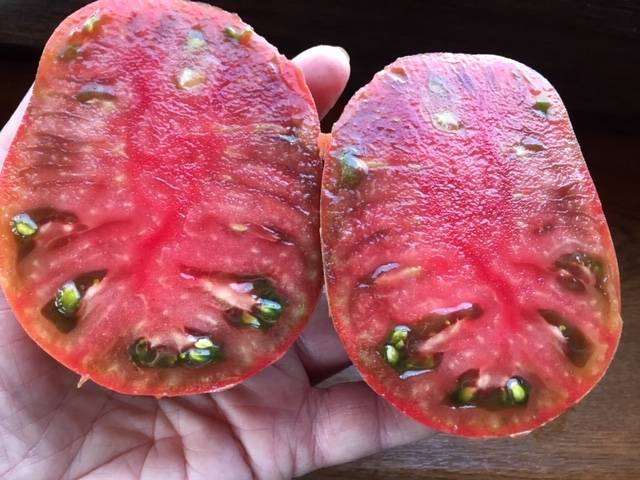

I grew both dwarfs from my “sweet couple” again – OPO and PPI. Both are among my season favorites once more. Both delighted me with their taste and yield.
Seeds were sown on February 20. I planted 1 plant outdoors and 3 plants in the greenhouse.
As a seedling, PPI is just gorgeous! The little plants are strong, stocky, they don’t stretch, and just radiate health! They somewhat resemble plants from the Dwarf Tomato Project, but they behave more like classic indeterminates, and by transplant time, they grow into rather tall little monsters, about 70-80 cm (2.3 – 2.6 ft).
The seedlings were already blooming by planting out time.
The greenhouse plants reached about 160 cm (5.2 ft), the outdoor one about 120 cm (4 ft).
The first fruit ripened in early July. Tomatoes are of medium weight, roughly between 150 – 350 grams (5 – 12 oz). The flesh is firm, without excessive juiciness, and the seeds sit in a green gel.
The flavor is intense, sweetness dominates, and the acidity is barely noticeable. Delicious right from the first fruits! They can sit on the counter for about 10 days without losing their flavor.
Here it is next to OPO, for comparison…


Is PPI a dark tomato? My garden label faded in the sun. It’s a good thing you photographed them side by side, thank you! I knew I had either PPI or OPO planted there. Seeing this, I realize I have PPI. A very tasty tomato.
Galiy said:
Is PPI a dark tomato?
Yes, Galya. PPI leans towards the “blacks” (dark purple/brown). It most likely is a true dark variety. And OPO is pink-crimson-red.


Tatka said:
Yes, Galya. PPI leans towards the “blacks”… And OPO is pink-crimson-red.
Thank you, Tanyusha, for the seeds. The tastiest tomato.
Tanechka, I logged in specifically to thank you for the info about OPO and PPI, and also for the seeds. I got a couple of seeds of each, and I will definitely be saving my own seeds now, because these are very tasty, beautiful, productive, and trouble-free tomatoes.
My seedling was brutally chewed up by invisible pests right at the beginning; only one leaf remained… I waited and hoped a sucker would grow. And it did! It was late, but it survived, grew out, pushed through the struggle, and bore 2 full trusses! Thank you!
Good afternoon! I also wanted to add my review of these beauties—I will definitely be replanting them! Tatiana, these plants are from your seeds, thank you!
My plants grew to 1.5 – 1.7 meters (5 – 5.5 ft), and the fruits were all large. I pruned them to 4 stems. The tomatoes are delicious and meaty. I want to try planting them outdoors next year. This year all my other Dwarfs (except these two) are sitting outside and have performed wonderfully.


Elena G. said:
My plants grew to 1.5 – 1.7 meters, and the fruits were all large…
Lena, I’m so glad they were to your liking. And they turned out so huge for you! Mine were much more modest in size.
Dwarf PPI.
Tanyusha, it completely won my heart too, thank you for the seeds! This season I planted several plants in different spots in the greenhouse, and it was a huge success! It grew like a full-fledged indeterminate. I pruned it to 2 and 3 stems. It set a lot of fruit—beautiful, uniform, meaty, and of excellent taste, weighing up to 360g (12.7 oz).


Svetikk said:
It set a lot of fruit—beautiful, uniform, meaty, and of excellent taste, weighing up to 360g…
Svetik, thank you for making me so happy with this! And they turned out so weighty for you!
For some reason, my PPI had rather small fruits this year, staying around 200 grams (7 oz), no more. I want to plant at least 4 plants of it again next season.
@Tatka, I have 2 PPI seedlings. One has regular leaves, and the other has potato leaves. Is that possible? (I couldn’t have mixed up the seeds).
Rara Avis said:
One has regular leaves, and the other has potato leaves. Is that possible?
Lena, that hasn’t happened to me. It’s unknown exactly how “young” this variety is—if it’s a newer breeding line, it’s possible that the leaf type genetics are not completely stable yet.
Dwarf PPI.
Another dwarf that you just want to keep growing again and again. Productive and tasty. At the seedling stage, it truly is a dwarf—sturdy and stocky. But in the greenhouse, it behaves like an indeterminate, albeit a shorter one. It grew to about 1.6 m (5.2 ft).
The fruits are dark beefsteaks, averaging 200-300g (7-10.5 oz). Very tasty, just like its “stepbrother”, Dwarf OPO. It’s perhaps even more productive than OPO due to the larger fruit size and overall plant vigor. It’s a mid-season variety, and the ripe fruits store quite well.
I decided to test these two dwarfs (PPI and OPO) based on numerous positive reviews, and I definitely made the right choice. I liked both; each is good in its own way. Even though they aren’t strict dwarfs in the classical sense, they still maintain the main advantage: compactness as seedlings and relatively modest height at their final planting spot. And most importantly—they are NOT late-season, and they are delicious. Before this, most of the dwarfs I tested in our region wouldn’t fully ripen on the vine, even in greenhouses.


PPI is a good variety, but I expected more. It didn’t quite reach “masterpiece” status for me.


Chrizantema57 said:
PPI is a good variety, but I expected more. It didn’t quite reach “masterpiece” status for me.
For me, it never really gained vigor. I planted it for three years. Got about 2-3 tomatoes per plant. Taste-wise, it was just an ordinary tomato flavor for me. It remained short in the greenhouse.
I’ll show my PPI too.
It was of medium height, grew near a wall with direct sunlight only until noon. Dark fruits with a juicy, excellent tomato flavor. Photo from August 7.

OlyaSashina said:
…grew near a wall with direct sunlight only until noon.
Olya, I’ve come to the conclusion that this exact placement—where direct sun hits only until noon—is the absolute best for this variety.
Although, over the last five years, I’ve planted it in every possible spot in the greenhouse, and it felt fine everywhere.
Tatka said:
Olya, I’ve come to the conclusion that this exact placement… is the absolute best for this variety.
Yes, Tanya, it made me very happy! I finally got around to growing it. My greenhouse gets full sun all the time now, but at least this specific side only gets PRE-noon sun. I was afraid to put it directly in the baking midday heat since it was my first time growing it. And it’s a good thing I did—the other side of my greenhouse floods during heavy rains (the drainage from the house roof isn’t adjusted yet), and a lot of tomatoes on that side cracked completely.
Diagnosing PPI: Is it Bull-Stemmed (Too Vegetative) or Just Thick?
Good afternoon! Tatyana, please tell me, is this PPI plant getting too vegetative (bull-stemmed), or is this normal development for it? The thickness of the stem is making me a bit nervous. It only set 1 tomato on the very first truss.
Also, how many leaders (stems) can I let it grow? Right now it wants to split into 4… I’m wondering if I should pinch the extras or if it will be fine like that.

RaDda said:
is this PPI plant getting too vegetative (bull-stemmed), or is this normal development for it?
Natasha, it’s a bit hard to see the growing tip in the photo, but if it’s only the stem thickness that’s worrying you, that is completely normal for this variety. At least, my PPI plants always have these chunky, thick stems—it’s just a varietal trait.
RaDda said:
And how many leaders (stems) can I let it grow? Right now it wants to split into 4…
No, don’t prune them if you have a way to trellis them! Four stems is the absolute sweet spot.
Unlike other indeterminates, I never prune PPI (or OPO) down to two stems. I leave at least 4, which is what it naturally wants to do anyway… Honestly, it usually wants to do more and can easily handle 6 or even 8 leaders. Obviously, I don’t let it get that crazy with multiple heads in the greenhouse anymore because it gets too crowded and impossible to tie up.
But one year outdoors (back when I thought it was a regular compact dwarf), it turned into an absolute monster octopus covered in suckers, and every single one was loaded with tomatoes! I didn’t know how to prune such a plant back then, and by the time I realized how many new shoots there were, they were already so thick and powerful that I was scared to cut them off. I completely lost count of the stems! 😂
RaDda said:
The thickness of the stem is making me a bit nervous. It only set 1 tomato on the first truss.
Natalya! I haven’t grown this specific variety myself. Time will tell what kind of yield this plant will give you. But based strictly on the condition of the growing tip, I’ll share my thoughts.
You can determine if a plant is in a vegetative/generative balance by looking at the top leader (the distance from the very top growing point down to the highest blooming truss). That distance should be around 6 to 8 inches (15-20 cm). If the top is longer than that, the plant is leaning generative; if it’s shorter, it’s pushing excessive vegetative growth (getting fat/leafy).
The stem thickness near the top truss should be about 1/4 to 1/3 inch (0.6-0.8 cm), and absolutely no more than 1/2 inch (1.2 cm) for large-fruited beefsteaks. Also, the blooming upper truss should curl downward like a little fist. If the flower truss points straight up toward the sky (like in your photo), it’s a classic sign of excessive vegetative growth.
In your case, the stem looks to be right at or over that 1/2 inch limit. The fact that the stem looks flattened/ribbed near the truss confirms it. This plant is clearly pushing too much vegetative growth, which is predictably why it aborted the other blossoms on that first truss and only set a single tomato. If this is just “normal” for this specific variety, as Tatyana mentioned above, then time will tell!
Natasha, Vadim…
Generally speaking, all PPI plants have a pretty sharp transition in thickness from the very tip down to the lower part of the top section. On mine, the stem right under the top flower truss is about 1/3 to 3/8 inch (0.8-1 cm) thick, but just slightly below that, the stem instantly gets much chunkier. They’ve always grown exactly like that for me.
Tatyana! A thickness of 1/3 inch (0.8-1 cm) is perfectly normal for a beefsteak variety. It’s a shame we couldn’t see the second important metric for the vegetative/generative balance—the length of the top leader. As I mentioned, it should be 6-8 inches (15-20 cm) down to the blooming truss.
In the photos, most of the upper trusses are already blooming, so it’s hard to make a 100% accurate diagnosis from just these pictures. But overall, I don’t see a massive imbalance, though a few plants are definitely getting a bit too “fat.” You can see the stem flattening out and forming a groove right under the top truss.
The Vegetative vs. Generative Balance: A Deep Dive
Tatka said:
No, don’t prune them if you have a way to trellis them! Four stems is the absolute sweet spot.
Got it, I’ll take a photo of the growing tip tomorrow just in case!
I’ll let it grow out to 4 stems then 👍. I don’t have room for any more than that since they are in the narrow center bed in the greenhouse. Thank you for the replies! 🌷🌷🌷
DRYGAN said:
the distance from the very top growing point down to the highest blooming truss…
Is this the distance I need to measure? This top truss is just starting to bloom. If so, it’s definitely 8 inches (20 cm), maybe even a bit more.

I also went ahead and picked off the baby “buds” (ovaries) that stalled and didn’t start growing right away. I only left the one little tomato on the truss that actually took off. Now I think I messed up… On my other plants, some of those tiny stalled “buttons” eventually woke up and started growing. I won’t pinch them off anymore!

RaDda said:
If so, it’s definitely 8 inches (20 cm), maybe even a bit more.
If it’s more than 6 inches (15 cm), it confirms the plant is leaning heavily vegetative. The main thing is to figure out *why*, and what you can do in your specific setup to stop or slow down this vegetative growth.
There is a known checklist of fixes for this, though backyard growers can’t control all of them. Ideally, you’d increase lighting, raise the average daily temp, widen the day/night temperature gap to 10-12°F (5-6°C), and drop humidity to 50-60%. But that’s hard to do in a basic greenhouse.
What you *can* do: cut back on watering, eliminate nitrogen from your fertilizers, snap off one leaf from the top canopy, and increase ventilation as much as possible. Pay close attention to your spring watering—let the soil dry out. The moisture should drop by about 10-12% by the evening after watering. This mild stress pushes the plant to shift into a generative (fruiting) phase.
Natasha, yes, they look identical! 👍 Honestly, your plants look perfectly fine to me. If tomatoes are setting and you aren’t seeing massive blossom drop, I personally wouldn’t change a thing. If it ain’t broke, don’t fix it! 🤷♀️
In general, PPI looks very different from other varieties both as a seedling and as an adult. It really stands out with its sturdy posture. I can always spot my PPI plants instantly.
I think you’ll agree that it builds its canopy and pushes suckers differently, too. When they are young, the plants are stocky, widespread, bushy, and very leafy. But as adults, they get slightly lanky (while remaining thick), the tops stretch out like snail eyestalks, and they almost look a bit “bald” because the top leaves stay small at first against the long internodes. I hope I’m explaining that right!
RaDda said:
I also went ahead and picked off the baby “buds” (ovaries) that stalled…
Wow, you have an iron will! I could never bring myself to pluck off baby tomatoes!
Now that single fruit you left on the truss is probably going to be massive… Our friend Natalya N. once grew a PPI tomato that weighed over 1.1 lbs (500g)—which is huge for this variety! I don’t remember if she pinched off the other blossoms to achieve that, though.
RaDda said:
I also went ahead and picked off the baby “buds” (ovaries) that stalled and didn’t start growing right away.
Natalya! If the blossom has already folded back its sepals, and the ovary hasn’t swelled up by then, it’s an unpollinated/aborted blossom. It’s never going to grow, even if you leave it on the vine until fall.
You probably had a mix of aborted blossoms and ovaries that were just swelling very slowly. The lack of fruit set on early trusses is usually tied to low light, excessive vegetative growth, extreme temps, humidity issues, or a nutrient imbalance (too much/little nitrogen, phosphorus, iron, or manganese).
That excessive vegetative growth in the spring is almost always caused by overwatering. It keeps the soil too wet while the sun isn’t strong enough yet. Just be careful with your watering can in the early season. If you squeeze a handful of soil 20 minutes after watering, water shouldn’t drip out or even feel squishy between your fingers.
Also, regarding your flower trusses pointing up at a sharp angle—that’s caused by wild swings in lighting while the truss was forming (e.g., intense blazing sun followed by days of heavy clouds). You can’t fix that now, just make sure to support those trusses with J-hooks once the fruit gets heavy, otherwise the stem will snap.


