Overwintering Chrysanthemums in a Greenhouse: An Unexpected Experiment
🌱 Quick Summary & Key Takeaways
- The Real Killer: Most chrysanthemums do not freeze to death in the winter; they die from crown rot caused by sitting in soggy, wet soil during freeze-thaw cycles.
- The Greenhouse Hack: Moving mums into an unheated greenhouse for the winter keeps the soil bone-dry, protecting the dormant roots from winter rains and melting snow.
- Timing: You can transplant blooming mums into the greenhouse in late fall. This extends their blooming season and gives them a safe place to go dormant.
- Alternative Methods: If you don’t have a greenhouse, growers in the comments share success with root cellar storage or taking winter cuttings.
Chrysanthemums… the beloved flowers of autumn. But for many years, I was tormented by the question: how on earth do I keep them alive over the winter? Our winters here can be very strange—sometimes it’s 50°F (+10°C) with pouring rain, and other times it drops to -22°F (-30°C) with absolutely no snow cover. And after such winter “surprises,” one beautiful mum after another simply failed to wake up from its winter hibernation.
I don’t have a root cellar, and all sorts of tricks with heavy winter mulches and covers never gave me a 100% success rate. But then, a “palace” appeared in my garden kingdom: a polycarbonate greenhouse. And shortly after, I purchased another large-flowered florist mum.
Deciding that fortune favors the bold, I chose not to plant the blooming stem in the flowerbed (it was already late September). Instead, I planted my “bouquet on a stem” directly into the greenhouse soil. There were still many buds on the mum, and being planted in the greenhouse allowed it to delight me with its magnificence almost until the end of November. After the blooming finished, I cut off the single main stem and discovered tiny new shoots emerging from the roots.
I’ll be honest—I hoped for a successful overwintering, but I wasn’t really counting on it. In late January, when the severe frosts began, I went to check on my beauty. The soil was absolutely bone dry, and the young shoots were “glassy” from the deep freeze. But there was nothing to do—I just had to wait for spring.
Finally, the spring sun began to warm things up. And to my absolute amazement, my beauty started coming back to life right before my eyes! I found no traces of winter damage on the new shoots; they were sturdy and dark green. And instead of one single branch, I ended up with a cluster of at least a dozen shoots! In May, I divided this wonderful little bush and planted it out in the flowerbed.
The Golden Rule of Overwintering Mums
Watching my chrysanthemum develop over the summer, I tried to figure out: what conditions are actually necessary for them to overwinter successfully? I read through countless amateur gardening forums online, finding a ton of advice, much of which contradicted itself.
Now, I will try to systematize the information I gathered piece by piece:
- Chrysanthemums MUST overwinter in dry soil. If the soil is wet, the frequent temperature swings (freeze-thaw cycles) will destroy the young basal shoots that start growing in the fall.
- Contrary to popular belief, this flower is not afraid of the cold. It is afraid of excess moisture. Bushes rot and damp-off much more often than they actually freeze to death.
- Heavy covers can be a trap. The various covers we use to protect our flowers from the frost often end up trapping moisture and provoking the growth of fungal diseases.
The conditions inside an unheated greenhouse, however, suit chrysanthemums perfectly. By moving them under a “roof,” we extend their growing season—in the fall, we give the large-flowered varieties a chance to put on a full show, and in the spring, they get a head start on growth. If there is a sudden winter thaw, a plant wintering in a greenhouse is not in danger of rotting. And the occasional winter rains won’t harm it at all.
Perhaps some might disagree with this method of overwintering mums in a greenhouse. I am not insisting, nor do I claim this is the only way—everyone has the right to choose what works for their microclimate. I will just be happy if someone finds this information useful.
Gardener Comments:
Thanks for the article! I have an immediate question—mine bloom in the outdoor flowerbed, of course. When is it “too late” to transplant a mum into the greenhouse? After it finishes blooming (most likely early November), is it too late? Thanks for the reply.
If you dig it up with a good, large root ball of soil attached, then yes, of course you can.
I was told that you can also overwinter Campanula (perennial bellflowers) in greenhouses this way. They apparently survive perfectly… but I haven’t tried it myself yet.
I buried 11 mums in my greenhouse, and not a single one survived the winter. 😢
Mine also didn’t survive this year. Mice ate some of them, and the rest just rotted away.
Mine overwintered beautifully in the polycarbonate greenhouse. I dug them up with a root ball, being careful with the young basal shoots, covered them with mulch leftover from the tomato plants, put a layer of row cover on top, and during the deepest freezes, I threw some woven burlap bags over them. In the spring, I gradually removed the layers. They are already blooming now!
veronika57 said:
Mine overwintered beautifully in the polycarbonate greenhouse… covered them with mulch… row cover… burlap bags…
But if you didn’t do this whole “dance” with the covers—wouldn’t they have just survived in the garden bed? All of mine overwinter right in the beds. My beds are slightly raised compared to the walkways (better drainage). I just leave them cut down for the winter and that’s it. Minimum effort, and they pop right up in the spring.
I mostly grow Globe Mums (Multiflora type), which are notoriously tender, so I tried to do the extra “dance.” But I am very happy with the results.
My Globe Mums also overwintered perfectly in the greenhouse, but I sprinkled them with dry oak leaves on top for insulation.
All my spherical Globe Mums overwintered perfectly, both the ones transplanted into the greenhouse and the ones left outside under cover with my roses. I never got around to transplanting one out of the greenhouse in the spring, and that Branbeach Gold mum grew to 70 cm (27 inches) tall inside! I had to break off half its branches because it was suffocating my tomatoes. But to my surprise, the tomato leaves in that “jungle” didn’t have a single spot of disease and were a very dark green color.
So I will probably transplant all my numerous Globe mum varieties later in the fall under the rose bushes and cover them together.

Forgot to mention that the greenhouse doors were left open for the winter, and there was no snow inside. Apparently, dryness is much more important for the wintering of Globe Mums than heat.
I didn’t cover the mums with anything inside, and I didn’t even cut back their old foliage.
The climate inside a greenhouse in winter is actually much harsher than outside. The soil freezes quite deeply, unlike garden soil under a thick blanket of snow, where the temperature sits just below freezing, and at a depth of 20cm (8 inches), it hovers right around 32°F (0°C). (I tested this over 2 winters).
However, daytime temperatures in the greenhouse are very often above freezing on a sunny day, and even the top 5 cm (2 inches) of soil can thaw out in a single afternoon.
As for Globe Mums, my overwintering experience is limited to just this past winter. I left 10 bushes in two different greenhouses. In one, I covered them with light scrap insulation. In the other, I left the mums completely uncovered to compare.
In the end, only 5 out of 10 survived, and I had losses among both the covered and uncovered mums. This method of storage clearly doesn’t work for me. Now I’m thinking—maybe it’s better to just put the root balls in the root cellar.
The temperature down there is about 41°F (+5°C). It is humid, yes, but if I don’t put the mums directly on the floor and build a little canopy out of scrap plastic above them so condensation doesn’t drip on them, it might work.
But the absolute best storage method is to take cuttings in the fall and keep them indoors over the winter as small potted plants. I did that, and interestingly, 2/3 of the cuttings kept trying to bloom all winter (I kept pinching off the buds). When I planted them out in the garden in the spring, I let them bloom freely. They bloomed through spring and summer, but of course, the bushes remained small because all their energy went into premature blooming.
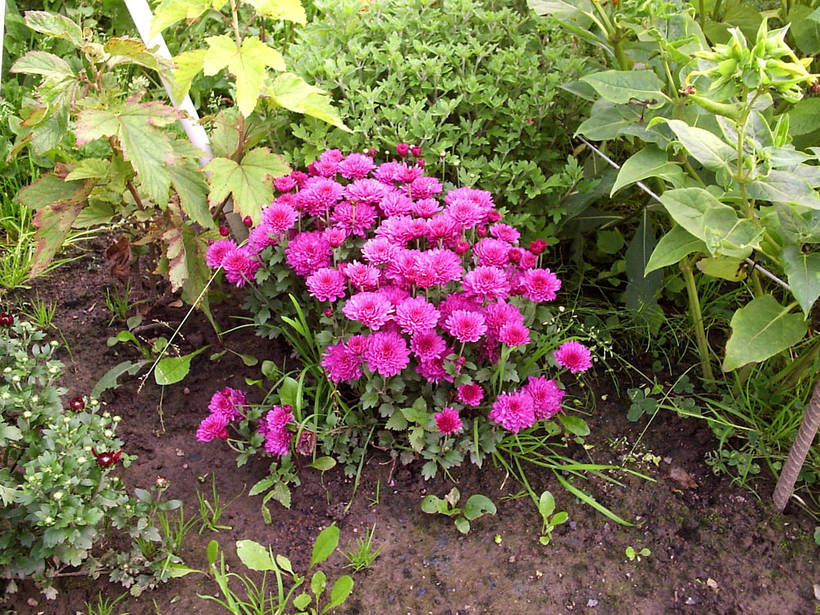
This year I decided not to transplant them into the greenhouse; I was short on time. The Globe Mums were growing next to the roses, so I just covered everything together in one long low tunnel. Let’s see what comes of it.
Do you need to water them when you transplant them into the greenhouse for the winter?
I dig up my Chrysanthemums, shake off the soil so only a little bit remains on the roots, and pack them all tightly together in a crate (roots down, tops up). I sprinkle peat moss over the roots, water them lightly, and put them in the basement/root cellar. I water them maybe 2 times over the entire winter. In February, I pull them out, and when they start turning green, I take cuttings to root for the new season.