Growing Astilbe: From Store-Bought Roots to a Thriving Shade Garden
🌱 Quick Summary & Key Takeaways
- Rescuing Bare Roots: Don’t let store-bought bare roots rot in the fridge. If they are sprouting, pot them up indoors immediately in a 1-gallon pot.
- Sun vs. Shade: Astilbe thrives in partial shade. It can handle full sun (and will bloom heavier!), but only if the soil is kept constantly moist.
- Soil & Water: Loves moisture and doesn’t mind “wet feet” (high water tables). Never let it dry out!
- The Secret Scent: Astilbe has a wonderful honey fragrance, but it usually only releases its scent in the morning sun.
- Companions: Pairs perfectly with Hostas, Bergenia, Lily of the Valley, and ornamental Alliums.
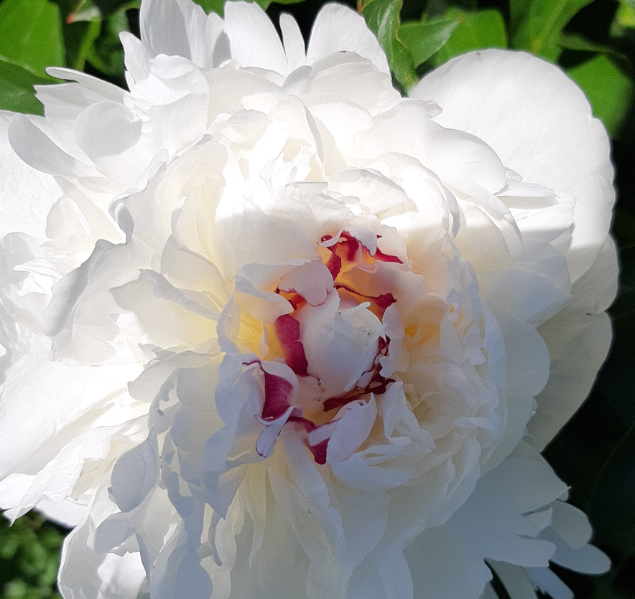
“… sweet scent of white Astilbe’s bloom,
May fill your garden like perfume!..”
Astilbe is an incredibly popular perennial in our gardens. It is beautiful, low-maintenance, and honestly, what more could most of us ask for!?..
How to Plant a Store-Bought Bare Root (So It Grows and Doesn’t Rot!)
In early spring, big-box stores and garden centers are absolutely packed with commercial bags of bare-root Astilbes. However, they are often stored in terrible conditions in the stores. By mid-March, finding decent planting material can be difficult—most of the bare roots sitting in plastic bags on warm shelves have already sprouted and started to rot.
Therefore, the best thing you can do is buy these roots no later than mid-March, or better yet, in February.
What you do next depends on the condition of the plant. If you see white or red thread-like sprouts emerging, it is too late to put the bag in the refrigerator. It will just rot in the crisper drawer, and you might as well throw your purchase straight into the trash.
But if you are sure the plant is still in “winter dormancy mode,” you can safely store the bag with the bare root on the bottom shelf of your fridge for a couple of months.
What if the plant has already decided it’s spring and is actively sprouting? Nothing could be simpler! You will need a bag of peat-based potting soil (standard seed-starting or all-purpose mix is fine, as long as it’s not too acidic), plus a 2-liter or preferably 3-liter (approx. 1-gallon) pot.
Plant your little root in the pot and put it on a windowsill. Let it grow!
The cooler your windowsill is, the better. After all, you probably want your Astilbe to bloom outside in the garden, not inside on your window, right? In a warm room, it will grow incredibly fast, and at temperatures around 68°F (20°C), it will almost certainly bloom by the end of April. Oh well, if that happens, just enjoy the early show! 🙂
Water your potted seedling only as the topsoil dries out. Do not water too frequently, or it will rot. But don’t let it dry out completely either, or it will die. Astilbe hates being parched!
Can You Plant Astilbe in a Smaller Pot?
You can, but as usual, the bigger the pot, the better. After all, nurseries sell blooming Astilbe plants in 1-quart to 1-gallon pots… However, if you use a small pot, basic potting soil won’t be enough. You will need to add some slow-release fertilizer and/or feed the seedling with liquid fertilizer as needed.
Planting Astilbe in the Garden
The great thing about Astilbe is that you can plant it in a shady corner of the garden (and oh, do we have plenty of those shady corners!), and it will make that spot look stunning. 🙂
It also doesn’t mind a high water table or soggy soil. It’s a lifesaver, not just a plant!
But this doesn’t mean you should shove your Astilbe into pitch-black shade inside a swamp. The absolute best spot is one where it gets direct sunlight in the morning or evening, but is protected by shade during the hot afternoon hours.
You can plant it under the canopy of trees that don’t have an overly dense crown. It will get enough dappled light, and it’s up to us to provide it with enough nutrients and moisture!
Astilbe cannot tolerate dry spots. Even a short period of drought will cause the plant to severely lose its decorative appeal (crispy, brown leaves).
If you want to plant Astilbe in a full-sun location, you can, but you must ensure it gets plenty of water during dry spells. In full sun, Astilbe blooms just as beautifully—in fact, the blooming is more prolific. BUT… it is much shorter-lived. You get roughly twice as many flowers, but they fade twice as fast. That’s the trade-off!
The Secret Scent of Astilbe
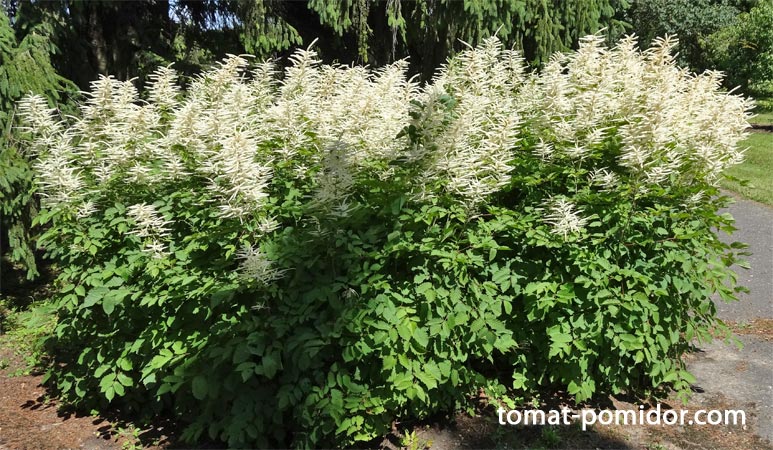
You might not have noticed, but Astilbe smells amazing! It has a rich, honey-like fragrance that carries quite a distance, attracting not only bees but gardeners too. 🙂 An interesting feature of this plant is that it only releases its scent in sunny weather, mostly in the first half of the day. So, if you want to enjoy this incredible honey aroma, plant your bushes where the morning sun hits them from dawn until noon.
Landscaping & Companion Planting
Astilbe bushes should be planted 40-60 cm (16-24 inches) apart. The taller the mature plant is supposed to be, the wider the spacing you should leave.
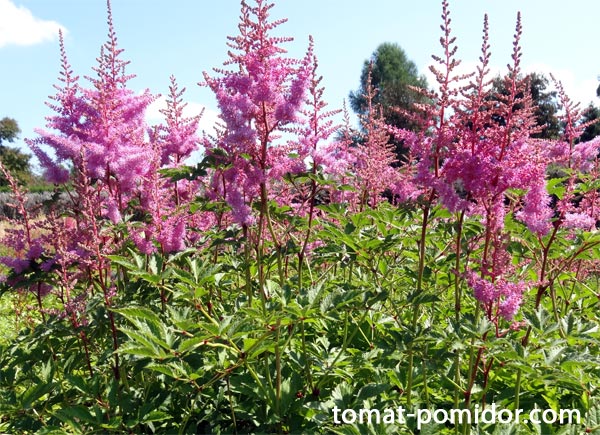
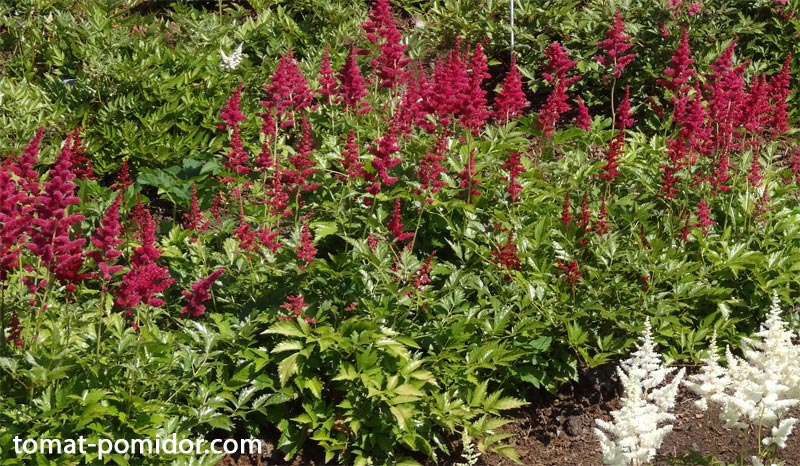
The feathery plumes of Astilbe blend harmoniously with most garden plants. Their most frequent companions in shade gardens are, of course, Hostas. They also look fantastic paired with large-leaved Bergenia (Pigsqueak), ornamental rhubarb, and other broad-leaf shade lovers.
A wonderful addition to an Astilbe bed is planting Lily of the Valley in the foreground (in the shade) or small perennial ornamental Alliums (in partial shade or sun).
Fun fact: Light-colored (white/pale pink) Astilbe varieties generally tolerate full sun better, yet they visually look much more striking in the shade. It’s a bit of a garden paradox!
Propagating Astilbe is as Easy as 1-2-3
Propagating Astilbe is simple. Like most herbaceous perennials, you just dig it up and divide the root clump into several pieces. It is best to do this early in the season, just as the new leaves are poking through the soil.
Plant the divisions into soil that has been thoroughly enriched with compost or well-rotted manure, and by the second half of the summer, it will usually bloom as if nothing ever happened.
Gardener Comments:
It’s a revelation to me that Astilbe has a scent in the first half of a sunny day! You think you know more or less everything about your favorite plant, and then… nope, I completely missed that. I’ll definitely check it out this spring… Thank you!

Can you tell me if it is okay to plant Astilbe next to Peonies?
Why not? Of course, you can. However, THEORETICALLY, the Astilbe might not grow quite as vigorously because Peonies (like other members of the Buttercup/Ranunculaceae family) tend to suppress their neighbors. But this level of suppression can easily be offset by good soil care, watering, and feeding. 😉