Quick Summary: Why Do Tomatoes Crack?
- 🌡️ The Main Culprit: Extreme heat combined with inconsistent moisture levels. When temperatures soar, roots can’t absorb water fast enough during the day, causing the fruit to slightly shrink.
- 💧 Nighttime Expansion: At night, when temperatures drop and humidity rises, plants greedily absorb moisture from the air and soil. The sudden influx of water causes the fruit flesh to expand faster than the skin can stretch, resulting in bursting.
- 🛡️ Prevention Methods: Drip irrigation is highly recommended to provide a steady, consistent water supply. Heavy mulching (8–10 cm / 3–4 inches of grass clippings) helps stabilize soil moisture.
- 🍅 Most Vulnerable Varieties: Unfortunately, the most delicious, thin-skinned, sweet, and large-fruited tomatoes (especially pink and black heirlooms) are the first to split.
The Summer of Bursting Tomatoes. Why tomato fruits crack and how to deal with it.
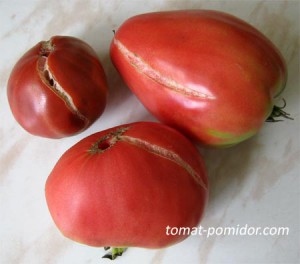
This year, whoever you ask is complaining that their tomatoes have burst right on the bush. There are fewer cracked fruits outdoors in open ground, but they are still there. And in greenhouses, it’s an absolute epidemic.
Actually, there is nothing surprising about this… The summer didn’t just turn out to be hot; it was incredibly hot. Many people wonder: what does the heat have to do with it? Well, the heat is exactly the main culprit behind the cracking tomatoes this year. ☀️
So, the question of the day: why do tomatoes burst and crack? And why does this happen more often in greenhouses than outdoors?
Without beating around the bush, this phenomenon is very easy to explain. In hot weather, during the day, plants desperately lack moisture. Even if you have drip irrigation set up in your greenhouse (which is rare in amateur tomato growing), when the outside temperature is over +40°C (104°F), the plant’s roots often simply cannot keep up with supplying the needed amount of moisture. Especially since the comfortable temperature for tomatoes is known to be 20-25°C (68-77°F), not 40-50°C (104-122°F) as it gets inside a greenhouse… The only saving grace is that deep underground, even in such heat, there is always a layer of soil with a comfortable temperature for the roots.
Therefore, in regular greenhouses where watering is often done just once a week, plants suffer from a lack of moisture during the day. At the same time, the size of the fruit slightly decreases, it sort of shrivels up… But at night, the plant greedily begins to absorb moisture: water vapor from the air condenses, settles on the leaves as microscopic particles, and is immediately absorbed through the leaves and stems. The fruits become saturated with water, stretch (often literally by fractions of a millimeter), and this stretching of the fruit is quite enough for the tomato skin to burst. 💥🍅
How to fix it:
The most effective way to combat tomato cracking in such hot weather is drip irrigation. Well, or at least water your tomatoes frequently—every day, or every other day. However, don’t forget that high humidity in the greenhouse combined with hot weather promotes the spread of certain fungal diseases (like Leaf Mold and Late Blight). Therefore, you should water directly at the root—for example, into plastic bottles with the bottoms cut off that are stuck into the ground…
The common practice—to water tomatoes rarely but heavily—always leads to the appearance of cracked fruits, especially in such heat and during the fruit-filling period. But at the same time, it reduces the risk of fungal diseases spreading.
Unfortunately, it is precisely the most delicious tomatoes—large-fruited beefsteaks, thin-skinned, and sweet ones—that usually burst first. Pink-fruited heirlooms are typically the absolute record-holders for the number of cracked fruits. 😞
I was worrying for nothing! It turns out practically everyone had their tomatoes crack. And I was already about to throw away the rest of my seeds. Now I will definitely plant them next summer and see the result!
To prevent tomatoes from cracking, you need to organize proper watering, i.e., water not every day, but once every 3-4 days, but heavily. Tomatoes do not like it when they are watered every day. In such weather, the greenhouse should have been shaded from the outside with something or whitewashed. Usually, in normal weather, tomatoes are watered once every 7 days.
In principle, everything is correct, but slightly the other way around… The thing is, it’s not that tomatoes DO NOT LIKE being watered often… it’s just that fungal infections strongly LIKE high air humidity. That is why it is often not recommended to water tomatoes frequently. However, maintaining a constant, sufficient soil moisture in one way or another would be highly desirable and would help combat cracking… And if you watered them once a week in such heat, they would have cracked even more and wouldn’t have sized up. The ideal solution would be a combination of mulching and drip root irrigation… 😎
The heat came when the tomatoes already had full foliage and fruits, so mulching wasn’t strictly necessary, although it is an important agricultural technique. And drip irrigation for tomatoes is completely incomprehensible to me. After all, their root system is not located like cucumbers’. I really want to know, has anyone grown a “tomato tree” in a barrel? I grow tomatoes in bottomless containers myself, but I haven’t tried a barrel.
Mulching helps maintain constant soil moisture, without sudden drying out and getting wet. In combination with drip irrigation, the effect of an even moisture supply is enhanced. Which, in fact, contributes to the even filling of fruits without cracking…
As for the tomato root system, it is highly variable and adapts to different conditions. If the top layer of soil has a lot of moisture and nutrients, it will develop a superficial root system, almost like cucumbers…
Dear Pomidoroved, what do you think about growing a tomato tree in a barrel? Have you read about EM-technology (Effective Microorganisms)… I think that in a 100-liter barrel you can grow it even without EM-technology, but fruiting will be late, because it’s outdoors, not in a greenhouse. But a 200-liter barrel…
Good day to you… Well, unfortunately, I don’t think anything about this tree, because I had no interest in growing it… I read that people had “something growing somehow somewhere,” but I didn’t pay close attention to it. 🙂
It’s not a tree per se, but an indeterminate tomato variety that is grown by continuously adding soil to a barrel. And because the root system increases, the main stem becomes thick, and this is what is called a “tree.”
(Later) Has no one really grown it, or is it just an advertising gimmick?
(Later) Alright, I found everything I was looking for about the tomato tree. If anyone needs it, search Google Images.
I bought ‘Shapka Monomakha’ (Monomakh’s Hat) from the Siberian series. They promise 700g (1.5 lbs) fruits. Has anyone planted it? I don’t see any reviews.
I planted 2 bushes of ‘Rio Grande’ tomato in a 200L (50 gallon) barrel. I didn’t prune the suckers. I harvested 2 buckets of tomatoes. I liked it. I will plant it again this year.
Actually, tomatoes should be watered at planting time, then when they produce fruit, and then when the fruits turn red, you need to flood them with a daily norm, and the tomatoes will be safe and sound.
Pomidorschik, are you saying that tomatoes should be watered 3 times per season? Stop talking nonsense and spouting gibberish. 🤦♂️
Alexey, I think that watering is very individual. Maybe he has such conditions, climate, and weather that three times is quite enough. I believe him ))). And for you, maybe even 10 waterings will not be enough. You have to look at the plants.
Good evening everyone, I grew the ‘Sprut’ (Octopus) tomato-tree outdoors in open ground. I got a pretty good harvest of tasty, sweet tomatoes. My tomatoes grew up to two meters (6.5 ft) tall, but as they write about them, to grow up to five meters, you need a year and a half of time. Alas, we don’t have that opportunity. Regarding drip irrigation, I was very pleased; the root system grew so much that in some places it was visible on top, even though I buried them deep when planting.
Having walked the path from building a greenhouse to harvesting tomatoes, I can confidently say: “Only Russian women and women from the post-Soviet space can accomplish such a heroic feat as growing a tomato crop. Only they are capable of hard labor in extreme conditions and telling stories about their achievements. I bow deeply to you, dear women of the tomat-pomidor forum. Be happy and in good health!” Respectfully, Lord. 💐
How simple everything is for you guys/girls! …but it takes a long time to write. I can’t do it briefly and concisely, because we need to consider the options for the right conclusion and tips. I will try to describe EVERYTHING in the “treasure box of experience” section.
My experience this year showed that you can get away with not watering at all, even in our scorching Volgograd summer. Everything was as usual, watering once a week, until ‘Black Elephant’ burst looking like a McDonald’s hamburger. 🍔 It was about mid-July. Realizing that I was losing the crop anyway, I gave up and decided not to water them, following the example of grapes: when they start to color up, stop watering.
‘Black Elephant’ and ‘Black Prince’, having drunk even the lightest rain, burst again, but the rest successfully yielded a harvest, and when it got colder, they set plenty more fruits. All indeterminates were under a light spunbond cover. Next year I will confidently do the same. Of course, thin-skinned black tomatoes are more capricious, and they need to be more strictly isolated from water, because if they stick a root out to neighboring watered plants, they drink and immediately crack. The leaves dry up a bit, of course, but if you pick them off from the bottom, not that many will dry up. The varieties were Budenovka, Pound Rosemary, Persimmon, Black Baron, Chocolate, and a few mislabeled ones.
I haven’t watered for 3 years now. I mulch with freshly cut grass, making an 8-10 cm (3-4 inch) cushion under the tomatoes, and leave it like that all summer. Aside from a couple of feedings per season, they grow and don’t complain.
This year I went a bit overboard with potatoes, and it seemed to me that I didn’t have enough space for tomatoes, so I planted them closer together, more densely. Since I work in the city, and it got dark early this year, the tomatoes were practically abandoned. Everything grew! I was surprised when they grew so much that I was exhausted processing them all. They grew densely, and there were almost no weeds. Weeds are a headache for me; by the time you finish fighting them in the potatoes, onions, and carrots, it’s already time to harvest.
Exactly, weeds are like that, they crawl towards the light. But if you mulch them, denying them light, the light doesn’t penetrate. The roots of the old weeds remain and suck water from the depths. Meanwhile, our potatoes or tomatoes see the light, grow, and rejoice, taking water away from the weed roots. And there’s no need to weed or water! They just grow, and we rejoice. 👍
Quote from Nadezhda:
Has anyone grown a tomato tree in a barrel? I grow tomatoes in bottomless containers myself, but I haven’t tried a barrel.
I only grow the trailing/hanging ‘Talisman’ tomatoes in a barrel. They like it very much)))