📌 Quick Summary: Old-School Allium Secrets
- 🧅 Why Onion Tips Turn Yellow: A sudden lack of topsoil moisture causes the tips of onion and garlic leaves to dry out and turn yellow. An old farmer’s trick is to leave tiny weeds alone (they shade the soil) and avoid wild moisture swings.
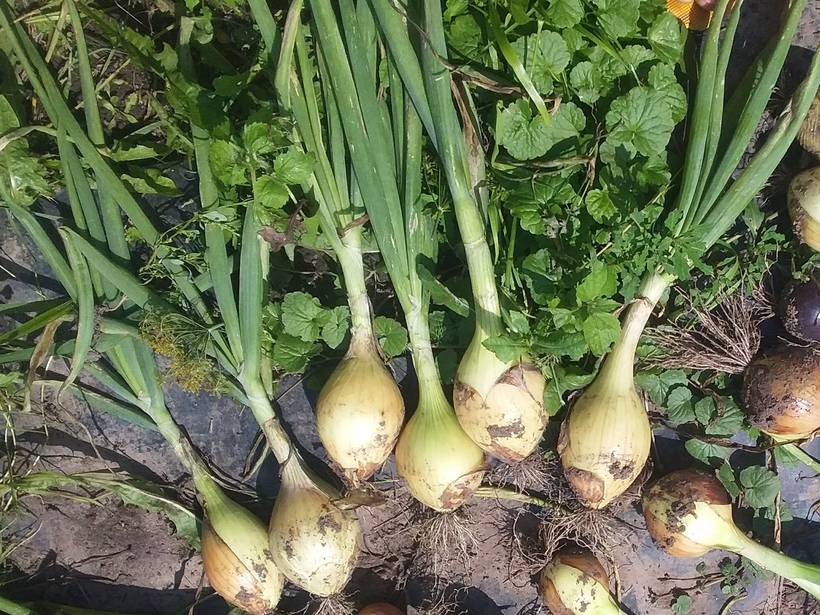
- ☀️ Exposing the Bulbs: About two weeks before harvesting onions, you should pull the dirt away from the bulbs, exposing the top half to the sun. This helps them cure properly and prevents rot.
- 🥶 Cold Soil Fertilizer Rules: When the snow just melts, the ground is too cold for soil microbes to process standard fertilizers like Urea or organic matter. The only Nitrogen fertilizer you should use on early spring garlic is Ammonium Nitrate.
- 🌳 Nature’s Thermometer: Don’t want to measure soil temperatures with a thermometer before applying micronutrients? Just watch the trees. When the birch leaves start opening, the soil is warm enough!
Photo: MADanilich.
Aleksan9ra wrote:
Andrey, I won’t argue with you, I’ll just state my opinion. Deep planting is meant for winter garlic. For spring garlic, deep planting is useless.
Good afternoon, Lyudmilka!
I ain’t looking to argue with NOBODY, we are just having a dialogue and sharing opinions, that’s all! Onion and garlic have a very specific root system, especially garlic. They respond heavily to early NPK feedings and the moisture levels in the top layer of the dirt. That is exactly why they have their own growing quirks.
If you want a solid onion harvest, quit pulling every single tiny weed out of the beds. And you absolutely must pull the dirt away from the bulbs, exposing at least half of the bulb to the air, about two weeks before pulling them up.
Why?
Because the topsoil dries out fast, and the onions and garlic feel that sudden thirst. That is exactly what causes the tips of the leaves to dry up and turn yellow, and not just the “old” outer leaves, but the young ones too! The consequences are obvious: pests move into those hollow leaves, and then… well, you know.
Garlic doesn’t react quite as violently to moisture swings. But still, premature yellowing of the old leaves at various growth stages is an indicator of either natural maturity or wild swings in soil moisture. If the soil moisture is stable, the leaves on both spring and winter garlic will only start drying up after they are 3/4 of the way through their growing season.
Maybe things are different in other regions, I won’t claim to know it all. Soil, humidity, and sun are different everywhere.
As for planting spring garlic, I agree with you, Lyudmila. You plant it shallower (about half an inch to an inch above the clove, on average), but it all depends on your dirt and how hot the sun bakes it.
As for me, during hot days, both my onions and garlic require a very light watering, just a tiny bit, just to keep a little moisture in the very top layer of the soil. I stop watering completely 7 to 10 days before the harvest.
That’s about it! It’s easier for me to explain my methods by taking pictures. What am I supposed to do in the winter!?? You just picture a garden bed in your head and try to describe it…
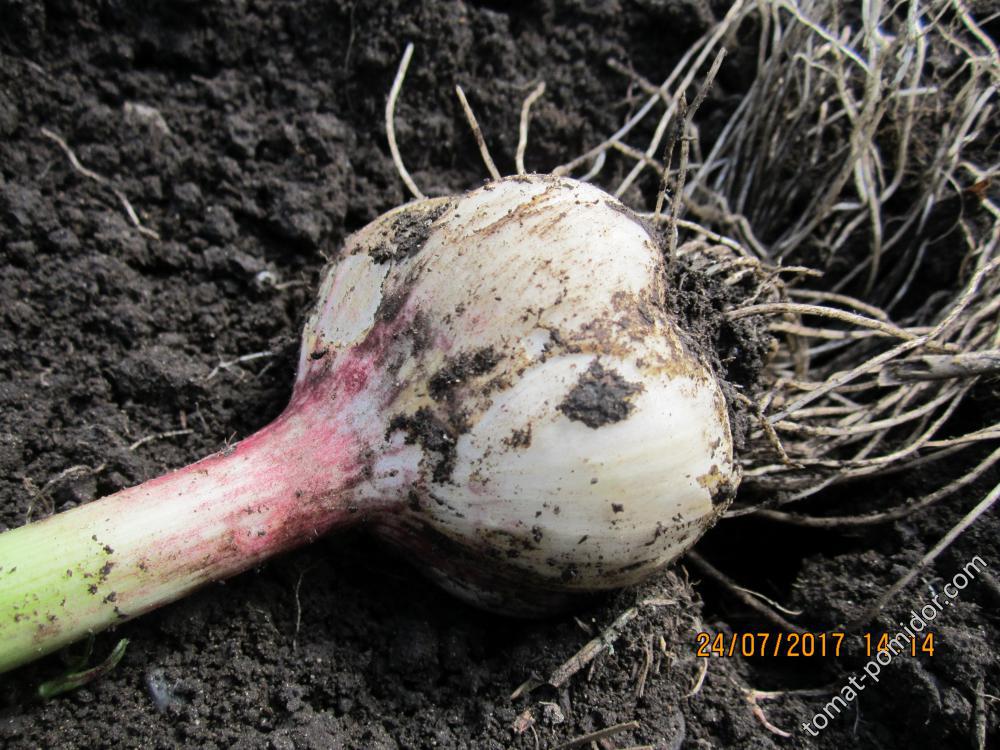
As for winter garlic roots, they have some unique development traits. In the fall, after planting, the garlic root grows mostly straight down. The earlier we plant it, the stronger that taproot gets.But in the spring, the moment the sun starts warming up the top layers of the soil, it starts pushing out tiny lateral feeder roots. This is how the garlic gets its nutrition. That’s why it is crucial to pull the mulch back as early as possible and hit the garlic with Ammonium Nitrate, specifically Ammonium Nitrate and not Urea, because it is the only one that works in freezing temperatures.
Aleksan9ra wrote:
In the fall, after planting, the garlic root grows mostly straight down.
Yes! It has its quirks, and not just winter garlic. Honestly, garlic is kind of like humans (maybe not ethical to say, but true for some varieties!). 🤭
A clove sprouts a “momma” stalk, which has its own path in life. Then the “babies” (new cloves) appear. At first, they feed off the “momma,” who has her own root system. Then the babies grow up and (just like humans) start their independent life using THEIR OWN root system, but they stay under the “protection” of the momma until they grow their own skin strong enough for independent living.
Oops! I am drifting into fairy tales again. Looks like the time for writing fairy tales is over, a lot of folks don’t get them. But if I speak in another language (botany, geography, climate data), the other half of the readers won’t understand… After all, most readers pick up pure practical experience from their ancestors, videos, books, and analyzing their own mistakes.
“…It is gloomy and very dark here…”
Same here, it is snowing, but in the middle of the day it looks like late evening… and it is strangely warm for our area. Believing long-term weather forecasts… personally, I just don’t. In nature, just like in modern life, EVERYTHING changes so rapidly, it’s hard to predict anything.
MADanilich wrote:
They respond heavily to early NPK feedings and the moisture levels in the top layer of the dirt.
Good afternoon! Allow me to jump into the discussion. I agree about NPK, especially in the spring, but they also absolutely need Magnesium (Mg) and Sulfur (S) for health and nutrition, and to prevent the tips of the leaves from drying and turning yellow!
Lyudasik wrote:
…they also absolutely need Magnesium (Mg) and Sulfur (S)…
That is just the “side dish” for ALL plants, we ain’t even talking about that. Every single plant needs its own specific set of trace elements and ratios to be “complete” and have a good immune system… to build up an “antivirus” against diseases and negativity, so to speak. (Half-joking).
Lyudasik wrote:
…they also absolutely need Magnesium (Mg) and Sulfur (S)…
Lyuda, we are talking about the specific period when the snow has literally just melted. The soil temperatures are still very low, around 39F (+4C), so there is zero point in giving them anything other than Ammonium Nitrate.
About 7 to 10 days later, depending on the weather, you can hit them with Diammonium Phosphate plus micronutrients. And that is only if you didn’t amend the bed in the fall! If the bed was well-prepped in the fall, those nutrients will start working and you might not need anything else. Micronutrients won’t hurt, but save them for later, when the soil warms up to at least 54F (+12C).
Aleksan9ra wrote:
Micronutrients won’t hurt, but save them for later, when the soil warms up to at least 54F (+12C).
Absolutely correct, Lyudmila! I just need to add one tiny clarification… save them for later, when the soil warms up to at least 54F (+12C)……. AT THE DEPTH OF THE ROOT SYSTEM.
Now the concept is complete, from an agronomic point of view…
Yes, garlic starts its growth when the temperature at the root zone gets above 35F (+2C). In the spring, bare patches of thawed ground hit that temperature pretty fast.
P.S. Forgive me, Lyudmilka, for tracking mud all over your diary here, I am heading back to my own thread. I invite anyone who is interested to come visit. Though I don’t have any serious info posted right now… not yet… “Winter hibernation”, sotahspeak! 😁
Andrey, what is a “sotahspeak”?I have a really hard time reading overly serious, dry information. 😢 That is why I love Lyudmila’s diary! 😘 It’s simple and straight to the point. Thank you, Lyudmila, it really saves me at the dacha! 🌹
Galiy wrote:
Andrey, what is a “sotahspeak”?
It’s a joke! Andrey just slurred the phrase “so to speak”.
MADanilich wrote:
P.S. Forgive me, Lyudmilka, for tracking mud all over your diary here…
Andrey, drop by more often, I am always glad to see you, and useful information is never a bad thing.
As for soil temps, it’s easier to just say “wait until the birch leaves open up”, that’s easier for people to understand, we don’t exactly go out and measure the soil temperature with a thermometer every single time.
👨🔬 Editor’s Botanical Note: Freezing Soil and Nitrogen Lockout
In this thread, Ludmila shares an absolute masterclass rule for spring garlic care. She says: “That’s why it is crucial to pull the mulch back as early as possible and hit the garlic with Ammonium Nitrate, specifically Ammonium Nitrate and not Urea, because it is the only one that works in freezing temperatures.”
Why doesn’t standard Urea work in cold soil? It comes down to biology.
Urea is not readily available to plant roots. When you apply Urea, it must first be broken down by soil bacteria into Ammonia, and then into Nitrate. The problem? Soil bacteria are dormant in cold weather! If you apply Urea or organic manure when the ground is near freezing, it just sits there doing nothing while your garlic starves and turns yellow.
Ammonium Nitrate, on the other hand, provides Nitrogen in a form that the plant roots can instantly absorb, completely bypassing the sleeping soil microbes. This is why it is the ultimate “wake-up” fertilizer for early spring crops!