📌 Quick Summary (TL;DR)
- 🌍 Origin: Bred by J&L Gardens Seeds. There is a fun debate among growers regarding the name: many believe “Amazon” refers to the Amazon Parrot (which is green with red markings) rather than the river, given the fruit’s original coloring.
- 🌿 Plant Habit: Indeterminate, though relatively compact. The breeder lists it at about 1 m (3.3 ft), but in greenhouses with lower light, growers report it stretching to 1.5 m (5 ft). Important: It produces very wide, dense regular leaf foliage. It requires prompt and heavy pruning to ensure proper air circulation and prevent fungal issues.
- 🍅 Fruit Characteristics: Medium to large slicing tomatoes, weighing 200-300 g (7-10.5 oz). Note on Stability: The community has noted that this variety might be unstable or has segregated over time. The original J&L strain produces green fruits with red/brown stripes, while other prominent sources (like Tatiana’s TOMATObase) show lines that ripen red with yellow stripes.
- 👅 Flavor: Bright, sweet, with a very pleasant spicy/tangy kick.
- ⏳ Yield & Climate: Produces a good, steady yield (about 3-4 fruits per truss). Well-suited for greenhouses, open ground, and even large containers.
I grew it in the summer of ’16. The seeds were from J&L Gardens Seeds, the originator of the variety.
Description from the originator’s website:
“Banded Amazon is a full-size slicing tomato, compact bush with wide regular type foliage, indeterminate, about 1 m (3.3 ft) tall. It has a big, bright flavor that matches its striking appearance. Productive, with some tomatoes weighing up to 200-300 grams (7-10.5 oz). Suitable for containers or greenhouses.”
Everything turned out exactly as described, the only difference was that in the greenhouse my bushes grew up to 1.5 m (5 ft). But this was due to the internodes stretching in partial shade and the presence of quite a few overcast and rainy days.
The foliage is very wide; you need to start pruning it almost immediately after transplanting. The bush is sturdy. I think that if grown outdoors in open ground, it will act like a semi-dwarf and stay under 1 m (3.3 ft).
The yield, of course, isn’t a bucket per bush, but it is good. There are 3-4 fruits in a truss; my main stem managed to set 4 trusses, and a sucker set 2 more. I didn’t have to ripen any off the vine; I picked them fully ripe or right on the verge of full ripeness.
As a specific trait of this variety, I want to note that it needs good air circulation. In ’17, I will plant it outdoors under a row cover. And it didn’t get sick. Or maybe there was nothing left to get sick, since I prune the foliage heavily and don’t spare it.
Overall impression — a pleasant new striped variety, very uniform in shape, with a nice spicy-sweet flavor 🙂
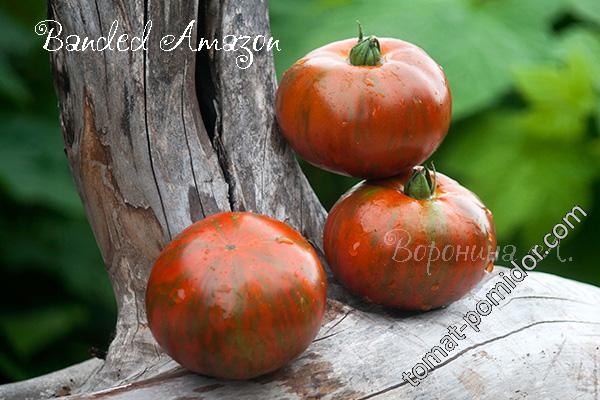
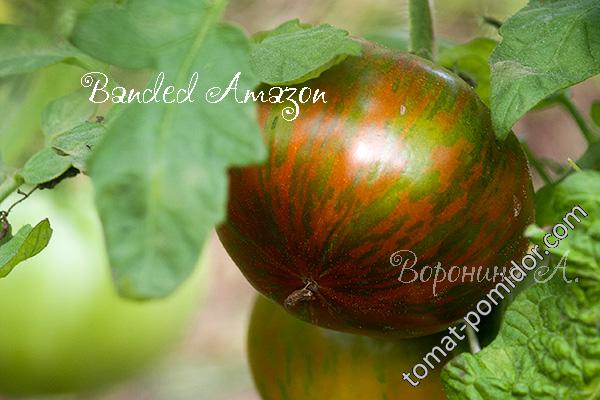
It seems to me that people might be misinterpreting the name. It likely doesn’t refer to the Amazon river/women, but rather the Amazon parrot. They are mostly green, and some species have red spots or stripes. Both words are spelled the same in English—Amazon.
Therefore, in my opinion, a more accurate mental picture would be the “Striped Amazon Parrot”.
Here is another interesting thing: in Tatiana Kouchnareva’s database, at Redko’s [a Russian seed seller], and in one other place, the photos show fruits that are red with yellow stripes, rather than red stripes on a green background like the originator shows.
What is this — an unstable variety?
In any case, the variety is very interesting, beautiful, and the height is attractive — 1.5 m (5 ft) in the greenhouse. I am ready to do a seed swap for it.