📌 Quick Summary (TL;DR): Cow’s Tit
- 🌍 Origin: A famous and slightly cheekily named heirloom from Russia, originally known as Korovye Vymya (Cow’s Udder) or Sisechka. Widely popularized among collectors by Russian seed seller V. Redko.
- 🌿 Plant Habit: Indeterminate (tall). Performs well both in greenhouses and outdoors, though yields can vary depending on sun exposure.
- 🍅 Fruit Characteristics: Elongated, pepper- or banana-shaped paste tomatoes. They are very dense and meaty, with thick walls and virtually no seeds inside.
- 👅 Flavor & Use: Excellent, rich flavor. Because they hold their shape beautifully when cooked, they are top-tier for processing into sauces, making winter salads, or slicing into baked casseroles.
- ⏳ Maturity: Mid-season.
Description from the seed packet:
“Tall (indeterminate), mid-season. Fruits are large, long, and banana-shaped, weighing 80-150 g (2.8-5.3 oz). They are very dense with almost no seeds, and the taste is excellent. Very high yield. Ideal for winter canning and salads. Suitable for greenhouses and open ground.”
My seeds were from V. Redko. The plant grew in the greenhouse on the shady side. It grew tall and ripened mid-season, but the yield was below average for me. “Just an ordinary pepper-shaped tomato,” my neighbor said when she saw it 😆.
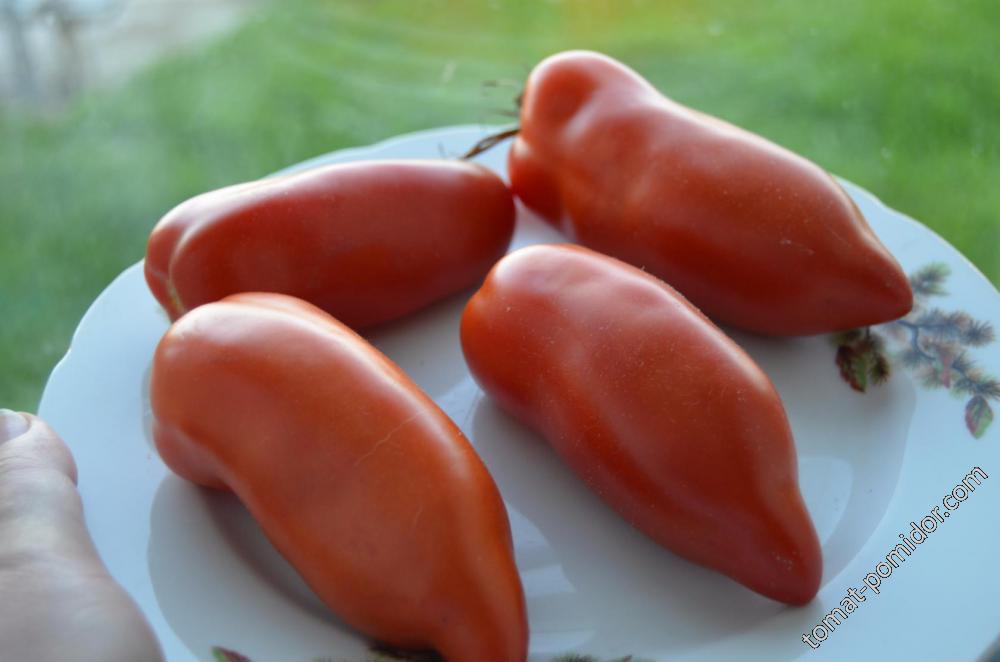
I also grew it from Redko’s seeds. My yield was excellent—each fruit truss was massive, about two hands wide! I grew 3 plants in total: one in the greenhouse and two outdoors. I pruned them to two stems.
Redko listed it as a canning variety, but my fruits grew to about 200 g (7 oz)—which is a bit too large for whole-jar canning. When sliced, they are a beautiful crimson red and very tasty, though for my palate, they lack just a tiny bit of acidity. They store quite well after picking.
I’ve also grown similar elongated types like Italian Plum, Federle, and Dragon’s Tooth. These varieties are absolutely fantastic for processing—the flesh is very meaty but not dry, with very few seeds. They are also brilliant for cooked meals. When you slice them into thick rounds and layer them in a baking dish alternating with meat, zucchini, and eggplants, they bake perfectly and don’t fall apart into mush.
However, the absolute leader among these elongated paste types for me is still Italian Plum—it produces the most uniform fruits with tiny or completely non-existent seed cavities.