When and How to Transplant Lilies
By Pomidoroved
Lilies are beautiful and unpretentious flowers, especially the Asiatic varieties. But from time to time, even they require the gardener to pick up a shovel. We are, of course, talking about transplanting and dividing.
How often should you transplant them? Usually, after planting, lilies grow perfectly well in one spot for 4-5 years without requiring any special care (rare feedings and mulching don’t count! 😉). But gradually, they increase in quantity, while their quality—on the contrary—deteriorates. This is simply because they get too crowded. The plants become shorter, weaker, and the flowers become smaller and sadder… What to do? It’s time to divide them!
Interestingly enough, the less you care for your lilies, the less often you have to transplant them. Because if you don’t feed them much and generally do nothing, they won’t multiply very fast. Just make sure the weeds don’t completely choke them out.
Dividing Overgrown Lilies! But When?
Here it is—the question that worries so many people. For some reason. It never worried me until I looked at what people were writing “on the internet.” Can you believe it, they often recommend dividing lilies in the spring, claiming that this is when their root system is actively growing.
I just want to ask these respected authors: Why on earth would you want to interfere with an actively growing root system? After all, if you damage it in the spring, the lily will bloom much later, and it will go into winter without having accumulated a proper supply of nutrients after blooming. Let’s leave the root system alone in the spring—let it grow in peace! That is our motto. We will transplant and divide our bulbs in the autumn!
Important! At least a month should pass after the lily finishes blooming, and preferably 1.5 to 2 months, so that the bulb has time to recover and is actually ready for transplantation!
Autumn Transplanting: Timings and Actions
Like all respectable bulbous plants, after blooming, lilies busy themselves by accumulating nutrients “deep inside themselves” (i.e., into the bulb) needed for their “spring start.” Therefore, let me remind you that after blooming, the green above-ground parts are not cut off until autumn, until they wither away naturally. Sometimes they don’t wither until the frosts hit; that’s fine—you can cut them off after the first frost. However, the green seed pods should be snapped off immediately after the flower drops its petals.
By early to mid-September, the above-ground part has usually done its job, and the lilies are actively preparing for winter. This includes, by the way, building up their root system. But unlike spring growth, the roots are now growing as a reserve for next year; meaning, for this year, they have largely completed their task. Now is the perfect time to start transplanting.
Climate note: The author of this article grows lilies in a Baltic climate (long, mild, warm autumns). For those who live deep inland or in colder continental climates (like Siberia or the US Midwest), the time for transplanting lilies is shifted back to mid-August, so that the bulb has time to establish itself before the deep freezes hit! In the Moscow and Leningrad regions, you can also transplant lilies in late August to early September.
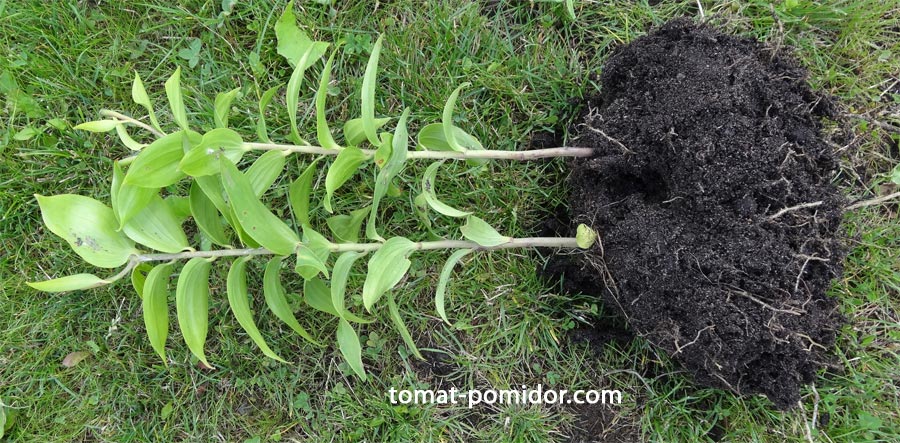
For lilies whose leaves have turned yellow (or even just started to turn), cut the stems as short as you like. Usually, stumps of 10-15 cm (4-6 inches) are left, but you can leave less. If the lilies are still standing completely green, it is not strictly necessary to cut off the tops, but in that case, you must damage the roots as little as possible during the move. Grab your sturdy gloves and a shovel, step back about 30 cm (12 inches) from the bush, and dig deep under the root ball.
Different species, and even different varieties of lilies, can have different root systems. For some, after digging like this, the bulbs fall apart right in your hands like potatoes, and you just pick them out of the dirt. For others, the root system is massive and tightly grips the entire ball of earth.
Here you will have to use your hands, slowly shaking off the dirt and freeing the large main bulb and the baby bulbs surrounding it. It also depends on the soil structure—separating bulbs in sandy soil is obviously much easier than in heavy loam.
By the way: The deeper you plant a bulb, the more baby bulbs (offsets) it produces. And the later it blooms.
It is not so easy to separate those massive, tangled clumps of roots. But on the bright side, lilies with root clumps like that can be transplanted any time you want, even when they are in full bloom, as long as you keep a large chunk of the original soil intact around the roots.

Busting Transplanting Myths
I honestly confess—I feel absolutely zero need to do the things that wander from one gardening article to another, such as:
- “Cutting the roots right down to the basal plate”
- “Soaking/treating the bulbs in Malathion, potassium permanganate, and other colorful, foul-smelling liquids”
- “Mandatory cutting of the above-ground part” (if it’s still green – why?..)
Well, suppose your lilies are actually sick or attacked by some tiny pest—then sure, you can soak them in a strong pesticide… But if everything is fine with them—why do it? And the roots? Why cut the roots off a plant that has perennial roots? Lily roots do not die off every single season like garlic or onions, for example; they grow all the time, sometimes faster, sometimes slower. If you cover your lilies for the winter or just mulch them well so that the ground doesn’t freeze solid, the roots will slowly continue to grow all winter long.
Depth and Spacing
Well, that’s almost everything about the transplanting process itself. There are two technical points left: planting depth and the distance between bulbs.
The depth can vary from 10 to 40 cm (4 to 16 inches). In sandy soil and warm places—plant deeper; in heavy clay—plant higher. The minimum depth is the diameter of the adult bulb multiplied by 2. The optimal depth is the diameter multiplied by 3 or 4.
The distance between bushes should be dictated by common sense and experience. The closer you plant them, the sooner you’ll have to divide them again. Plus, some varieties have huge heads of flowers, reaching half a meter (20 inches) in diameter. If you plant lilies like that too close together, it will just look ugly and crowded. For “regular” lilies, the average distance between bushes is 20-30 cm (8-12 inches).
With that, we can consider the autumn transplantation of lilies complete. Now you can mulch your plantings with hay or fallen leaves and wait for summer, when your beautiful lilies will delight you with their lush and bright blooms! 😊
Storing Dug-Up Bulbs
A dug-up bulb must be planted as quickly as possible—they dry out and spoil very fast in the open air. Lilies do not have a protective papery tunic like onions or tulips do. If for some reason you need to delay planting, place the bulb in damp moss or sawdust, or in a pinch, wrap it in a wet newspaper or place it in a plastic bag.
If you want to save a dug-up bulb all the way until spring, it is best to do this by burying it slightly in a root cellar where the temperature will be just above 0°C (32°F), or in the refrigerator, in a plastic bag with slightly damp moss or sawdust (you’ve surely seen how lily bulbs are sold in stores like this)…
Grower Comments & Experiences:
Very short and clear, and most importantly, straight to the point!)) Thank you! Excellent article, I wish there were more like this one! 👍