How to Grow a White Clover Lawn from Scratch: Honest Pros & Cons ☘️
Articles about lawns are usually so boring to read. They are all dry, like an accountant’s ledger: “Remove 10 cm of turf, lay 10 cm of turf. Pour 100 grams of seed per 100 square decimeters…” No, for people with creative ambitions, this won’t do at all! 😂
Let me start by saying I am not a lawn professional. If I were, I’d be writing about those 10 centimeters of turf. In fact, I never wanted a traditional grass lawn. You could say I was a fan of the anti-lawn movement before it even had a name! There are plenty of guys who dream of a lawn as some sort of symbol of domestic success. And there are probably just as many women dreaming of one. But I’ve been completely indifferent to lawns my whole life.
However, I *had* to make one. Since there was a bunch of empty dirt around my recently built house, a weed-apocalypse began—prickly thistles, pigweed, and some sort of grasses growing as tall as a man… Clearly, I couldn’t leave it like that. I had to either pave the whole thing with concrete/asphalt (which is unacceptable to me) or plant a lawn. A lawn was acceptable, even though I had never made one before.
And then there are the neighbors. You visit one, then another. They proudly show off their pristine lawns. I look at it… it’s just grass shaved like a buzzcut. Big deal. “No, I will be original—I will make a lawn out of clover,” I decided. Mostly because I had a random packet of white clover seeds lying around, meant for an area of 500 square meters. (For comparison, buying traditional grass seed mixes for the same area would have cost about 10 times more! 💰)
Step 1: Preparation & “The Log Roller” 🪵
But before sowing the clover, I had to give the surrounding ground some semblance of flatness and add at least a little topsoil.
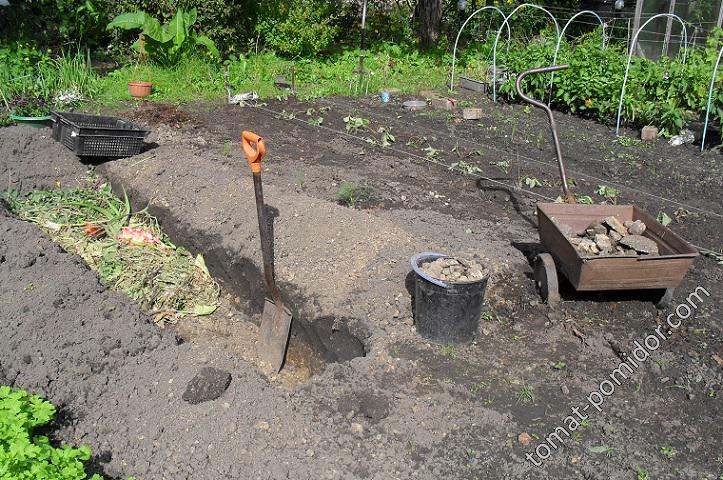
To level it, I used about 50 cubic meters of sand, topped with just as much black soil. I ended up with a relatively fertile layer of about 10 cm (4 inches). The workers hastily leveled it with rakes. Just before leaving, the last and “most important” worker revealed a professional trade secret to me (almost in a whisper, while his colleagues were already sitting in the running car ready to leave): apparently, before sowing grass, all this topsoil must be compacted.
I didn’t pay much attention to his words—if it needs compacting, we’ll compact it later.
Then it rained… The black soil compacted itself in some places, and in others, it didn’t. It became clear that the “just toss the seeds and wait” method wouldn’t yield a good result.
I had to go online and read about tamping and compacting lawns. Oh, the hilarious methods I found! Rolling a water-filled barrel. Putting a sheet of plywood on the ground and jumping on it—preferably with a family of no less than three people. 👨👩👦 There were also special lawn rollers considered. I liked the roller idea, but local stores either had behemoths weighing 300 kg (the size of half a car) or told me “it’s not the season yet, we’ll get them soon.” But it was already May. Waiting made no sense.
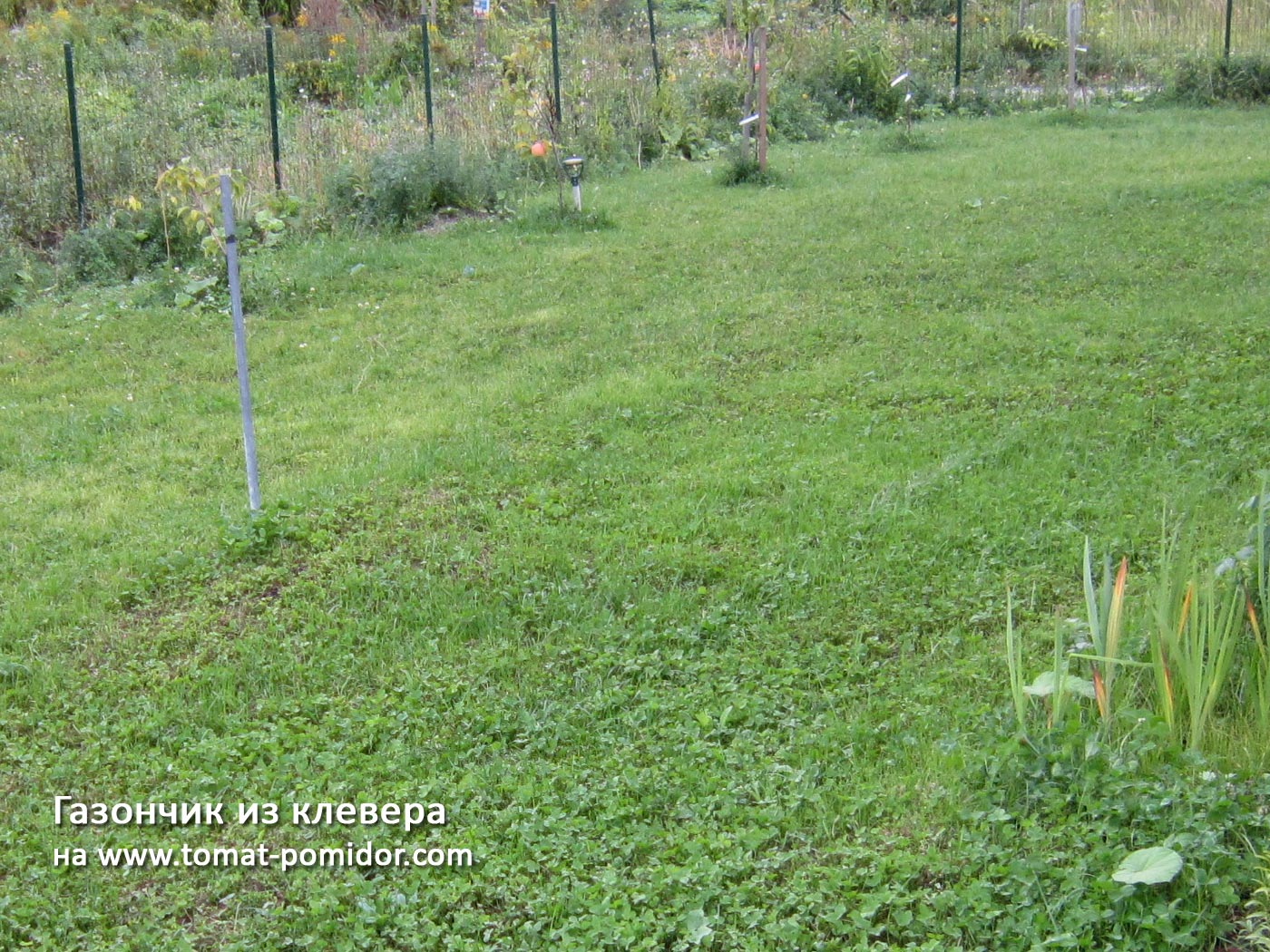
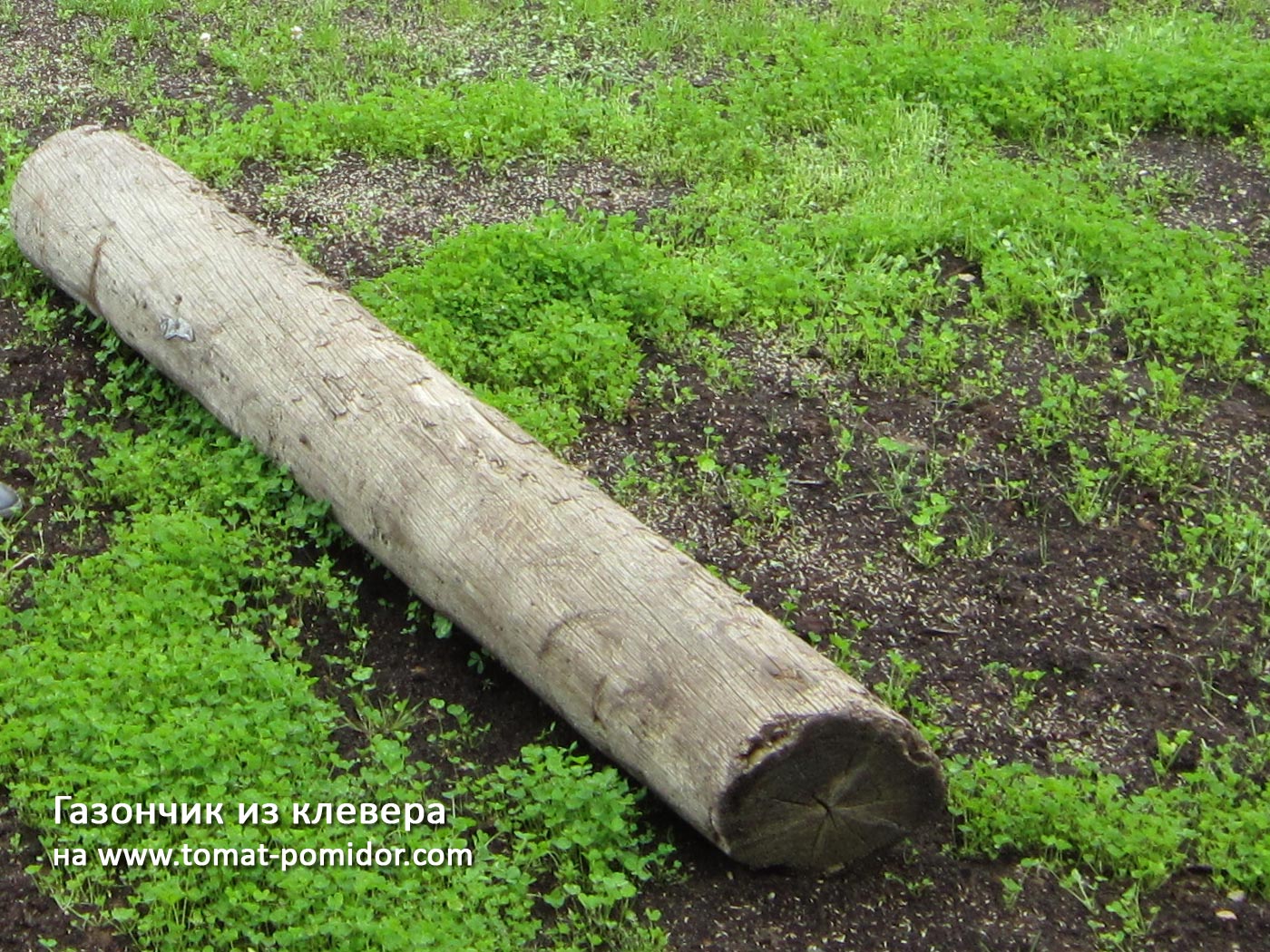
So, I applied an improvised roller method. There was half of a heavy wooden high-voltage utility pole lying on my property (what it was doing there, I have no idea). I adapted it to be a roller. The drive mechanism was foot-powered. You walk and push this massive log with your foot, and it rolls a short distance. We took turns lazily rolling this log around for a week. We compacted it somehow—not perfectly, of course. But perfection was never my goal.
Step 2: Sowing the Clover Seed 🌧️
As for the actual “sowing,” it was simple. I took the packet of clover seeds and walked around, scattering them with broad sweeps. I also found a few more packets of random grass seeds in my stash and scattered them in patches—waste not, want not! I even sowed alfalfa along the fence for extra beauty. If we’re doing a lawn, let’s go all out! Then I walked the log over the top again to roll the seeds in…
Pro Tip: Sowing lawn grass, even clover, should be done right before it rains. Check the weather forecast; if no precipitation is expected, you’ll have to water it constantly, or nothing good will grow.
May wasn’t very wet, but we had occasional showers. The clover and some of the grass sprouted quite quickly. I would periodically walk around and sometimes roll the log over it again. When it became obvious where the bald spots were, I tossed down more grass. And more clover.
Step 3: Mowing (Or the lack thereof) 🚜
From the numerous recommendations I read online, I knew the grass should be mowed when it reaches about 10 cm (4 inches). But firstly, I had no time. Secondly, I was lazy. And thirdly, I didn’t have a lawnmower. I only had a heavy-duty string trimmer (weed whacker) with a line. I used it to mow the other part of the property where no lawn was planned (we keep a sort of natural wild meadow there).
So, due to the lack of a mower and pure laziness, I didn’t mow the clover at all until August. I didn’t mow the grass either.
👎 The Cons and Disadvantages of a Clover Lawn
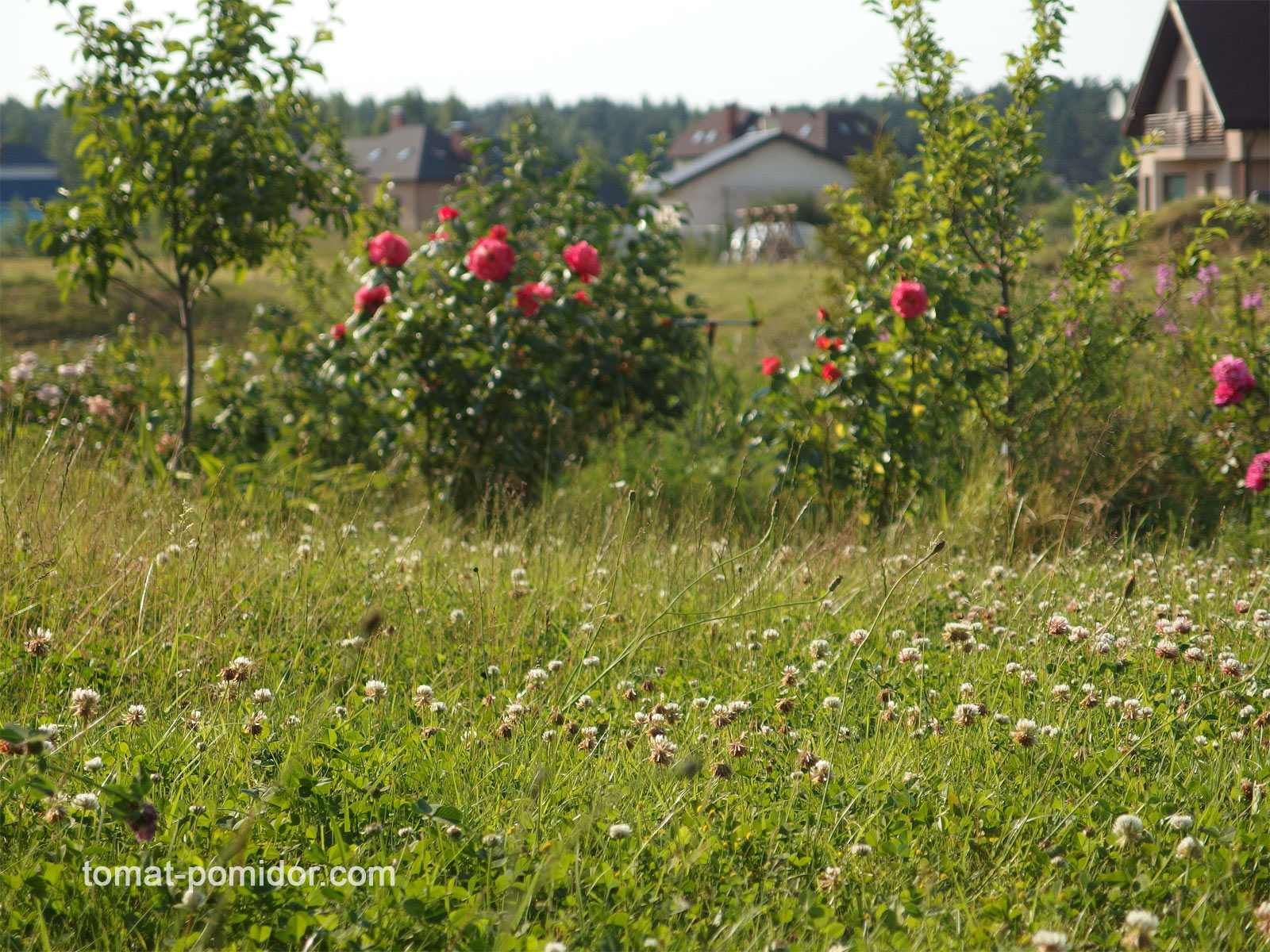
By August, the clover had grown so much that the obvious need to finally cut the damn thing became apparent. I must say, I had hoped the creeping white clover would form a beautiful, even little carpet, about 10 cm (4 inches) tall, no more. The peaceful buzzing of bees, the emerald greens of clover leaves, the blue sky, ahhh… That was roughly my calculation. 🌸
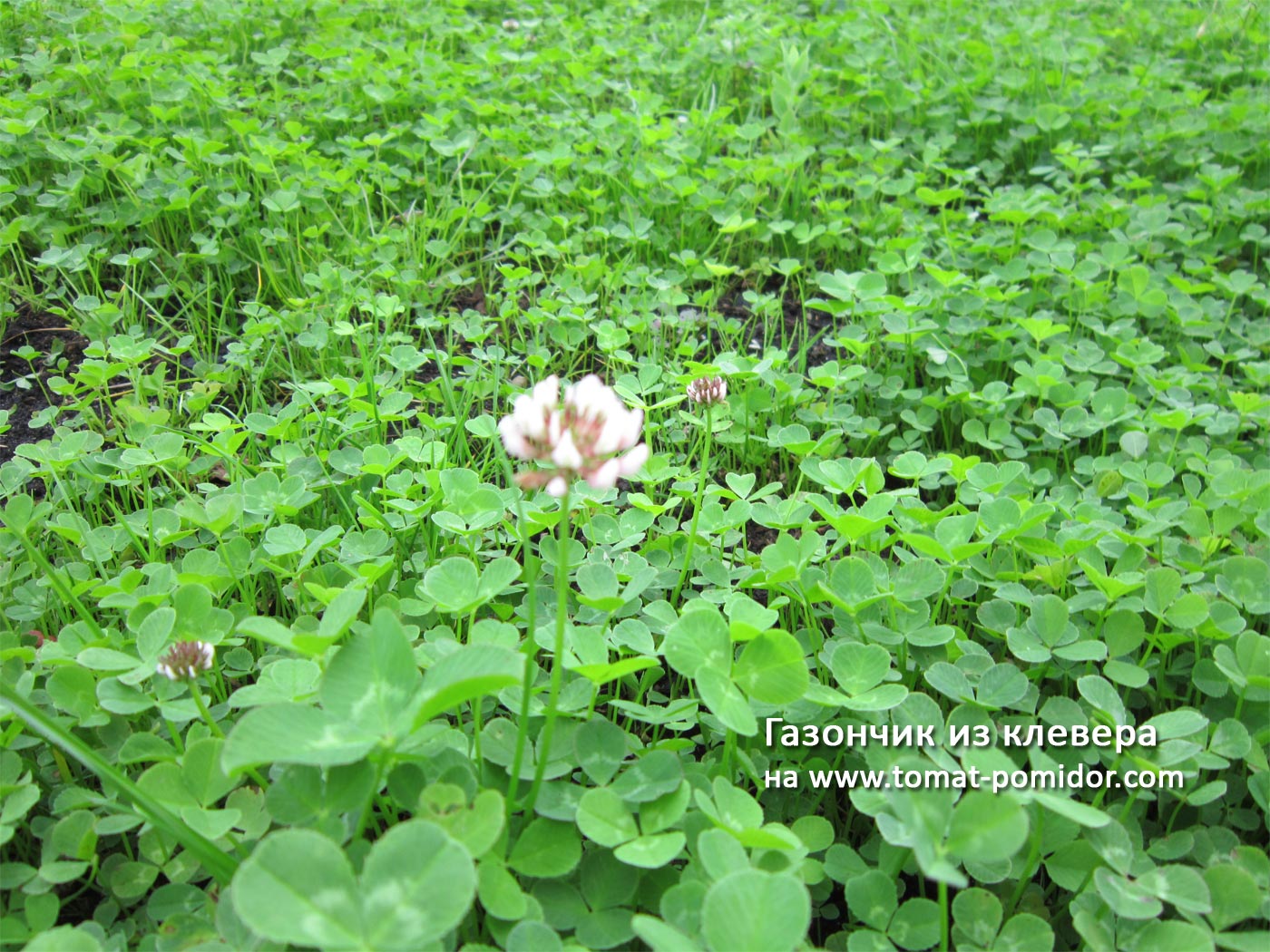
But the clover absolutely loved our yard. The creeping white clover thrived magnificently; it stood about 30 cm (12 inches) tall, bloomed profusely, and was terrible to cut with a string trimmer because it was always damp deep inside the thicket.
Furthermore, if it was dry and hot, the clover would become limp and all 12 inches of it would just flop over, making it incredibly difficult to cut again.
- Looks messy after trimming: Another downside of mowing with a string trimmer was the rather sloppy/trashy look of my improvised lawn—brown dry leaves, chopped stems, and other clover remains look untidy for a few days after mowing. This is probably the biggest disadvantage of a clover lawn. (Though, after about three days, the clearing covers over with fresh, bright leaves again).
- Extremely Slippery: If you have slopes on your property, be warned—cut clover becomes insanely slippery! ⛸️
- It’s Invasive: This is a relative con; for some, it’s a pro. Remember, this is a creeping clover. It quickly heals any bald spots, but at the same time, it tries to creep into everywhere it wasn’t invited—your vegetable beds, flower beds, etc.
- Attracts Slugs: By autumn, there were a lot of snails and slugs hiding in the thick clover. And mowing it in damp weather sucks. 🐌
👍 The Pros and Advantages of a Clover Lawn
- Dense Turf: Clover forms a very dense, well-knit turf.
- Eco-Friendly: If you mow infrequently and let it bloom, clover provides food and attracts bees, bumblebees, and other pollinators to your yard. 🐝
- Aesthetics: A clover lawn is fundamentally beautiful. (But it’s an acquired taste).
- Low Maintenance: It is unpretentious, sprouts quickly, and spreads rapidly.
- Durable: Clover is highly resistant to trampling. I tried hard to wear a dirt path into it, but failed.
- Nitrogen Fixer: Clover enriches the soil with nitrogen. And the clippings make absolutely wonderful mulch! 🌱
Bonus Pro: Our pet guinea pig, Gavryusha, reacted very positively to the clover planting. All summer long, he eagerly devoured massive amounts of it, giving all other vegetables a skeptical side-eye and eating them reluctantly. 🐹
Conclusions 📅
It’s too early to call what I made a “lawn.” But if I compare it to what was there before—it’s not bad at all!
Next year, I’ll try to convert at least part of the clover lawn into a normal grass one. Traditional grass harbors fewer snails. But I don’t plan to give up clover entirely.
By the way, in September, I finally bought a proper gas-powered rotary lawnmower and tested it on the clover. It worked much faster and produced a much higher quality cut than the string trimmer!
Update (June 6, 2015):
I was away for almost the entire month of June this year, so obviously, I didn’t mow the lawn. I thought I would return to a horrifying scene of total neglect and a weed-apocalypse. Not at all! The little lawn looked quite decent, and the clover finally bloomed. (The summer was dry and cool, hence the late bloom). So, if you are looking for a true no-mow lawn (or at least a very low-maintenance one) — white clover is exactly what you need!
Community Comments & Reviews 💬
I meant to give a quick update on how the clover lawn feels in its second season: Long story short, I’m thrilled with it. We had a sudden, hot spring this year. The “lawn” was mowed weekly, and by late May it started blooming. On a sunny day, it is a massive pleasure to sit in the shade near this lawn—the clover smells like honey, and the whole field is buzzing with bumblebees and bees (though for some, this might be a con; you can’t walk barefoot on it).
Thanks for the tale of your lawn torments!)) You described it so colorfully, I could vividly picture it all. I bought a 500g packet of clover the other day hoping to seed a crumbling slope at the edge of my lot. It’s bare dirt, falling apart, drying out, and looks ugly.
Tell me, does white clover develop a powerful enough root system to hold a slope together? Other slopes of mine got covered in strawberry runners and they hold the soil perfectly; they even fruit earlier than in the beds and require zero care. They are completely fending for themselves! 🍓⛰️
Olga wrote: …does white clover develop a powerful enough root system to hold a slope together?
It spreads very well and quickly! The root system, although somewhat shallow, is very powerful. It should hold that slope together very securely!
Hello, dear Elena. My mind is currently dreaming of a 30-hectare meadow far, far away from the city. 😂 So the clearing near the house on my small 20-are lot is maintained “somehow.” Meaning, when the grass gets too tall, I just cut it. The clover is rather stunted this year, by the way, not blooming yet. Probably due to the late spring.
Bees are a blessing, you never know how to lure them in! When my plum tree was blooming, there were hardly any bees around.
As for the snails—they successfully crawl everywhere even without clover, although they do prefer it over a shaved grass lawn.
First, to answer Yulia: If you want to get rid of it totally, use an herbicide like Lontrel. Also read (but haven’t tried) that heavy nitrogen fertilizer kills it off.
To the author: Huge thanks! Thanks to your story, I took a risk mid-summer and started a clover lawn. Last year I planted a mix of bentgrass + clover. The bentgrass grew quickly, the clover slower. I mowed with a manual push mower. After a few mows, their growth evened out.
The main thing is spring. I arrive in early May—the clover is emerald green, you can’t take your eyes off it! Mowed it twice in May. The bentgrass is practically invisible; the clover conquered it. My goal is to train the clover to become tiny and not need mowing. And secondly—I prefer a lawn with “soul,” not a soccer field. 💚 I also sowed a mix of bluegrass, fescue, and clover near my city apartment block. As the old-timers say: whichever grass likes the spot best will stay!
Sofya wrote: Can you somehow contain the clover?
Honestly, clover isn’t the most evil weed. It’s low, enriches the soil with nitrogen, and chokes out much worse weeds… so maybe just let it creep? Sometimes, of course, you don’t want it somewhere… but it crawls anyway! 😂 But pulling it out mechanically is much easier than regular “grass.”
As for slugs… I don’t know, to stop them you’d have to cement the whole yard. Or cover it in lime. But that’s not aesthetically pleasing… Meanwhile, I have moles! Those are some real pieces of work. 🦦
Good afternoon! In the fall of 2015, I sowed RED clover to eradicate weeds from my plot. I thought, clover is clover. I couldn’t get to the country house until mid-June. This red clover shot up to 40-50 cm (15-20 inches) and was incredibly thick! We barely managed to mow it. Then we mowed it every week or two. It kept shooting back up 15 cm. There is sooooo much biomass. We were exhausted to death this summer! 😫 I think I’ll scatter WHITE clover this autumn.
My question is: how tall does white creeping clover actually grow? If it’s only 10-15 cm (4-6 inches), I wouldn’t mow it at all!
Oksana wrote: how tall does white creeping clover actually grow?
Good afternoon. As I understand it, there are different varieties of white clover now… But realistically, it’s about 15 cm (6 inches). However, I suspect your established red clover will just choke out the white one…
Just adding that the clover on my city plot actually grew! Considering nothing had grown there for 30 years and it was a trampled piece of wasteland—the clover lawn is simply a miracle. By the way, I covered it for two weeks with landscaping fabric, because our city pigeons act like wild beasts. Watered it a little. The seeds first pulled into the soil, and after a few rains, the clover exploded. I mowed it about three times. In the autumn, I inspected the previously barren soil—in just two months it took on a much nobler look, as if garden topsoil had been added! 🏙️🌱
Next year I will finally conduct a targeted experiment. I will test if it’s true that white clover can be “tamed” like a dandelion—meaning it grows smaller leaves after several May mowings. I’ll report the results! On the banks of the Berezina river near us, there is tiny, jewelry-sized clover growing. Crowds of people trample it; I guess the clover adapts to the foot traffic. (P.S. The Berezina is where Napoleon lost his army. It’s a few miles from my house).
I can’t express in words how grateful I am to white clover! 🍀
I wrote earlier that I planted clover under the windows of a city high-rise. This spot was a sun-baked wasteland with tightly compacted sandy soil. Right next to an internal road where cars drive and park day and night.And then spring came with a gift—last year’s clover brilliantly survived the winter and the heavy snow piles mixed with road poisons that the snowplows dumped on it. In a week, I’ll be mowing it again! Meanwhile, on my country plot, the clover has been bossing around for three years now. Causes absolutely zero trouble. I mow it with a manual mower whenever I feel like it. The grass is incredibly tender—requires no effort.Note that clover is for lovers of natural meadows, not for fans of stiff “hedgehog” lawns. So, choose what you love!
Inga wrote: Is there any experience planting a lawn without rolling it with rollers?
Good afternoon, Inga! I started having fun with white clover this year too.. I didn’t use a heavy roller, but my husband still went over the planting with a hand tamper, because the seeds are tiny and get quickly blown away, washed away, or eaten! 🐦
Due to a tough spring, it took a loooong time to sprout…. the seeds waited until it got warm… but meanwhile, quackgrass, milkweed, wormwood, and some other thorny garbage that nothing can kill sprouted beautifully… All the neighbors watched with wild laughter as I crawled around the plot with a mini-sprayer of Roundup, spot-watering every single weed… 😂 Most weeds died, but still far from all of them))))))))) The clover sprouted… but it’s sitting there looking miiiiiny for now))))
My seeding rate was 1 kg per 100 sq meters. We watered every day for three days, but now I haven’t watered for two weeks because we noticed a strange pattern—my neighbor sowed a week later and watered heavily every day.. her seeds didn’t sprout at all… She sowed again—same result.. Our municipal water comes in at no higher than 5 degrees C (40°F)… my husband and I concluded that in cool weather, watering seeds with ice water just makes them rot… 🧊💧
Guest wrote: What about other flowers? Will it choke them out?
Depends on the flowers) Clover roots are powerful, but shallow. In principle, it is a formidable weed, but not a very malicious one. 🌼