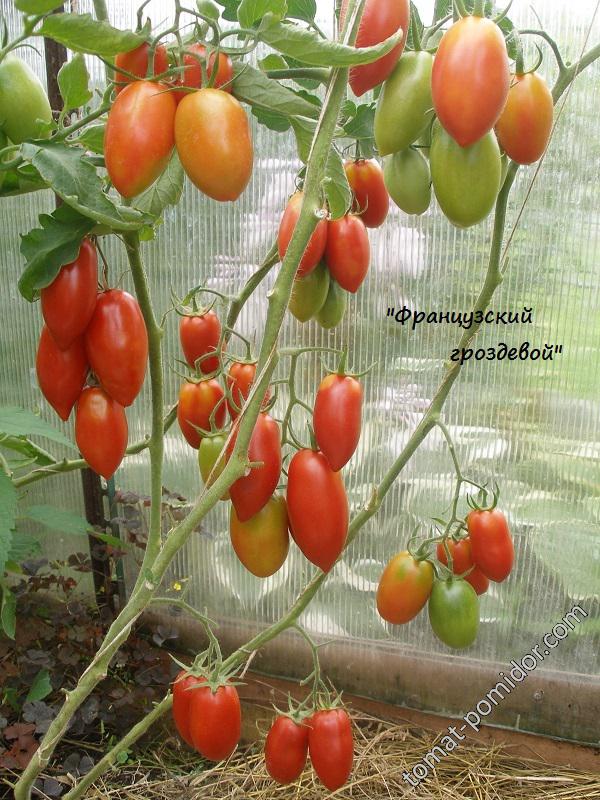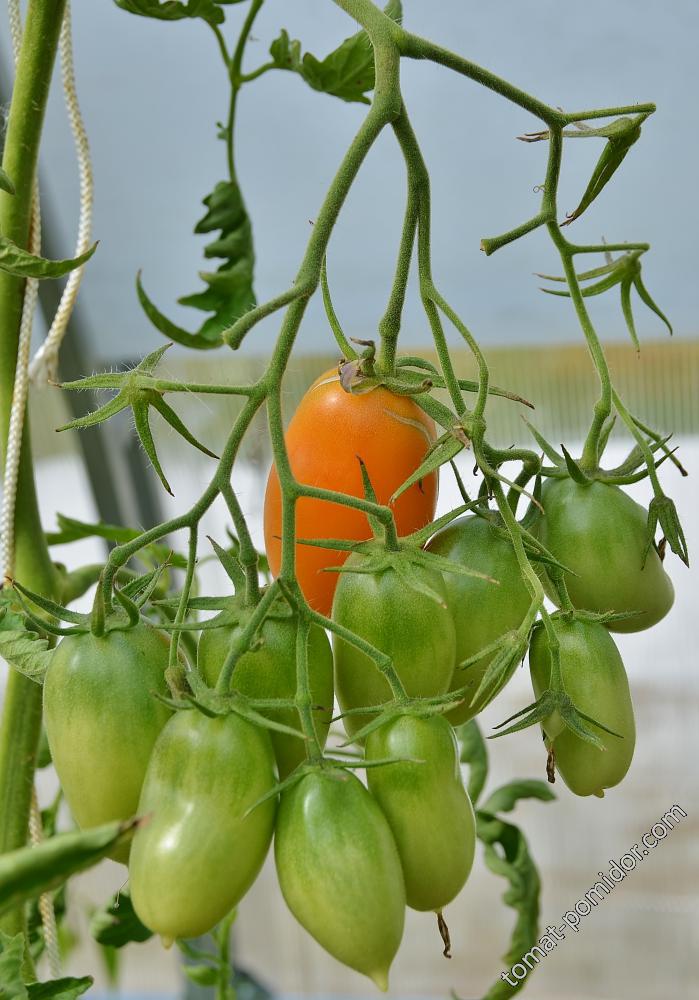
Quick Summary of Chukhloma (Orange Icicle/Paste)
- 🌍 Origin: A highly successful Russian commercial variety from the Gavrish seed company. It is the orange sibling to the red variety Khokhloma.
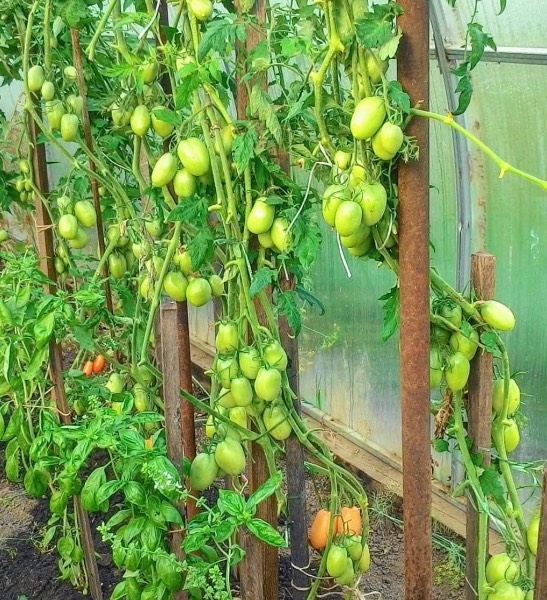
- 🌿 Plant Habit: Indeterminate (very tall) and vigorous, easily exceeding 2 meters (6.5 ft) in a greenhouse. Growers note its distinct foliage: the leaves are very long (25-30 cm) and grow parallel to the main stem, pointing downwards.
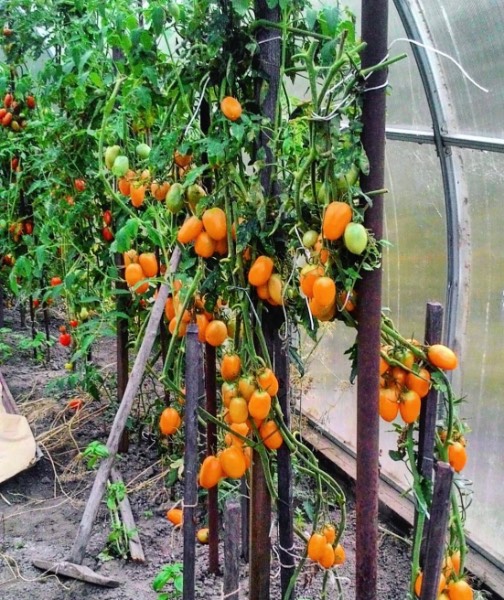
- 🍅 Fruit Characteristics: Bright orange, elongated plum or “icicle” (sosulka) shaped paste tomatoes. Average weight is around 100-120 g (3.5 – 4.2 oz). They grow in large clusters.
- 👅 Flavor & Texture: Sweet and dense. As a classic paste tomato, it is not overly juicy and can develop small hollow cavities when stored for a long time.
- 🥫 Storage & Uses: Exceptional shelf life! It is renowned for its ability to resist rot and mold in storage. Perfect for canning whole (they do not burst in jars) or slicing into salads.
- ⏳ Maturity: Mid-late to late season. Needs a long growing window to reveal its full potential.
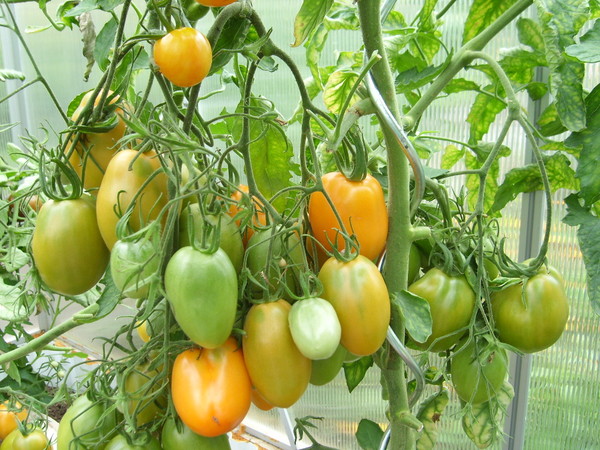
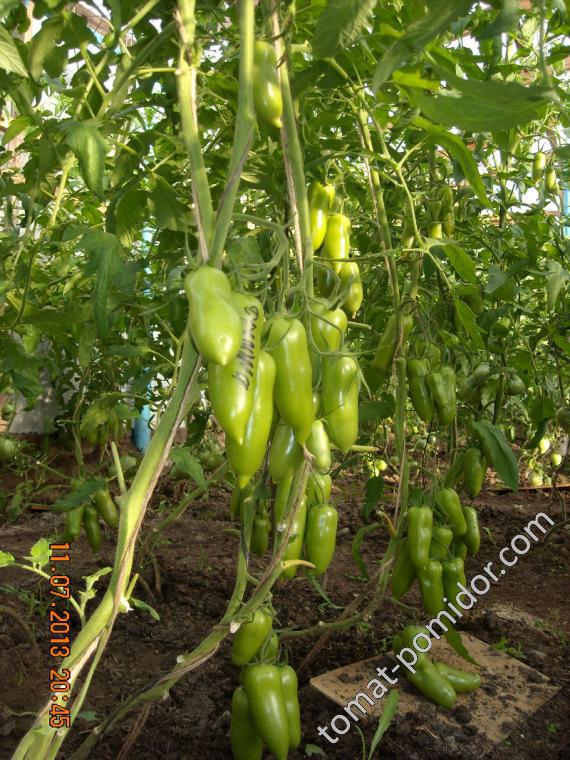
As written on the Gavrish seed packet, it is recommended for film shelters and greenhouses. I agree. The yield in open ground (OG) was not high. But the 4 bushes under film were covered with tomatoes from top to bottom. I trained them to 2 stems, and in August I let almost all the new suckers grow, which also managed to set fruit. Picked them on October 7th and they are slowly ripening at home and in the basement. Last year, this variety lasted all the way to New Year’s! The clusters hold 3-5 fruits each. I picked 2 clusters (3 and 4 fruits) and together they weighed 500 grams (1.1 lbs). On one bush, which reached a height of 2.5 meters (8.2 ft), I counted 22 trusses. So the yield definitely matches the variety description.
I would like to point out that all 4 Chukhloma bushes were equally tall and productive. A special feature of the leaves: they are long, 25-30 cm (10-12 inches), and they press against the stem, meaning they grow parallel to it downwards.
Edited January 24, 2015 by Drosera
They are a bit on the dry side and hollow inside, which is why they store for so long. They have their own distinct taste, though admittedly inferior to De Barao (shown at the bottom of the photo for color comparison). De Barao is also still keeping well up to today.
What is its ripening time?
I am stubborn and plant seeds in February, including Chukhloma, so we start tasting this variety at the end of July.
Great photos!!! Such tall bushes and completely covered in tomatoes. We don’t get to see that in our Northwestern region; here Chukhloma has an average yield. We sow in March and eat at the end of July/August 😃
I completely agree with the variety description, I don’t even need to post photos, it looks exactly as if it was taken in my greenhouse. In the summer in July, the tomatoes were tastier, but closer to autumn they became a bit drier and cavities appeared inside. But even their walls are tasty, which is not the case with many other “icicle” varieties. 😉
My Chukhloma was not dry, there were no hollow voids, and there were 5-7 fruits per cluster.
Yes, glorious photos. A feast for the eyes!
I also grew it, didn’t prune the suckers, tied up everything. It got very tall in the greenhouse, over 2 meters. I would say the taste is good, and it stores normally, but I gave up on it because of blossom end rot (BER) and its excessive height. Plus, in our region, even with early sowing, it starts setting fruit quite late.
I read a review on the internet by Zinaida Lyubimova from Siberia about this variety, she is happy with it. Her seed packet description said 20-25 fruits per cluster, but she got 7-8, like Sofia. My packet says 8-12; I generally got 4-5, but they were very thick, chubby icicles.
Rodebielesumer said:
Her seed packet description said 20-25 fruits per cluster…
Yeah right. That would mean clusters weighing 2 to 2.5 kg (4.5 – 5.5 lbs) each 🤦♀️ Seed companies will write absolutely anything… Not even all cherry tomatoes have clusters like that, and for Chukhloma, I can’t even imagine it 🤐
I once had a mutant cluster (megabloom/fasciated truss) with a huge number of fruits, but the tomatoes on it were all different shapes and sizes, and they kept growing on this truss the entire season. So I would pick the ripe ones, and the tiny ones would just start growing. I much prefer 6-10 fruits per truss so that all the tomatoes look identical.
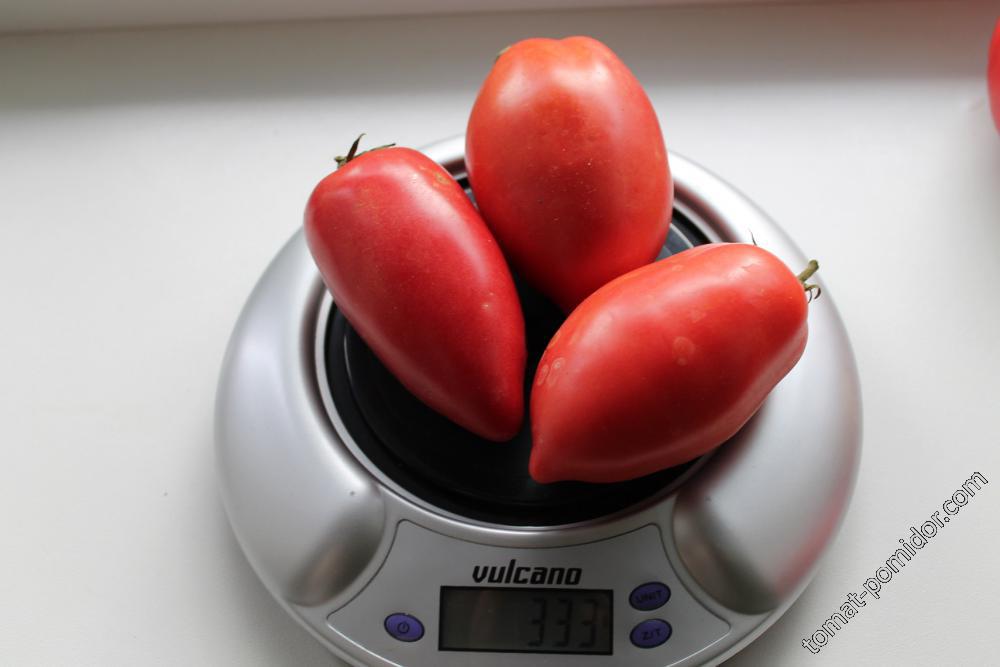
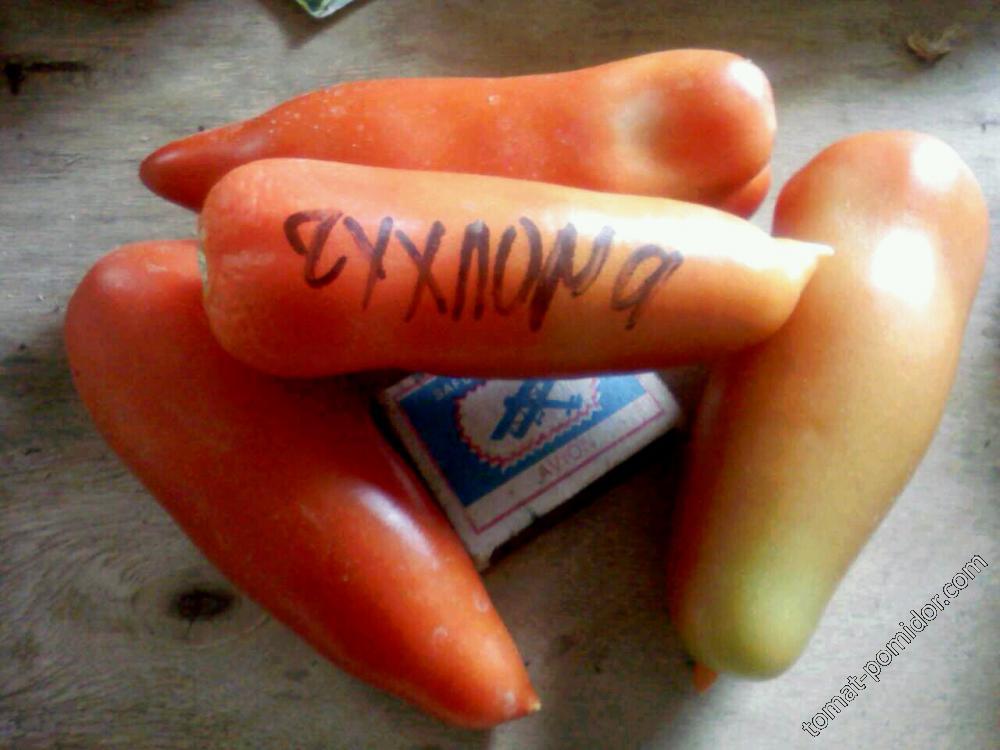
How interesting, the variety is the same, but the shape of the fruit is different. Mine is much more elongated 👀
valentina-Abakan said:
How interesting, the variety is the same, but the shape of the fruit is different.
Valya, but why is yours red, when the girls have yellow or orange ones? 🤷♀️
No Galya, it’s not completely red, it’s more of a red-orange. Otherwise, everything else matched the description perfectly. It’s now a permanent resident in my garden 😃
Actually, Chukhloma is orange-yellow. That tomato of yours looks much more like Khokhloma.
Excuse me, but Khokhloma is red, and Chukhloma is exactly orange-red. That much I know for sure ))))
It’s my favorite tomato. There is absolutely no red in it whatsoever.
valentina-Abakan said:
Excuse me, but Khokhloma is red, and Chukhloma is exactly orange-red…
Color-wise, yours definitely look more like Khokhloma, they have a red hue. Chukhloma is bright, saturated orange-yellow. When there are 6 tomatoes in a cluster, they weigh 100-120 g (3.5-4 oz) and are longer, but if there are up to 18 tomatoes in a cluster, they weigh around 50-60 g (1.8-2 oz). I don’t remember which seed brand I bought, but all the seeds matched the original description perfectly. However, mine were shorter than what was advertised on the packet.
🌺 No problem… I’ll just rename it to KHOKHLOMA in my seed stash….. 📝 It’s a great tomato anyway and looks beautiful on the vine… It doesn’t turn into mush when pickled… stays nice and firm. The only downside is that it’s a bit too long.. 😲 you have to pack them standing up in the jars like cucumbers…. 😃
I am very happy with this variety! Productive, tasty, and not dry at all. Seeds were from a commercial packet from Gavrish.
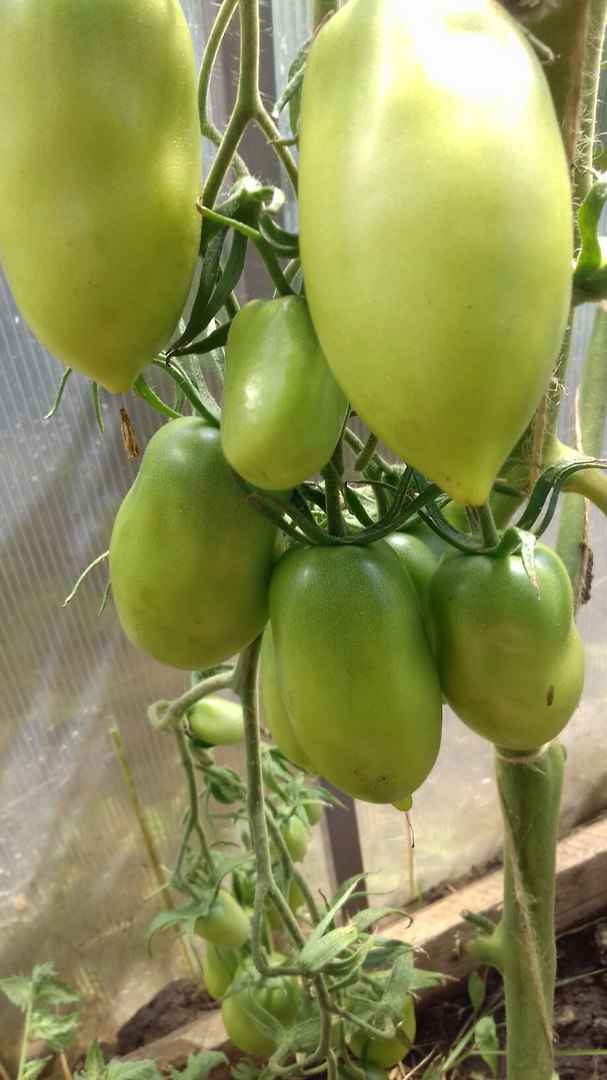
I’ll add that the variety is quite late-season; don’t expect ripe fruit before August in the Moscow region.
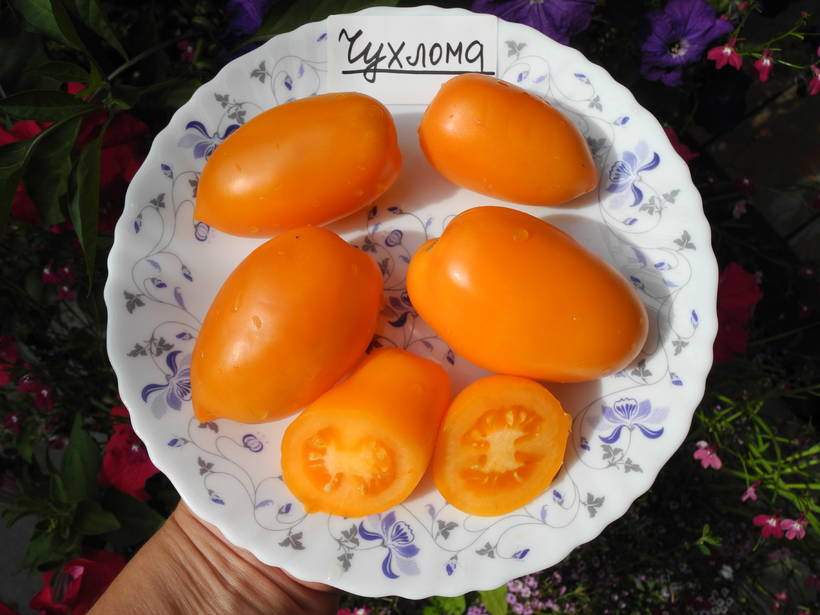
Color is orange (seeds from Gavrish). For me, it is tasty and sweet. Productive, with a thick skin, stores very well. And, importantly, it is not prone to disease. I grew it in the greenhouse last year—it was the very last one to catch fungal diseases (most likely leaf mold / Cladosporium).
I highly recommend it to anyone who likes sweet tomatoes.
I liked Chukhloma. Plentiful, taste is quite good, suitable for both fresh eating and canning. Looks beautiful and fruits right up to the bitter end. I didn’t have any hollow voids inside. The only downside (but this is most likely our Northwestern region problem) is that it takes too long to get going and doesn’t have time to reveal its full potential. But even with that, and despite our cloudy, cold, and rainy windy weather, it performed very well in terms of yield and taste.
This year I repeated my favorite “icicle” (paste) varieties, and Chukhloma is one of them. Grew in the greenhouse on 2 stems, set fruit perfectly all the way to the roof. The fruits are sweet, moderately dense, and when fully ripe in sunny weather, they are even juicy.
I’ll say right away that I’m embarrassed to write about this, but it turned out to be an accidental, harsh, but very useful experiment. 😅
We were away for 3 weeks, and I left a crate of ripe tomatoes on the balcony that I didn’t have time to process. When we came back, the entire crate was just one solid mat of Penicillium mold. Imagine my surprise when, at the very bottom, I found 3 absolutely healthy Chukhloma tomatoes, and a few equally undamaged Lucid Gem tomatoes. Go figure!
Chukhloma is one of my favorite varieties. I only grow it in the greenhouse; one year I tried to duplicate it outside, but the yield was disappointing. I don’t prune the suckers at all; it manages to pull through and ripen everything it sets. It is a heavy feeder. There are no more than 7-8 fruits per truss. But I make up for it in sheer volume. Stores beautifully. Looks absolutely gorgeous in jars. It’s “my” tomato by all measures.