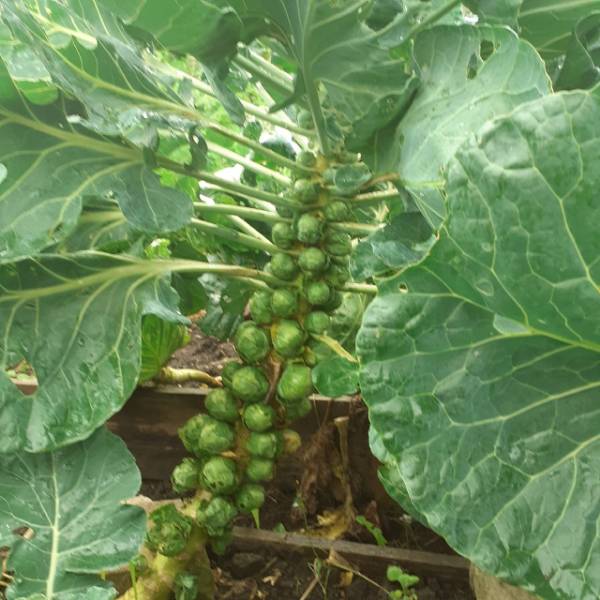
📌 Quick Summary (TL;DR): Growing Brussels Sprouts
- 🌱 Vegetative Period: Very long, ranging from 130 to 170 days. In most regions with shorter summers, they must be started indoors or in a cold frame.
- 📏 Plant Size: Height ranges from 30 cm to 1 meter (12 to 40 inches). Sprouts weigh about 30–50g (1–1.7 oz) each.
- ✂️ Pro Tip (Topping): Once the plant reaches its typical height, pinch off the top growing point. This forces the plant’s energy into developing larger, tighter sprouts rather than growing taller.
- ❄️ Frost Tolerance: Can survive autumn frosts down to -8°C (17°F). A light frost actually improves their flavor, making them sweeter!
- 💩 Feeding: Responds well to organic “weed tea” (fermented nettle/compost) in early stages, and phosphorus-potassium fertilizers when sprouts start forming.

How to Grow Brussels Sprouts: A Step-by-Step Guide
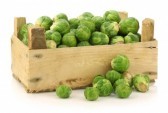
Brussels sprouts belong to the cabbage family and have become quite popular. After all, they are rich in iodine, which improves the function of both the brain and the thyroid gland. Additionally, these little cabbages strengthen the nervous system and are often included in heart-healthy diets…
Growth Habits & Varieties of Brussels Sprouts
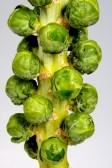
The earliest varieties have a growing season starting from 130 days, while the latest can take up to 170 days. The small heads, weighing from 30 to 50 grams (1 to 1.7 oz), form directly in the leaf axils along the stem. The plant height ranges from 30 cm to a meter (12 to 40 inches).Because of such a long vegetative period, growing Brussels sprouts in most parts of Russia (and similar cold-climate zones) is only possible by starting seeds early for transplants.
Perhaps this is why so few people want to get to know them better? But they are absolutely worth it! Nowadays, breeders have introduced many interesting new varieties with both classic green and striking red-purple coloring.
When I first bought Brussels sprout seeds, I knew little about the specific varieties and just bought the pretty ones—with red and green heads. I never regretted it. After maturing, when pickled whole in jars alongside mixed vegetables, they were both delicious and visually stunning.
Starting Brussels Sprouts from Seed
The very first time, I sowed them in seedling trays at the end of March, planning to transplant them into open ground in mid-May. I used standard, all-purpose potting soil. Later on, I switched to using my own garden soil mixed half-and-half with compost. Per bucket of this mix, I added a 0.5-liter jar (about 1 pint) of wood ash and a tablespoon of superphosphate.Nowadays, I sow the cabbage seeds directly into a small cold frame, which I dedicate specifically for my brassicas. The cold frame is prepared using the “hot bed” method. At the bottom are grass and branches, above that is a layer of manure, and the top layer is soil.
I sort the seeds, selecting only the largest and plumpest ones. I sow several different varieties, aiming for about 20 plants each. I lay the seeds out in a shallow trench. Of course, not all will germinate, but I still space each seed about 5 cm (2 inches) apart. I water the soil thoroughly and cover the frame with glass or polycarbonate.
In this cold frame, under natural conditions, the seedlings develop much faster and sturdier than they do indoors. Because of this, I sow them in mid-April. By the end of May, the seedlings are hardened off and ready to be planted out in the garden.
Transplanting into the Garden Bed
I select the strongest seedlings and plant them in pre-prepared holes. I add a handful of compost and a handful of wood ash to each hole. I plant the seedlings slightly deep, so the central growing point is just above the soil level—literally by half a centimeter (1/4 inch).It’s best to transplant in the evening or on an overcast day. Since the root system is still small, I cover them with a large burdock leaf for shade. By the evening of the next day, I remove the leaves; the little plants have already started to perk up and establish themselves.
As soon as they are well rooted and actively growing, I feed them with liquid compost tea from a barrel. This is a fermented brew of stinging nettle, wood ash, old hay, and kitchen food scraps (I put everything in there except greasy/fatty foods).
Pro Tip: When the plant reaches the typical height for its variety, I pinch off the top (the crown) to stimulate the growth of the little sprouts. At this stage, I switch to feeding them with phosphorus-potassium fertilizers. With this kind of nutrition, the sprouts set much tighter and grow larger.
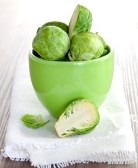
Brussels sprouts are incredibly cold-hardy and can withstand autumn frosts down to -8°C (17°F). In fact, once they get hit by frost, their starches turn to sugars, making them even tastier! They are fantastic in soups, marinades, casseroles, and omelets.
I freeze the extra sprouts for the winter. In autumn and winter, I love dipping them in batter or frying them rolled in egg and breadcrumbs. It makes an excellent side dish!
There are no special secrets to growing this crop. Because of that, even a beginner gardener will have no trouble growing it successfully.
I will definitely give this a try. They are absolutely delicious in vegetable soup with green peas.

We also really love Brussels sprouts. I was always surprised why so few people bother to plant them. Now it makes sense! I will be growing them this year. I already sowed my seeds for transplants on April 10th.
Thanks for the great article!
I had completely forgotten about them! I used to plant them all the time, but one year the crop failed, and I guess I held a grudge against them—I haven’t sown them in about five years. This year I sowed them again, but honestly, only three seeds germinated. I planted what survived. Fingers crossed, even these three little plants will give us a delicious harvest 🙏 Thanks for the article, the information is very useful for me!
Thank you! I had no idea that you needed to pinch off the tops (top the plants) to get the sprouts to size up! 🙏🙏🙏
No matter how many times I’ve tried growing them, the little heads never formed properly for me, even though I tried both the red and green varieties. Thank you so much for the tips, I hope this year I’ll finally get it right.
Hello everyone! I bought seeds for late-season Brussels sprouts (150 days). If I want to harvest them in September, does that mean I need to sow them indoors in March? What will they look like by the time they are finally planted outside? Won’t they become completely rootbound and leggy sitting in pots that long? In March, I won’t have a hot bed or an outdoor cold frame ready, so should I just try starting them on the windowsill at home? Does anyone have experience with starting them this early indoors—any tips on how to keep the seedlings healthy and prevent them from suffering indoors for 2 full months?